Edgar Alwin Payne and His Art
by Fred S. Hogue
Edgar Alwin Payne has painted as Homer sang wandering from place to place where his fancy moved him. He is the rolling stone, the floating cloud, the vagrant bee. Wherever there is warmth and variety in color, a contrast of plastic and static form—wherever nature has unfolded one of its divine masterpieces Payne has made a pilgrimage, as the faithful to a shrine; and he writes on canvas with pigments his symphonies as Homer sang them to the tune of his lyre.
Had he been born in Arabia ten centuries ago he would have been one of the priests of the fire worshipers. He would have been at home among the Druids of ancient Brittany. Born in a century immersed in materialism, he has broken the fetters of conventionalism, he has fled the mean and the sordid and has gone forth to hold solitary communion with the mountains and the sea.
In all history of landscape painting, there is no painter who would travel further or surmount more obstacles to view nature’s masterpieces and very few who would bring together in a single collection canvases from so many parts of America and Europe.
And, like Homer, many communities claim him as their own. The dwellers of Southern Missouri have a higher appreciation of the rocky summits and wooded slopes of the Ozarks since they have seen them on canvas as Edgar Payne visualizes them. Thousands of tourists he made a pilgrimage to the California and Mexican Sierras to find those mountain lakes, so rich in color and shadow, whose secrets hidden in their depths are never disclosed, so placid and yet too treacherous—those slumbering pools that Payne has painted as no other artist, living or dead, has painted them.
On the coasts of Brittany there are communities that preserve as choice treasures sketches of the tuna and the mackerel fleets that furnish the motif for his witching, colorful canvases of the fishing craft on the coast of Brittany. Artists are no novelty on the coasts of Brittany south of Brest. But this quiet and affable American was different. He came with his wife and daughter and lived for a season among them. He went forth in the gray dawn on a fishing cutter and was one with the crew. While they fished on the banks he sketched; and he was not averse to lending a hand when the nets were drawn in.
But Payne was to them a child of fortune, favored by destiny. He possessed a spark of the sacred fire that, for want of a better term, we call genius. The rushing tides, the swelling sails, the dash of the spray on the prow of the swiftly moving cutter, the opal cloud that sauntered across the blue arch above them, the purple and gold of the horizon—all these lived again in color, light and shade on the canvas illuminated and glorified by his brush. He alone possessed the art of expressing on canvas the emotions and the impressions that they all experienced in their daily converse with the sea.
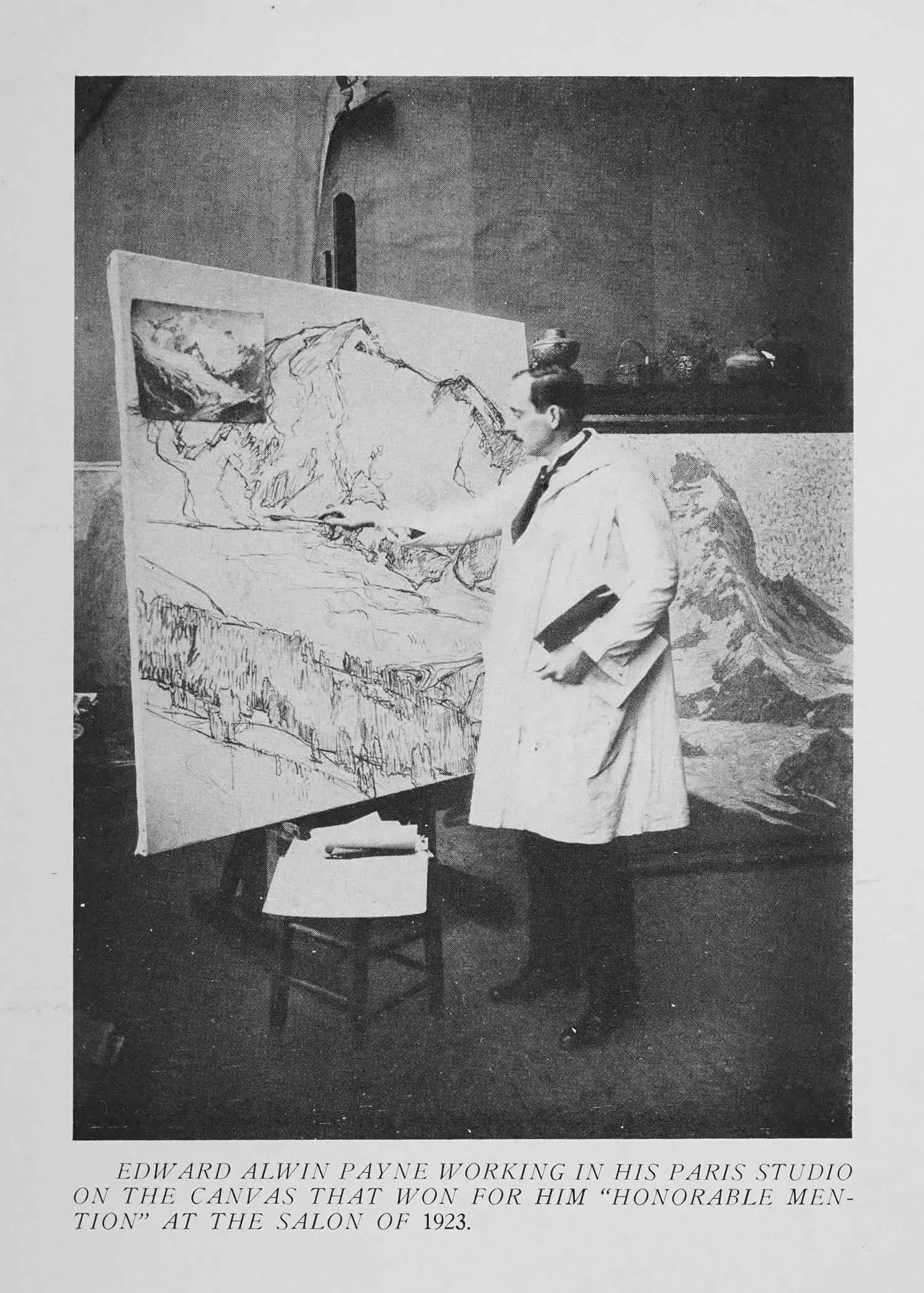
But Payne could be chained to no single location. He was as restless as the Wandering Jew. From Brittany he soared as on the wings of the morning to the Swiss Alps. He descended to earth at Interlaken and became the companion of the Alpine guides, not for a few days but for whole seasons. He painted the Jungfrau, the Matterhorn, the Eiger, the Monch and some of the peaks of lesser fame, but of still greater beauty—painted them in their changing moods, painted canvases whose endurance is only second to that of these eternal barriers.
For an American artist to paint a Swiss mountain is not new, but the art of Edgar Payne soars high above mere decorative effects. Those rugged Swiss mountains on his canvases are studies in architecture, and in geology. There is nothing superficial about his art. His youth and years of production have been spent in communion with nature. Geologists have marveled that they could classify every strata on his canvases. A boulder on the mountain side was not to him merely a mass of stone. He searched the secret of its origin. His delineation of the rock was that of a portraitist.
One of the marvels to me of his art is correct reproduction of atmosphere. fle has painted in Southern California, in France, in Switzerland and in Italy. But he never confuses his climatic tones, a defect of almost every artist that has wandered far afield. How often have I seen a Southern California landscape under a sky of New England or the North Sea! I am sure no living landscape artist possesses a sharper and truer perception than Edgar Payne.
Switzerland charmed him, the call of the sea was not to be resisted. I can follow him in his canvases from Lake Lucerne through the French Alps to the canals of Venice. But the stagnant waters repelled him and he was soon cruising with the fishing fleet on the Adriatic. The scroll of the centuries rolled back and he was in the midst of the flotillas that left the port of Tyre when Nineveh and Babylon were the wonder cities of the oriental world, when the Queen of Sheba came to view the Temple of Solomon.
It is from these canvases that I learned the sailing crait of the Adriatic differ little from that of the eras of Biblical history.
From the Adriatic he cruised into the Mediterranean, to bask in the sunlight of the French and Italian Riviera. One senses this change by the different prows, sail and rigging of the fishing cutters. The fishing craft on the Mediterranean Canvases are those of ancient Egypt; and one marvels how that distinction has been preserved through the centuries. The fleet of Xerxes is replaced by that of the Pharaohs.
These canvases which Edgar Payne has brought back from Southern Europe will assure his reputation as a marine painter. None has delved deeper than he into the sea and its mysteries. Whether it be the mountain lake, the Atlantic off the coast of Brittany, the harbors of the French and Italian coasts, the shoreless expanse of waters of the Adriatic and the Mediterranean, or the moving tides off the shores of Southern California, Edgar Payne has caught them in their secret moods and reproduced them on his canvases.
As I studied the canvases in the present collection, I sensed a feeling of regret that he should have wandered so far. I wished he might have been imprisoned in California, like a bird in a golden cage, that he might have remained as loyal to us as the Flemish painters to the Low Countries and the British painters of the epoch of Gainsborough and Lawrence to the British Isles. But I appreciated that it would have been to clip the wings of his inspiration, to fetter his genius with a golden chain.
The art of Edgar Payne is cosmopolitan, universal. No State can claim him as his own. He is the floating cloud, wafted by the winds of caprice—perhaps of destiny. He is a minstrel painter, welcome wherever his fancy leads him, and his canvases form a necklace of pearls that encircle half the globe.
He is young in years to win the appellation of master; and that appellation consists of the awards his canvases have won in every country and every exhibition where his canvases have appeared. ‘The art critics of Paris and Rome are even more enthusiastic in their appreciation of his creations than those of his native country. Just as Thomas Payne said that he was a citizen of the world, Edgar Payne can say that he possesses a habitat in the art world of two continents.