Edgar Alwin Payne
A Biography and an Appreciation
By ANTONY ANDERSON
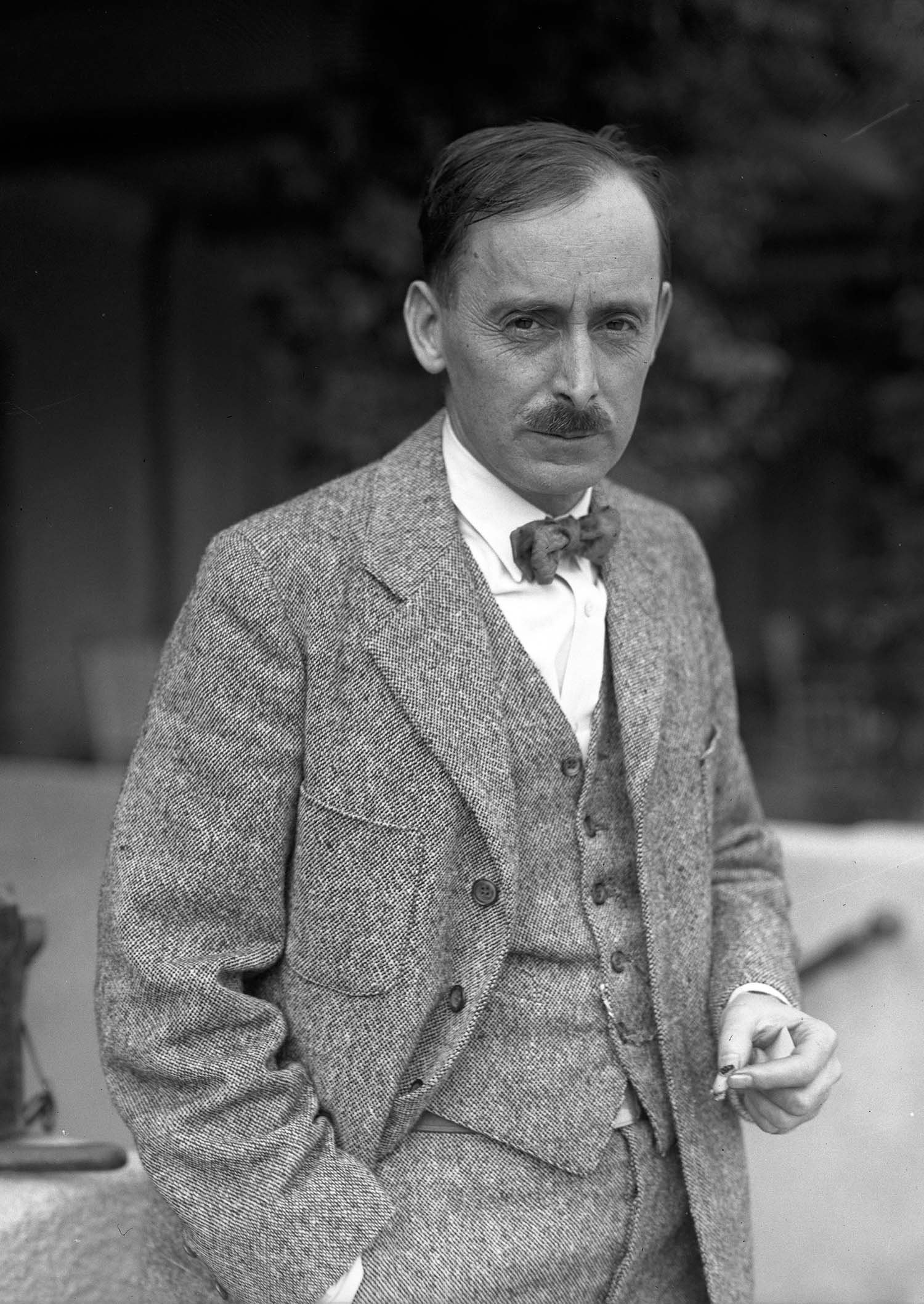
Edgar Alwin Payne is an American landscape painter whose outstanding qualities as both technician and interpreter have been proclaimed by well known critics in Paris and New York, a high estimate that is verified in his own exhibitions. Los Angeles, too, and Chicago, have declared him to be one of the elect in art. Exactly four years ago, when he was showing in the same gallery that he has chosen for his present exhibit, I wrote of him in the Los Angeles Times:
“Payne sees nature in a big and comprehensive way, and something of this bigness of outlook he communicates to us. Which is, when all is said, one of the chief functions of art. You will find poetry and beauty in the pictures at the Stendahl, and a vitality that is amazing.”
Poetry and beauty, and the power to express them, have come out of Missouri, where Payne was born, as they have come out of Maine, or Ohio, or California, and as they will continue to come so long as the human spirit feels the need of the consecration and the dream. The poet and the painter began to sip the manna of beauty on the day of birth—the honey-dew that may be distilled anywhere and everywhere, from lowland levels to Olympian slopes.
None the less at the tender age of fourteen the sturdy and independent Edgar Alwin shook the dust of Washburn, Missouri, from his feet forever,—the dust that was mixed so unpleasingly with the honeydew,—traveling first to the Ozarks in Arkansas, but soon finding these as dusty as the narrow streets of Washburn. So he turned his face southward and went to Old Mexico.
Why do very young artists leave home? For a hundred reasons. In Payne’s case it was because, having exhausted the possibilities of pokeberry juice in the making of pictures, he had joyfully pounced on a few pots of paint belonging to his father—and been found out. There was some disagreement. Argument failed to clear the atmosphere. Edgar Alwin’s father refused to recognize his son’s first masterpiece. So the lad turned his eager eyes towards the mountains, the low-lying Ozarks, delicately blue and very lovely on the horizon. It may be, too, that the wanderlust was already awake and alert to all the allurements of glorious adventure. Certain it is that Payne has traveled much and in many countries since that day so big with fate.
He found plenty of adventure at once,—Old Mexico is full of it,—and after the proper interval and the customary quota of hard knocks, he also found fame, which is not good for the very young and the very inexperienced. California beckoned and offered him that. For, though Payne began as a portraitist and a muralist, landscape had always held his secret and loyal allegiance, and in 1911 he met with his true affinity, California landscape—its mountains, its foothills, its rocky Pacific shores. After 1911, still a seeker, still an adventurous wanderer, he was irresistibly drawn to California again and again, and for the past six or seven years his home and studio have been in either Los Angeles or Laguna Beach.
Payne studied for a short time in the Chicago Art Institute, but, like so many other men of strong and original talent, he did not feel at home in an art school. He needed elbow room, a place in which to dream, to think and to work in his own way. He turned to murals,—plenty of room there,—for his decorative sense has always been very strong, a decided factor even in his easel pictures. Many of these murals were painted in Kansas City, New York and Chicago, and placed in those cities, but it was in California that he painted his magnum opus, 26000 square yards of decorated canvas for eleven floors of the Congress Hotel in Chicago, the subjects being entirely Italian—though Payne had not been in Italy at that time. But youth is always imaginative and venturesome, even undismayed by 67,000 pounds of lead. However, there were other courageous youths on this immense job, Conrad Buff, Jack Wilkinson Smith and Grayson Sayre—in whom you recognize names that have since become some of the best-known in the art of California.
On his first trip to the West, Payne met, in San Francisco, Elsie Palmer, a young art student whom he subsequently wooed and wed in Chicago. The wedding took place in 1912. Exactly ten years later Payne, with his wife and daughter, made the longest painting trip of his career, for it lasted two year's and brought him, in the course of the first year, through eastern France, along the French and Italian Riviera, to Rome and around Rome, into Venice and the Adriatic, through Switzerland and the Bernese Alps.
He was painting fast and furiously all the time, for once again he had come upon his strongest affinity in art. The Swiss Alps are much like the High Sierras, though bolder, more rugged, more densely blanketed in snow and fringed with evergreens, more strung with happy villages. Then Payne rested for the winter in Paris, holding a very successful exhibition of sixteen canvases at the Galeries Jacques Seligmann, 57 Rue St. Dominique. He also exhibited in the spring Salon, his picture bringing him an honorable mention.
he second year of his sketching tour found him in the chateau country of France, along the banks of the Loire, and here Elsie Palmer Payne also painted, her medium being water color. They sketched along the entire coast of Brittany from the Loire to Mont St. Michel, though much of their time was spent in lower Brittany, in the picturesque fishing ports of Concarneau and Douarnenez. What an itinerary for a painter! That Edgar Payne, ever alert, ever eagerly looking for the ‘“‘picture,’’ neglected no single item of this beauty on the way, his exhibition at the Stendahl amply proves. What industry, and what talent!
But mere industry and technical talent, however persistent, do not paint pictures that live. To these attributes must be joined the image-making faculty, the power to see with the soul as well as with the eye. Payne has been dowered with this gift to a marked degree. His stupendous mountain forms are not imitations of nature, they are interpretations, and they assume the vitality of pictures through the passion of a painter who also happens to be a poet. They are created, nothing less, from the elements of art,—how few these elements are, and yet how dynamic, how infinitely varied in their outward manifestations!
It would seem that none of their variations has escaped Payne’s creative curiosity. Descending from the mountains, he is equally keen-eyed in the valleys and along the sea levels. So it happens that the exhibition of paintings now held by him, the output of more than two years of hard and joyous work with the brush, is as replete with diversities in form as it is rich in color. It is the full and determinate expression of many moods, though its one recurrent theme, its leit-motif, is beauty. We may rightly call the present exhibition a painter’s symphony, for it holds all of life as Payne sees and feels it through the medium of art. We know—the pictures tell us—that he sees clearly and feels deeply.
Public honors have come to him, of course, though he has not sought them. He has been too happily absorbed in looking for and proclaiming the haunting beauty of this visible and invisible world to grasp at the bubble reputation. But public recognition is good 1n its way, though not the highest good to the artist,—who must always find that in himself, in the satisfaction of work well done, the vision realized,—and such recognition has been Edgar Payne’s from the very beginning of his career. Much more will follow, we may be sure.
His Salon honor of 1923 has been spoken of. The Chicago Art Institute has given him the Martin B. Kahn prize. From the Los Angeles Museum he has received gold and bronze medals, from exhibitions held in Sacramento gold and silver medals, from the Southwest Museum of Los Angeles a first prize. He is represented in the permanent collection of the John Herron Art Institute of Indianapolis, in the Chicago Municipal Collection, in the Southwest Museum of Los Angeles, 1n the Peoria Art League, and in the galleries of the University of Nebraska. Many private collections have been enriched by his noble Californian and European landscapes, for the understanding love for native American art has not been slow to discover and appraise a talent so powerful and so individual.
Descriptions accompanying reproductions by Antony Anderson