The Lure of the West
Episode 76
Episode length: 1 hour and 5 minutes
In this episode of The Artful Painter, I sit down with Western artist Nicholas Coleman to talk about what actually drives his painting process — it’s not just technique, but also curiosity, memory, history, and places that won’t let go of you.
Raised in the studio of his father, Michael Coleman, Nicholas grew up surrounded by Native models, reference materials, taxidermy, and the working realities of the art business. What stayed with him wasn’t just technique — it was a deep respect for history and for the places that shaped it.
In this episode, we discuss his return to the Coors Western Art Exhibit, the tension between authenticity and trend-chasing, his recent exploration of African wildlife inspired in part by painters like Wilhelm Kuhnert, and why he sometimes ignores deadlines to get a painting “out of his head.” We also talk about art school battles, conservation history, spaghetti westerns, and what happens when an artist receives a fifty-page contract connected to George Lucas. Have I got your attention now?
If you care about painting, place, and preserving something larger than yourself, this conversation will resonate.
Nicholas Coleman is certainly my kind of artist!
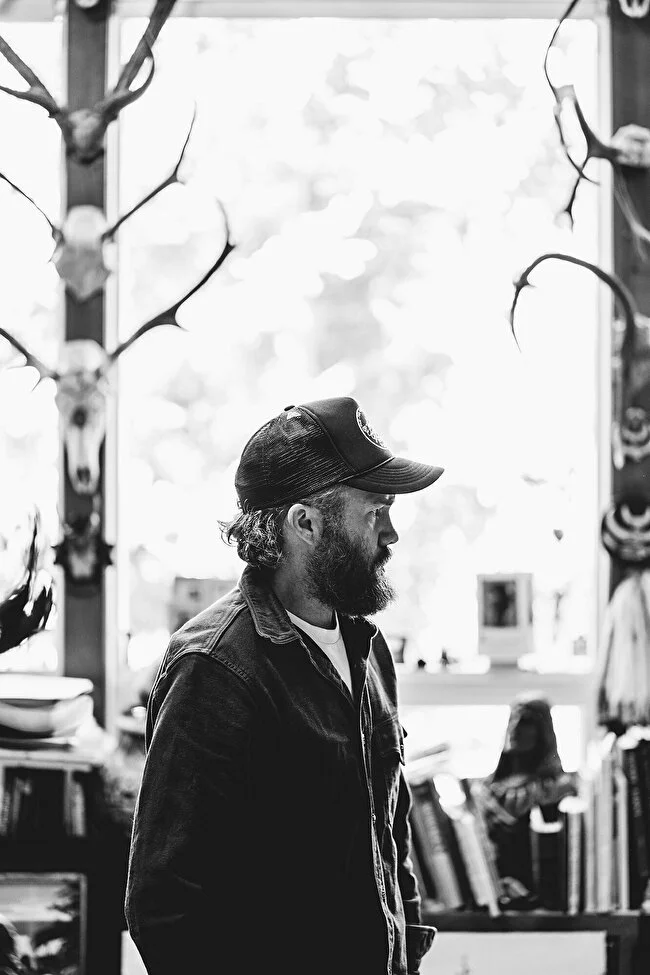
Nicholas Coleman


Click on the images above for a larger view.
Links
Nicholas Coleman
Website: https://www.nicholascolemanart.com/
Instagram: https://www.instagram.com/nicholascolemanart/
Facebook: https://www.facebook.com/nicholascolemanart
Other Links
Bloody Bozeman: The Perilous Trail to Montana's Gold: https://amzn.to/4rer2UQ
Henrik Coleman: https://www.henrikcoleman.com/
Mediocre Amateurs: https://www.youtube.com/@mediocreamateur
Available on:
Apple Podcasts
Amazon Music
Spotify
YouTube
Transcript
A Note About This Transcript
This transcript has been edited for clarity. I’ve endeavored to capture the thoughts and expressions of my guest as accurately and truthfully as possible. In some cases this means completing incomplete thoughts, removing stammers and word fillers such as um, like, you know, and so forth. I’ve edited the transcript to make it easier to read. Please pardon the inevitable errors that I may have made or overlooked.
Carl Olson: You just got back from Coors [Coors Western Art Exhibit & Sale]? What was that like?
Nicholas Coleman: I haven't been in that show for fifteen years. I was talking to Logan Hagege – and I think he got invited back last year – but he and I both got rotated out. I haven't been back in fifteen years so there’s been quite a bit of change. It has changed from the stockyards – which was great – but now they have this new legacy foundation location. It's like the most amazing lodge, convention center, a beautifully constructed venue. It already was a fantastic show and I think it's going to start being one of the best shows of Western art in the West and in America. Fantastic artists! I was I was impressed.
Carl Olson: I wished I could have gone. I had planned to go, but I had unexpected oral surgery, so – so much for that. So next year it's on my to-do list. I would definitely like to go. I mean it's almost in my backyard. I should be able to go.
So so how does that work getting into Coors? Is a by invitation show or do you apply?
Nicholas Coleman: I think you can apply. And once upon a time, maybe I did. I can't remember how I got in it in the first place. But last year I was at the Briscoe show in Texas talking to Teal Blake, and he said, “let me introduce you to somebody,” and it was Gracie Wells. She's the new director the the Coors show. She invited me back into the show, and so that's kind of how it went for me. Maybe for some up up and coming artists there might be an application process. So it’s a “you do get invited” kind of a thing.
Carl Olson: You had several pieces in that show?
Nicholas Coleman: I did.
Carl Olson: How long is the show open?
Nicholas Coleman: I think it's up for at least a few weeks – maybe four to six weeks. I think there's still an opportunity to go to go see the show. So I think I have a few of the miniatures and a few other paintings that maybe got sold.
I know I'm behind on some deadlines with the Briscoe show that's coming right up in March [2026] and I still have to finalize what paintings I'm sending. I already know I'm behind and I hate doing that. I just want to make sure that I get the best work to the show.
I have no idea what's trending. I just paint whatever I feel is my best work. Then I send it and I just kinda hope for the best. And you would think there should be better planning involved! My hope is that the quality and the sales equate into it if I’m few weeks late.
Carl Olson: It's interesting you said you don't follow what is trending. When you went to the Coors show I imagine you saw things that made you say, “Wow, that's interesting!”
Nicholas Coleman: Yes, definitely.
Carl Olson: What did you see?
Nicholas Coleman: Yeah, there's a few. I don't think other artists are painting trends. They're painting who they are. If I was to give any advice to any up-and-coming artist or any artist who who was asking for any kind of help, it would be just paint what you are passionate about, what gets you excited. Your enthusiasm will show through to the buying audience and collectors. They can tell when you love your subject.
I could definitely see that there were a few standouts to me – I wish I was paying more attention to names. That's my other problem – a lot of times I'll know the artwork and sometimes I'll know the name of the artist and other times not. At the show so many people said hi to me and, I'm like, “Who is that?” They're maybe a little more conscientious than I am when it comes to that. The thing is I've been around. I'm not a spring chicken anymore. So people actually do know who I am, which is always a shock to me.
I'm not playing favorites or anything, but Teal’s work always stands out. He's always up to something innovative and new. Stuff that you don't typically associate with traditional quality work. He may do a big bucking broncho painting on a piece of brown butcher paper. It appears unfinished but it is finished. It's not in big solid frame. It has a mat on it and it's framed and there's paper still showing through. You could call it a gamble, but it's impactful and so when you walk by his painting it grabs your attention. You go, “Wow!” That kind of stuff perks my ears up. When I see it I take I take notice.
For artists I think that's what you want is for anybody walking by your stuff and from across the room they go, “Wow, what's that?” And they get up closer and it’s, “Wow, it's even better!”
Carl Olson: Well, that's a good feeling when that happens. It is important, I think, to paint for yourself. But you're also painting hopefully something that resonates with people that want to see your work, want to buy your work.
Nicholas Coleman: Definitely.
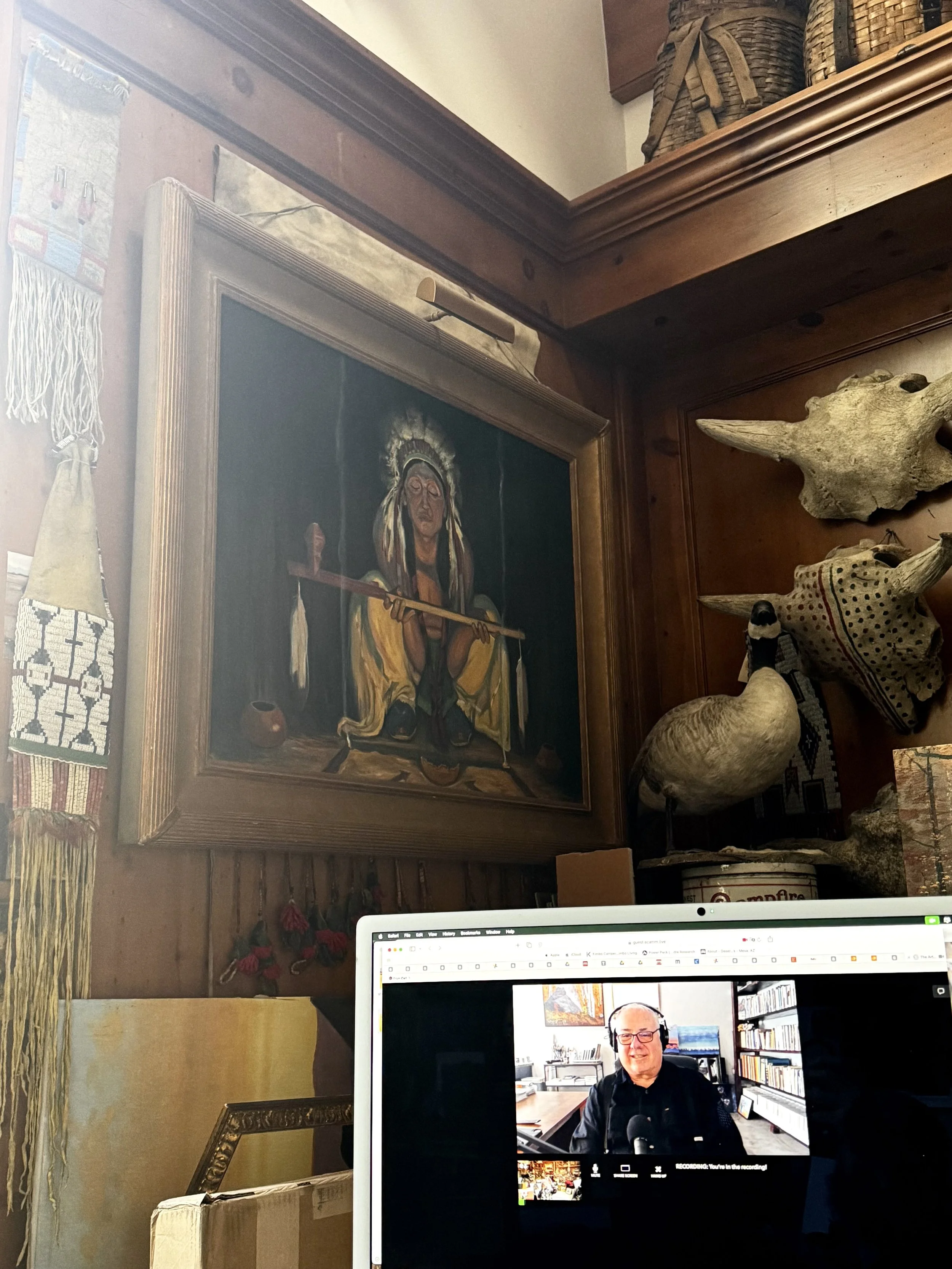
Carl Olson: I was trying to think back the first time I heard of you, and it actually was through your father, Michael Coleman. He was the first person I became aware of in your family. I was just learning how to paint. There's a painting behind me [points to painting of teepee and mountains].
Nicholas Coleman: Oh, yeah! Hey!
Carl Olson: I've never sold it. I don't publish it other than you see a little glimpse because it was an inspired copy of your one of your father's paintings. I did have a person offer to buy it. However, I said I can't sell it. It's very personal. And besides, it kind of a copy so I could not in good conscience sell it. Did you ever did you ever do that – copy other paintings to learn?
Nicholas Coleman: I have a a neat Couse copy that I did when when Steve Rose of the Biltmore Gallery was still alive. Every once in a while he'd send my dad and I transparencies of Frank Tenney Johnson's Couse paintings for sale and and I really love some of the early nineteenth twentieth century stuff. He sent us this Couse painting and I had it for two days, so I had to paint a copy fast! I just saw it come up for sale – it might be coming up at Christie's. The original is like thirty-three by forty-three [inches], and I made mine thirty by forty [inches]. I took out a couple of things so it wouldn't be a direct copy. And I didn't have enough room! But I've had it for about almost twenty-five years now, sitting here in my studio looking back at me. I've faked a couple of dealers out when they came in my studio and saw this thing.
At the time it was a three hundred and seventy five thousand dollar painting at the time. He overnighted it to us and it was a little bit out of the frame and we put it back in the frame and when we got it back to him I got in trouble a little bit. Because it was a little bit out of the frame again. “Hey!” I said, “Hey, blame FedEx!”
My dad, when I was a kid, always had me doing copies of some masters. I have another copy of one of my dad's Philips Wouwerman horse painting. He gave it to my daughter for one of her birthdays and it's supposed to be in her bathroom, but it's in my studio at the moment. So my dad goes, “Hey, that's not yours!” I go, “I know, I know.”
Let me grab it. It's holding up some books... [gets up and gets the painting]
Carl Olson: Yeah, go ahead. It's all right.
Nicholas Coleman: This is this is kind of a neat copy that my dad did [holds painting up to camera]. Isn't that cool? I think it's so cool.
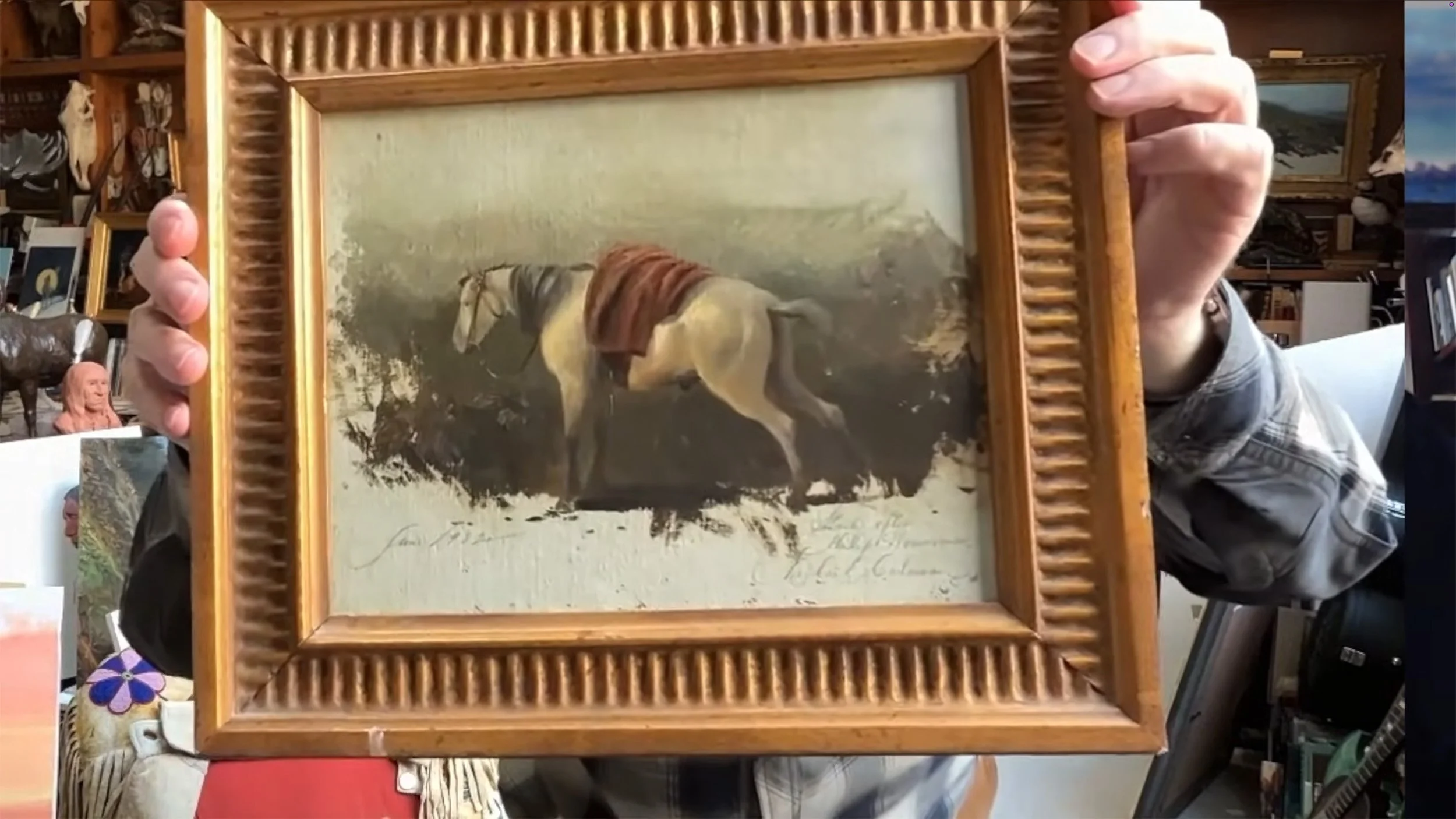
Carl Olson: That is cool.
Nicholas Coleman: So I'm actually doing him a copy to put back in his bathroom. I just need to finish it now, so let's see... Oops! I lost the books.
Carl Olson: I love your books. I think that's what started our interaction was books. What are you reading?
Nicholas Coleman: I found a new book. It's in the other room. it's it's kinda got a long title: The Bloody Bozeman by Dorothy M. Johnson. It’s something about the Bozeman Indians up in Bozeman, Montana, and some of the early mountain men.
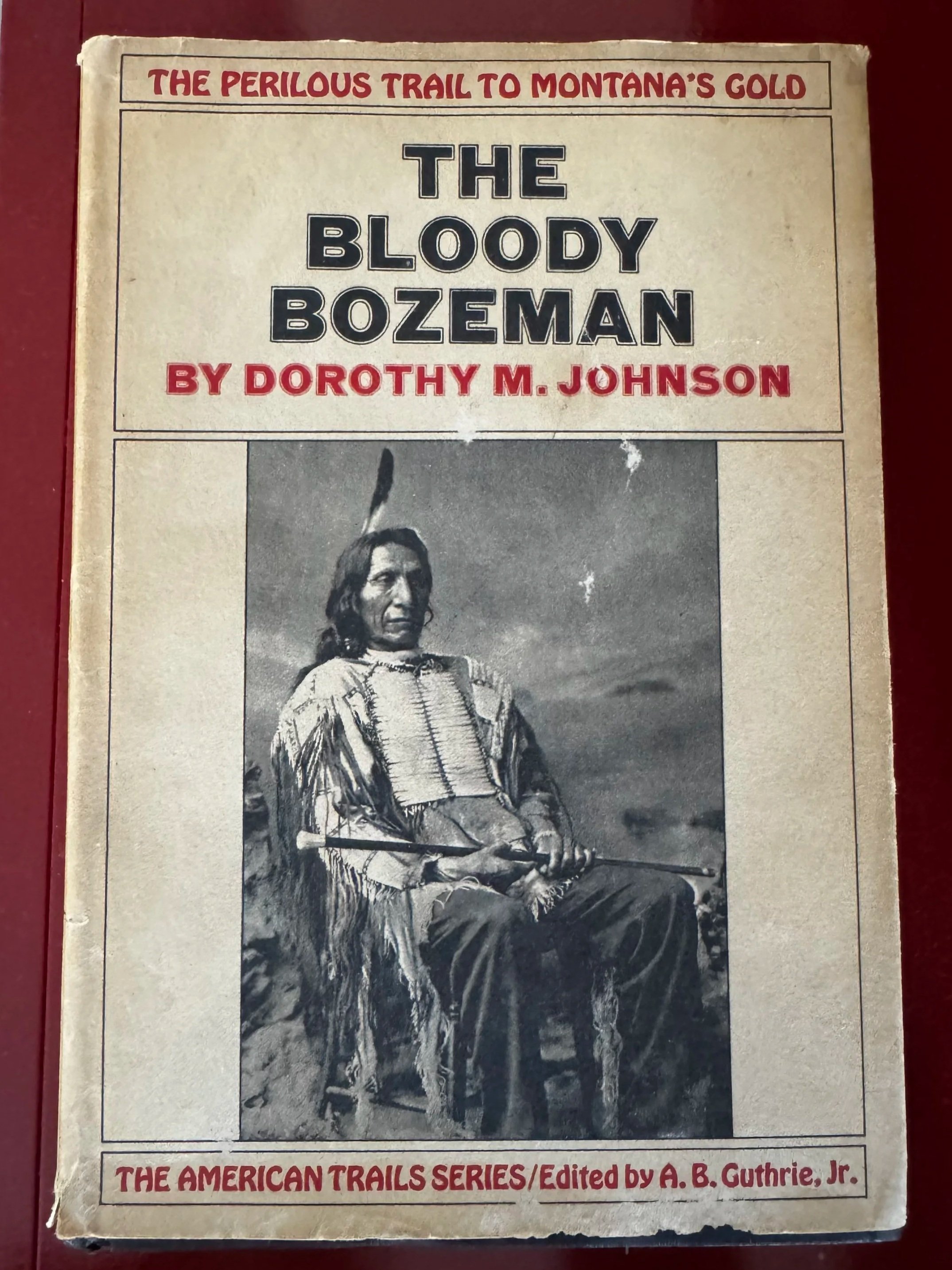
Nicholas Coleman: And then I was looking at a Wilhelm Kuhnert book the last few days. I've been working on some African work lately and he's always been an inspiration. I think there might be some more African and wildlife paintings of the future for me.
Carl Olson: Have you been to Africa?
Nicholas Coleman: I have. I want, I need to go back is my problem. Some of those old photographs of him [Wilhelm Kuhnert] in camp sketching his kills... I think he started his first trip to Africa in 1896.
I think to myself, oh my goodness, the things he saw. Travel was just a little bit harder than it is nowadays, for sure. So you you had to really, really want to go. I think he went back about four or five times. And boy, I'm sure that guy had a few adventures for sure!
I take my dad to shows and people go, “You're still alive?” to my dad, who's seventy-nine and and still the hardest working guy I know. I don't think they ever thought he was dead, but he really hates going to shows and and leaving a studio. I drag him around every once in a while to make sure everyone knows he's still around. So whether he wants to or not, people want to know if he's alive or not.
Carl Olson: You said something earlier which I liked. You talked about being around interesting people. Do you feel that being around interesting people has shaped or influenced the way you approach your art?
Nicholas Coleman: To be honest, probably yes. I've had the opportunity to meet some wonderful people that actually did change the trajectory of of what I was doing with my life and my career at at certain times of my life.
I got kicked out of the Masters of the American West show in 2013 for a misunderstanding. I was like, “Great! Now what am I gonna do?” I've met some I've met wonderful people and I’ve met a few weirdos for sure. That's my fault. But then people have reached out to me and it turned into invitations.
For example, of all funny things, I was invited to a motorcycle show happening in the south of France in Biarritz. And I met this wonderful person who is now a good friend named Vincent Pratt. He called me or emailed me and said, “Hey, I really love your artwork. I put on a show in the south of France. Would you want to participate?” It was the next year, after the year that I would have been absent from the Masters of American West show. My wife goes, “Hey, you never know what the universe has in store for you. Maybe it's something even better. Don't don't beat yourself up.”
Typically I am a very optimistic person. Things punch me in the face and I get back up, I look around, and I expect there won't be any more fists waiting for me. He called me and invited me to this show.
I have another funny friend who is my scout master who owned the Harley Davidson dealership in town. It's a big one out in Linden – it could almost be a headquarters, it's so big! This is in Utah and I was doing some motorcycle paintings for him at the time. A friend had to convince me to do this.
He's like, “Well, why don't you?”
I'm like, “Well, because I don't do that.”
He goes, “Why not?”
I'm like, “I don't know.”
He's like, “Are there any rules that say you can't do that?”
I go, “No.”
And he goes, “Well, you know, you think of Harley Davidson, you think of the West, you think of open deserts, you think of the the outdoors. That’s you”
I go, “True.”
He goes, “Well, why not do a big landscape with a couple of your motorcycles ripping through the landscape?”
And I go, “Well, that's an idea.”
So it sometimes takes outside influences to get me going – moving someplace. And then I told this this new friend, I said, “Hey, I've been working on some motorcycle paintings.”
He goes, “You do motorcycle paintings?!? Let's let's do that, too. Can you send those?”
I said, “Sure!”
And so that turned into a wonderful friendship.
I've met editors of magazines in the UK, and I met friends in Belgium and in Spain, and it turned into a kind of brand work. I was doing interesting paintings for people that I wouldn't have met in the West, or interior designers or people that typically are sometimes buying paintings for decoration. And then it turned into a show in Japan.
And even my own gallery, the Bighorn Gallery, turned in an opportunity to do a commission for George Lucas.
Carl Olson: You did a commission for George Lucas?
Nicholas Coleman: I did. He did a series called Star Wars: Visions. His company ended up buying my painting and a number of other Western artists' paintings. I think Jamie Wyeth was in the group and although he or his handler sent a very strange Vietnam-looking painting.
For Star Wars: Visions, it was other artists take on Star Wars. And I know I know Jeremy Lipking did a painting and and I think Andy Thomas did a painting, and there were a few other Western artists that did some paintings. They were going to do a big big show. When I had my actual show in Japan, it was happening simultaneously, so I got to go see my paintings at this Star Wars: Visions show up in a giant skyscraper. It was standing room only to get in. There was a big long line going up the spiral stairs up to this giant building. I bypassed that long line and said, “Hey, I have tickets waiting for me to go into the show.” I got in trouble for taking photographs and I had to remind them that, “Hey, look! This is me!”
So you definitely meet interesting people.
Then funny things happen and you get invitations to places you wouldn't normally have gone. Maybe a hunting or fishing trip here and there, for example. I had a friend that wasn't a friend yet but who turned into a friend – he goes, “Hey, my wife didn't shoot this big elk, but we got a photograph on our cell phone, this terrible photograph. Could you paint her a painting for Christmas for me? And by the way, can I convince you to do, you know, half trade and and half cash. I'll take you fishing up in Wyoming.”
And I said, “Sure, that sounds great.”
He happened to be the property manager of Johnny Morris – the CEO and founder of Bass Pro Shops. He was in charge of helping form the rivers on his properties for fishing. And I said, “I’ve met Johnny. He's come to a couple of shows of mine up in Wyoming.” He said, “Let's get him on the phone.” That turned into some some T-shirt designs for Johnny and a few other fun things that we that we did together.
So back to your question... you definitely meet people, and interesting things happen.
Carl Olson: So I want to go back to George Lucas. I want to know how that works. What do they do? Does somebody from there just pick up the phone and calls you and says, “Hey, we want you to do a painting?”
Nicholas Coleman: It was a bit like that and then an email and then a fifty page contract showed up.
Carl Olson: A fifty page contract?
Nicholas Coleman: It was like you can't do this, you can't do that. We like this, we like that. You can't share this... I asked for all kinds of reference material. And, you know, my little kid version of me was like, boy, Star Wars! 'cause I loved it. There was magic in that there was only three movies when I was a kid. And now there's fifty three movies and I don't know what's going on anymore. I don't care as much because there's so much and I've lost interest. That's the problem.
It was one of my funny, childhood little things. I'm like, “Hey, this is great and fun.” And then my contact, Jonathan Rinzler – sadly he passed away of cancer a few years ago – was the most helpful guy. He invited us – my wife and my family – although they were little kids at the time, to San Francisco to go on a tour of Industrial Light and Magic. I got to see all kinds of pretty amazing sculptures and models and some of the early filmmaking things that they invented to to composite certain shots.
My little my son, my little boy, [Henrik Coleman], now he's 18, is a budding little filmmaker and sculptor himself and loves practical effects. He just told me today he did a bust of Lincoln for the the high school art show – his senior high school – and and it just got in. He also did a claymation of Werner Herzog – one of his favorite directors. His brain is constantly spinning and whirling around.
So it's fun to show him all these things and and to expose him to all these things. I even looked just a few weeks ago, if Industrial Light and Magic does tours – they do not. So I just realized how lucky my wife and I were to get a tour about fifteen years ago or so now. We saw how they make toys, their video game things, some of the old map paintings that some of the old famous map background designers were doing.
My son kind of wants to bring all that back and he's been watching a bunch of spaghetti westerns lately. We watched a funny one with Klaus Kinski the other night where it is filmed in Italy, supposed to be in Utah – which was pretty funny – but there's this mute guy who's the good guy who gets shot down at the very last four minutes of the movie. But his big thing was he was shooting people's thumbs off and my son's like, “Boy, this is great. I gotta cast a hand and I gotta figure out how to shoot people's fingers off. This is gonna be great.”
He also loves like the opening credits – it’s kind of almost a cartoon, you know, and then gunshots, and then the freeze frame of the guy's face. So my son - he's actually trying to figure out how to do that right now. He was explaining it to me and I'm looking at him and I said, “You're on your own, buddy. I don't know about this.” But that doesn't stop him. He's a kind of a constant force I which I love to see so he's one of the busiest guys I know.
Carl Olson: I think it's beautiful that you're you're nurturing his interest in that.
Nicholas Coleman: It's fun. That's the other thing, too. I couldn't stop him. He's going to do it anyway, even if I said go for it.
Carl Olson: That's interesting about the spaghetti westerns – I still watch them. I love them.
Nicholas Coleman: Oh, yeah! The music's great. Some of the the the scenery is amazing. What was really funny we noticed that they had these guys on horseback on no trails. They're in five feet deep snow, barely getting through the snow. It looks so cool, these awesome mountains in the background, but definitely not in Utah. Wonderful pine trees. Everywhere everyone was going, they were up to their chest in snow though, you know, there probably would be a place where there's a trail – that's what I'm thinking. Let's do this.
Carl Olson: There was one I saw – I wish I could remember the name of it – but it opens up with the Durango & Silverton train that's down the road from here where I live. So the whole opening sequence, the titles, and all this is really cool cinematography, and it's that narrow-gauge train. But the action goes to Spain. This Western is actually shot mostly in Spain.
Nicholas Coleman: Yes! That is one of the longest opening scenes ever and I kind of love that it is.
Carl Olson: I knew one of the film editors for the Hunger Game movies. His name is Alan Bell. He and I had a conversation about editing, and one of the things he mentioned was he likes to linger on a shot. He said most movies are very frenetic. A cut can't be more than two seconds. He said he wanted to linger on certain shots to immerse the viewer into the moment. A lot of the Hungar Game movies were filmed back where I used to live in Georgia. There was a park there [Sweetwater Creek State Park] that I explored every square inch of when I was a child. And it was pretty cool to see the scenes of the movie filmed right there in the spots that I as a child – the rocks that I would sit on are in the movie.
Nicholas Coleman: That's cool. My son – I'll send to you – did a movie called The Lost Cowboy and it's one of his first western things that he really, really wanted to do. In one scene he's crossing this old, neat bridge, but his guys cross the whole screen. I said, “You know you could cut that up a little bit. People don't need to see the whole thing.” My son goes, “No no no! I hate weird jump cuts. No, no, no, no!” And I said, “All right, this you know, it's your movie.” I don't want to ruin his vision because it's untouched at the moment. Somebody down the road is going to try to change it and I don't want to be that guy.
Carl Olson: Well, he may be creating a new language for film or going back to the roots of what filmmaking was.
Another filmmaker I know: Gail Tattersall – he filmed the entire series of House MD several years ago. We were just talking about trends in cinematography, and one was how filmmakers want to make the ugly beautiful. He says the problem with making the ugly beautiful is people don't realize it's actually ugly. So he would try to endeavor to show the way it was: if it's ugly, it's ugly. Does that make any sense?
Nicholas Coleman: It does. It does.
I fought against an art professor when I was in college who a couple of times tried to kick me out of his class a few times because I didn't agree with him. His take on art was so strange to me and and it turns out that he was at school at the same time my dad was at school here in in Provo, Utah, at Brigham Young. When my dad went in the sixties they were pushing post postmodernism and my dad was pushing for landscapes and roosters and chickens and cows and pastoral kind of things and and the Barbazon School, Hudson River School paintings were what my dad's first love.
This guy, my gosh, at the time I was twenty one, there was a thirty five year old woman who was a high school art teacher who was enrolled in the class for advanced watercolor techniques. By the way, I never saw one advanced watercolor technique demonstrated in this class.
It was one of my very last classes, which is why I didn't let them kick me out. I had to actually pull some rank with the dean to keep me in the class. A couple of other teachers said, “Keep him in.” I wasn't trying to be antagonistic or anything. There were only six students in this class.
This one woman – the high school art teach – she goes, “I’d love to paint landscapes.”
And he goes, “Well, by the time we're done, I'll have you painting parking lots.”
She's like, “Excuse me? Like painting parking lots or painting paintings of parking lots?”
He's says, “Either or.”
You could tell she was trying to understand what in the world this guy could be saying.
She asked, “Do you want me to learn and to grow and to try something different?”
He replied, “No. I want people painting ugly things. There are so many landscape painters out there. We need people painting things like parking lots.”
And I said, “No, no, no, no, no, no, no! Sorry, no!”
Carl Olson: You did this during the class?
Nicholas Coleman: I said, “You cannot tell her what to paint.”
“Even if you think there are too many landscape painters out there,” I said, “the landscape hasn't been painted by her.”
Yes, landscape paintings have been painted by people, but not by her. Then we had a few other conversations in that class, and he's like, well, maybe you should leave.
I said, “I wish I could, but I can't.”
Yeah, he was a fun guy. And what's funny is – it was kind of a point of pride – to be, after the fact, that some of these encounters I would have with professors would say the West has been painted, it's been done, it's been all these things. And my whole thing was, “Well, it hasn’t been done by me.” My experience and my how I how I view it and how I see it. At that point I laser focused what I wanted to do.
Had I been a little more amenable, a little more malleable, maybe I would have... but my whole instinct is that the professors are there to help facilitate the vision of their students who are paying for this education. If they want to do one weird thing, okay, what tools can I give the student to get him to where he actually wants to go as opposed to brainwash him and make him go down this other road.
One time I brought some stuff framed that I was sending to my gallery up in Jackson Hole and this professor says, “This looks like you're trying to sell it.”
I said, “Bingo! You're right, I am.”
He says, “Well, what are you doing that for?”
I said, “Well, I have a gallery up in Jackson Hole who sells my work. But my mom asked me to graduate from college and then I could do whatever I wanted, but in the meantime, I'm here with you.”
He didn't like that.
When I had a one man show in New York at the Bartfield Gallery as I was just finishing up college, they had made a brochure and they sent me ten copies. I made sure to leave one at his office before I left.
Carl Olson: Do you know whatever happened to him?
Nicholas Coleman: He's still alive, which is shocking to me. I think he might be in his nineties. I've been told by Vern Swanson, who is the director of the Springville [sp?] Museum here, who's a treasure trove of knowledge, said to me: “I feel bad for him. I think he's had a few strokes, mini strokes.”
He was into this postmodern stuff and he loved mixing his own paint and it was always kind of a dull. The paints were never very vibrant, in my opinion. My kids were at the Springville [sp?] Museum a few weeks ago dropping off my daughter's little drawing for her high school art show. There was a painting there. Before I knew it was his, my daughter goes, “That's the saddest thing I've ever seen.” And then I looked, I'm like, it’s my old professor. Perfect. And it in their permanent collection. I gotta stop talking about that and focus on positive things.
Carl Olson: If you had the choice – it was very kind of you and very respectful to respect your mother's wishes, but if you had one hundred percent the choice, would you have chosen to go school [college]?
Nicholas Coleman: My early years as an artist were kind of funny because even in high school, I was a good student. I was in all the honors and AP classes – mainly because my mom wanted me in them. She was my taskmaster. She told me when she was in college she said to her friends, “Hey, let's go out and party!” Her friends were like, “We all are on the same class... we gotta study for the test.” And my mom's like, “Study? What are you talking about?”
She goes, “Nick, I was a terrible student. It was a miracle I got into BYU, but that was just the the thing you did in the sixties.” She was from California and the Mormon kids all went up to BYU. And she goes, “Then I realized, well, people like to pay attention to their education.” So I think she's a smart lady. I think she wanted to make sure all her children had an education. Even at the time when I was a kid I understood the need for an education.
There was a life drawing class at the Springville [sp?] Museum that I thought would be fun to take. My mother’s like, “No, you're not going to go look at naked people!” You know? I was like, all right, sure, fine. Saturday morning I was heading over there. She's says, “What do you think you're doing? No, you don't need to do that.” Later I took the figure drawing classes at BYU and they modest – in some kind of swimsuits for the for the drawing classes. I mean it was certainly fine.
One thing that made my mom mad is there was a test coming up for me. Her thing was you should be able to be so prepared you could go bowling the night before your test. And I was going bowling with some friends. She asked me, “What do you think you're doing? Don't you have that test tomorrow?” I said, “I do.” She says, “Well, you should be home studying.” I said, “I’m so prepared, Mom, I can go bowling.” I don't think I told her how poorly I did on that test.
Carl Olson: Well the secret is out now!
Nicholas Coleman: My senior year we got into an argument I was going to end up going to the state college. I thought agreeing with her would be the right course so I said, “Okay, I'll go there.” She said, “That's the wrong answer, mister!” So I applied to BYU. My thing was I wanted to get busy doing the thing I wanna do.
I'm like my son. My wheels are always spinning about the next painting, the next place I can go to get the ideas for the paintings, that’s what I want to do. In in the evenings I couldn't even go to sleep. My brain was spinning around so much. I had to learn how to calm my breathing down, calm my thoughts down, almost meditate, before I could actually get to sleep.
And with my son he’s like, “I can't even get to sleep my brain won't turn off!” So I've been trying to teach him some tricks and he's already ahead of me in skill. I'm still trying to think what on the earth I would have done if my mom wasn't cracking the whip. I maybe would have gone [to college] just because I didn't know where else to find girls, you know.
Carl Olson: Well that's an honest answer.
Nicholas Coleman: I'm a little bit of a hermit. You can tell by my beard. I just chopped two inches off yesterday because I kinda look like a crazy person with my hair out and my beard down – goodness!
Carl Olson: Your father [Michael Coleman] was an artist and now you're an artist. Was there a point where you resisted the idea of being an artist or or was it something that you always wanted to do?
Nicholas Coleman: I think it's something that I've always wanted to do. When I was in his old studio – when I was a little kid – we had all kinds of Native American models show up to the house and my dad would dress them up. There's a picture somewhere in here where you see me [as a child] peeking around the corner. I’m just two or three years old. A guy sitting is sitting on a saddle system my dad had set up. There's an Indian guy sitting as it were on his horse, posing for my dad. And then there's me watching and seeing these the amazing looking people would show up and pose for my dad.
I was also the kid that wanted to go muskrat trapping or raccoon trapping up the canyon with him before school. I'd beg to go on the fishing trips. I begged to go on all the hunting trips that I could with him. I'd sneak in and paint on his paintings and I figured if I didn't get in trouble I must have been doing a good job. I think he just kinda laughed and fixed whatever the heck I did. He would actually mark off spots for me on the canvas or Masonite board he was painting on at the time. A lot of times it was dark spaces under rocks that he was he was doing and I'm like, boy, I gotta paint! I begged to go to the art store and and get Prisma color pencils and and all the fancy pencils, charcoal, clay – I wanted to do it all.
And then my parents, when I was twenty one, sat me down, and had this conversation: “If you go to college and finish, I'll let you do anything you want to do.” Even yesterday, my mom and I were talking to my sister and my mom is like, “This is why I told you it wasn't easy.” I said, “I never I never thought it was!”
Also, when I was a teenager, I used to make mats for my dad's watercolors that we would send off to New York and different places. I was the kid that got sent out to the neighboring city to his paintings photographed and have transparencies done of his work. And I was the shipper. I was the runner. I got this mini-apprenticeship that I don't think he realized he was giving me, but it taught me the ins and outs of the art business. I met all the art dealers. He took me to some of the shows. So I kind of knew what I was in for without knowing that's what I was signing up for.
My mom's like, “Are you sure you really want to do this?” And my dad's like, “You're not doing this because you think I want you to do this, right?” And I said, “No. This is what I want to do.”
My dad then asked me a good question: “What are you thinking about when there's nothing else to think about?” And I replied, “Painting. And the next painting.” And he goes, “Okay, these are good answers.” That helped him stop worrying about me so much.
For the longest time they pushed us into being lawyers and doctors. My little brother for Google and he is very smart. You know the joke for him in high school because they him wanted to go to MIT? “M-I-T P-h-D equals M-O-N-E-Y.” That was my dad's funny little thing for him. All of my dad's kids had a knee-jerk reaction when it comes to authority – we do the opposite of what anybody's telling us. There is a little bit of a rebelliousness in all of us.
I just had a hard time especially in high school. My mom reasoned, “If you can, try not to argue. Just do the work. Argue after school, argue with me. Vent your frustrations to me.”
Even with my kids, I'm doing slightly different approach. I'm not cracking. We emphasize how important education. Because it is really – especially this day and age – very important.
It's not to say that everything you're learning is going to make you the smartest guy. But what you learn are tools. They're jumping through the world's hoops and these tools help working with other people. There's no escaping people. You're always going to run into them and you’re always going to run into something silly that's just crazy. You need to know how to deal with it. I think that's where the benefit of going to college is – you're learning the systems of the world and the hoops you need to jump through and and how to work with other people.
One of the best lessons my mom probably ever taught me was: Make sure when you meet people, make sure they were glad they met you. Every once in a while you have a weird encounter and you go, Wow! Now you have a funny story about them. Then my thought is: what's the story they're telling about me when they go home?
Carl Olson: I value education highly, and that education should never stop. I've mentioned this before and I've gotten hate mail as a result of it, but one of my interview questions for people that applied to work for me was, “What have you read lately?”
95% of them could not answer that question. Unfortunately, in software, you must read. You've got to read the code. Of course, that's even changing now with AI. But at that time that's what I needed. I needed somebody to read. I needed someone that was curious, because software is about problem solving.
Nicholas Coleman: I think curiosity is an underrated skill, actually, especially this day and age. I have a friend who has a YouTube channel called Mediocre Amateurs. He's very self deprecating, but he shouldn't be because what he does is not amateurish at all. I've traveled with him all over the all over the world. He wants to visit space. That's one of his goals but it’s funny because I have zero desire to visit space. I'm like, “Vacuum?” And he goes, “It'd be so cool!” And he goes on to tell me how amazing it would be. He's visited some of the harshest places on the earth. He did Kilimanjaro by himself. I was in the Dolomites with him a year or so ago. He likes to punish himself physically. I don't know if he is aware of this. His wife is a seamstress and she was making some costumes for my son's film project. They came over and visited with us the other day and we were joking about his endless need to travel. None of the stuff he does is lavish at all. It's done on a shoestring budget. He has to do it. He's compelled. It's fun to see him do this. I just worry about his safety some of these times. His wife's like, “What am I gonna do? I can't I can't stop him. He has to do these things.”
It goes back to just being endlessly curious about the natural world. We were up in Canada and we're there for a day up in Banff and he looks around and says, “I’m surprised that no one's recognized me.” Not even thirty seconds later someone goes, “Hey, Mediocre Amateur!” I say, “Well what what do you know?”
He's from Utah. He's met people from other countries who say, “We're here because of you. You showed us step by step. You showed us maps. You showed us things we needed.” And that's his his thing, too: education of how to do these things. If you don't know how to do this, this is how you do it. He's turned his platform into this wonderful sharing opportunity. It's not just me, me, me. It's “Yes, I'm here doing this, but you can too.”
Carl Olson: That is neat. Speaking of curiosity, I am very curious about your studio there. You seem to be a collector of things, a collector of memories. Are these props that you use in your paintings?
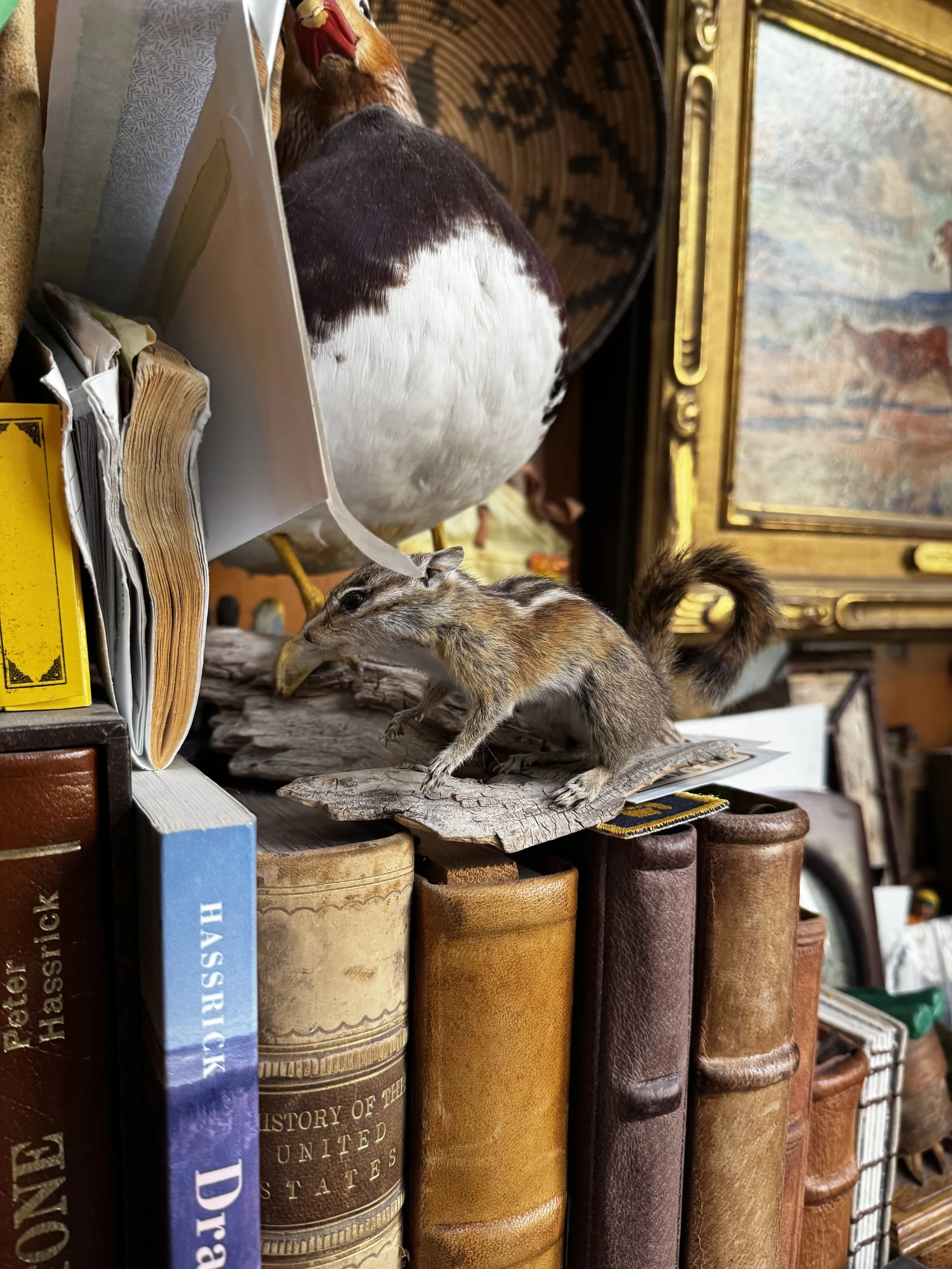
Nicholas Coleman: Props, yeah. These are things that have been following me home since I was a kid. I have a little freeze-dried chipmunk that was one of my very first kills, we'll call it. We used to have a cabin up at Sundance Mountain Resort. We could see across to Robert Redford’s cabin. I used to run into him when I was skiing as a kid. A lot of funny things have followed me home over the years from hunting and fishing trips. I've rescued a few heads and horns out of a antique shops in the West in funny little towns.
My dad a few years ago got mad at me because II bought a book. My dad says, “I’ve got that book! You know how long that took me to find that book?” Now you can just type things in, track it down, and have it shipped to your door within three days. My wife gets upset with me sometimes because I am a bit of a pack rat. But it's an organized mess. There's definitely a story behind all kinds of funny things in here.
Carl Olson: Do you go out into the wild, go outside and do outdoor painting?
Nicholas Coleman: I've taken my painting kit to Italy, Alaska, and up to Canada.. My problem is I do love to see it and just be there and not worry about the work aspect of it all the time. I used to draw on airplanes but I can’t ignore the fact that I'm on an airplane.
There are mosquitoes in a few of my paintings, and squirrel tracks that have found their way into some of my paintings that I've done outside. But I typically am a studio painter. I do get out with my camera and if there's something that I really need to get down, I'll sketch it out, bring it back to the studio and along with my photographs do a lot of my paintings.
“My brain is my Photoshop. I don’t project or trace anything on.”
Nicholas Coleman: My brain is my Photoshop. I don't project or trace anything on. A lot of my photographs are inspiration. It's an angle, it's a color, it's a shape. If a mountain range needs to be recognizable – yes, there definitely is reference aspects to my photographs. And then what's fun too is I have my old actual photographs – physical photographs that I've taken that I used to do, and then also a lot of my dad's stuff. There a few key ones that my dad and I have tried to save over the years. They are good examples of certain shapes and colors that that we gravitate towards and try to remind ourselves of a certain time or a feeling of a day that that we loved.
Carl Olson: There are times I like to paint outdoor because it can be fun. I live close enough to areas that I can go paint and be private. I don't like the spectacle of it. I don't go to these “plein air” conventions. I just don't like that.
Nicholas Coleman: I've been invited and my problem is I am very introverted. Crowds drive me nuts. Loud anything – I can't last very long. I've been invited but I don't go. I've been invited to places and I just can't pull myself to get there and hang out with other painters and artists. The whole idea – I can’t. I'm very strange and I've joked with my other buddy who says, “Yeah, you're broken. There's something wrong with you.”
I have a couple good friends and my wife and my kids. I'm good. I have good acquaintances, and well, I have more friends than that. But I try to keep it small.
Carl Olson: My daughter uses this phrase: when her social energy quotient is used up, it's time to go.
Nicholas Coleman: My wife's family will come visit and after a number number of minutes I'll hear, “Where did Nick go?” And I'm like, “Oh, no! They noticed I’m gone. I thought I was being sneaky.”
Carl Olson: Let's talk about your your painting process. I’m not looking for the technique. What I'm looking for is the thinking process of how you go about deciding what to paint and how you develop that. You already mentioned your brain is your Photoshop and I love that. I've never heard anybody use that expression, but that is so cool. I'd like to know more about your process of developing an idea for a painting.
Nicholas Coleman: I wish I was more organized, but I guess what's made my work my work is the way I get to go about my work. It goes back to curiosity and enthusiasm. My dad and I keep an eye on certain auctions for some of the deceased masters: Carl Rungius, Bruno Liljefors, Albert Bierstadt, Thomas Moran, and Frederick Church are some of our most favorite guys.
The prices that are realized on these paintings at auction are just astronomical. However, my dad's thing is, “Well, we paint. We can do that.” Granted, we're selling our stuff. He says we can always paint another painting. If we love that stag painting so much and we love that line, he says, “What's to stop us from trying doing that ourselves?”
When I was looking at the Kuhnert book the other day, I go, “Wow!” I was meeting with some people in Denver that we still work with that are the founders of the Lewa Foundation in Kenya that that are are trying to bring the numbers back for Grévy's zebra and the black rhino. My dad's old hunting friend – he's a professional hunter – he goes, “I have this wonderful book that I thought of your dad when I found it.” I can't remember who he got it from – maybe a tracker in Africa – but basically it's from the 1920s. It's like a recipe book but it's crisp crunch crunchy and old and it has all these newspaper articles from the early 1900’s. What was really cool was one of the articles about an Englishman who kills 136 elephants. That's the headline. You go, “Holy cow!” I started reading it and it says that sometimes he kills six before tea time. He does the same thing the next day. His name was Commander David Blunt.
Well, I've hunted with David Blunt's son years ago, and his name was Nikki Blunt. There are historical, wonderful things that happen in Africa when it comes to conservation and when it comes to hunting. The reason I paint the West is I love its history. I love the wonderful parts of history and I love the terrible parts because that's what makes good stuff so good and it makes the bad stuff bad. And of course we don't want to repeat the bad stuff and and here we are in the future, in the present, trying to move forward, you know, and we want things to go right going into the future. So that's why you need to remember the bad, awful parts, so you don't repeat those parts. And sadly we see a lot of those same things repeating themselves right now. Because some people don't want to worry about or bother themselves with history or how certain things happened or they don't believe certain things happened – which blows my mind!
Carl Olson: Factual history is inconvenient to a lot of people.
Nicholas Coleman: Exactly! When I was a kid my dad shared books about with me about life and death in the Yellowstone, grizzly bear attack stories, and I was just amazed and entranced by the lure of the West, the history of the West. Provo, Utah was named for the French fur trapper Étienne Provost who came through Utah County in the 1820’s.
I live in the foothills of the Wasatch Front under Squaw Peak, just twenty minutes from Sundance and Provo Canyon where Étienne Provost was taken captive. Four of his six-man party were killed. He escaped with another guy, never to return. All the cities up the Wasatch front are Murray, Ogden, Draper – all named for mountain men who were here way back when... There's so much history here. There's so many cool things that happened, and I'm still on the tip of the iceberg, especially when it comes to my painting and the things I want to accomplish.
And then the history of Africa is magic, and I can see why Teddy Roosevelt and Carl Akeley were two pioneers in conservation efforts. The whole reason that we have the mountain gorilla today is because Carl Akeley shot one, and he goes, “My gosh! If white men discover these creatures, they're going to be gone!” So immediately in the early 1900’s, they protected gorillas and they're still around today because of Carl Akeley and Teddy Roosevelt. And if visit the Natural History Museum in New York, while you're standing in line waiting to get in, you read the history of why he started that.
And then we have Yellowstone. Because of Thomas Moran and Teddy Roosevelt, the setting aside of these places that are just still magic to this day.
There's this history of the West where bits and pieces are still preserved. I think in Western art, there are a number of artists, talented artists, that are that are doing their best to preserve that feeling, that spirit. I think my dad's tapped into that, and without him knowing that's what he was doing with me.
That's definitely my goal – to help preserve the this heritage of the American West and the magic of the West. In wild places especially. There are a lot of these things that I get excited about and read about.
So When I was going through that book of this guy's hunting stories (and he's part of a professional hunters group) – he's eighty years old. He says, “I found this book and I wanted to share it with these other professional hunters on Facebook.” And I still wanted to track this book group down if I can, if it's not private. But all the postcards and photographs – it was this treasure trove of hidden secret knowledge that no one knows about all in this little book. And he's like, “I think I'm gonna give it to your dad.” I like “please do!” I'll take it to him. We’ve got to figure out a way to preserve this book and share it because – just holy smokes – it's so cool.
So this has kinda been my process. I get excited! I have on my paint my easel right now a painting of three Grévy's zebras that I just I had to get out of my brain once I started doing some research on them.
I have deadlines – but don't tell anybody – I’ll stop my deadlines just to get something out of my brain because I have to. I have no idea if it's going to sell. I have no idea if it's going to find a home. I have to paint it.
Carl Olson: Nicholas, I really appreciate you joining me in this conversation on The Artful Painter. It's been a real pleasure talking with you, having an insight into your studio, your thinking process, and your beautiful art. It's been a real pleasure talking with you today.
Nicholas Coleman: Thank you so much. This has been fun and I appreciate talking with you.