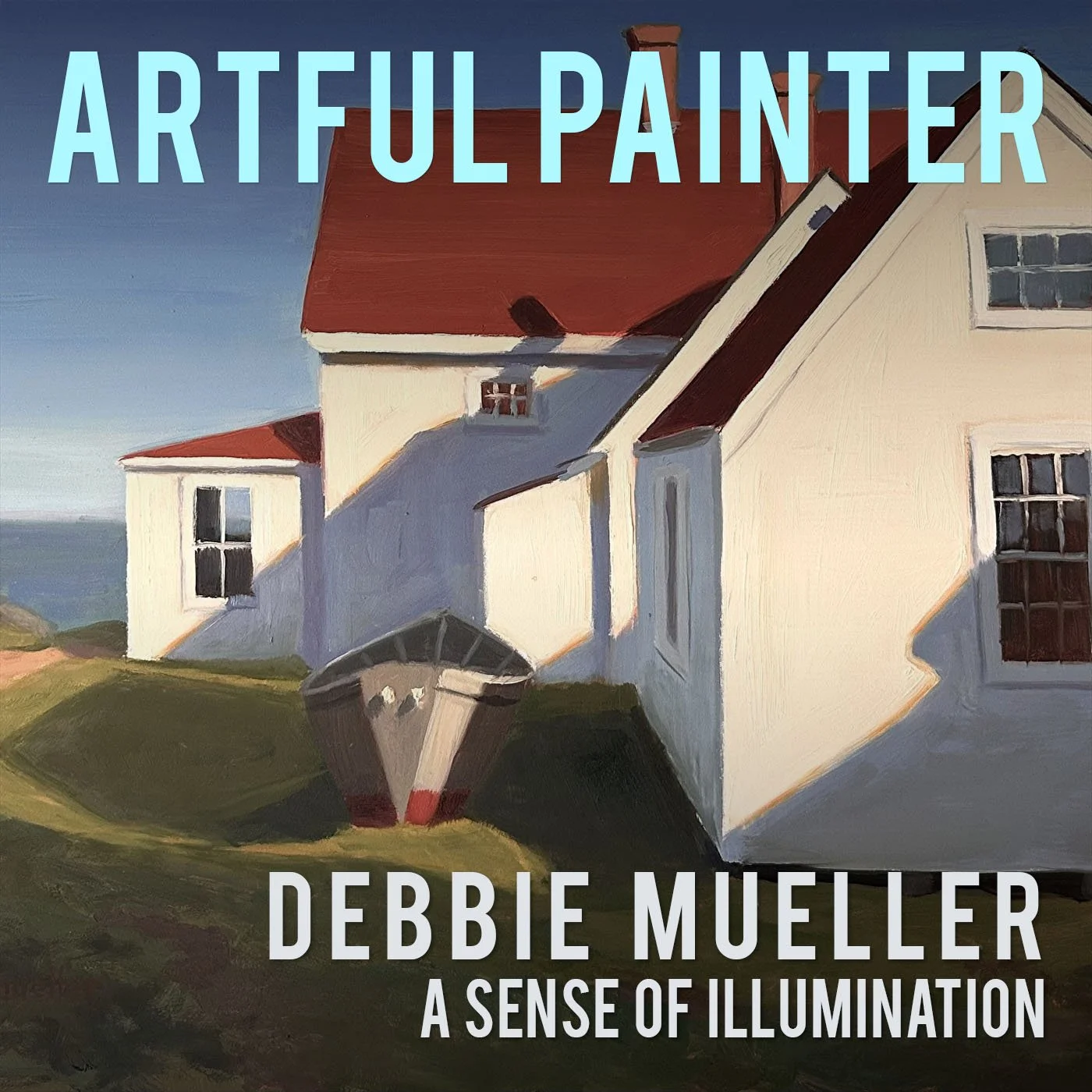
A Sense of Illumination
Episode 77
Episode length: 1 hour and 5 minutes
There’s a moment in life when something shifts—quietly, almost accidentally—and it takes on an unexpected new direction. For Dr. Debbie Mueller, that moment came on a rainy day in Sarasota, Florida, with a reluctant brushstroke and a “really bad painting.” It changed everything for her.
In this episode of The Artful Painter, I converse with Debbie Mueller to explore her remarkable transition from a career in medicine to becoming a full-time artist. Though she found her work as a doctor in a successful OB-GYN practice rewarding, that one “really bad painting” sparked a decade-long journey that eventually lead to her leaving medicine and to pursue painting full-time.
Debbie’s paintings are known for their luminous quality, thoughtful composition, and inviting sense of presence. She exhibits nationally, teaches workshops, and continues to expand her reach through galleries and competitions.
Here are a few tantalizing talking points Debbie shares in her conversation:
Why it’s never too late to start painting
How Debbie transitioned from medicine to full-time art
The power of daily painting challenges (and what they teach you)
A step-by-step breakdown of her painting process
How to balance self-critique without self-sabotage
Why community matters—especially for solo artists
How rejection (even at high levels) is part of the journey
Your first painting doesn’t have to be good—it just has to begin something
Growth comes from volume and repetition, not perfection
Strong artists develop self-awareness, not just technical skill
Limiting your palette can actually expand your creativity
Emotional connection matters just as much as technical accuracy
The bottom line: sometimes, all it takes is one small decision to begin. I’m sure Debbie is in for an exciting ride of her life as she pursues fine art painting full-time. I’m so glad to share with you Debbie’s story in this delightful and inspiring conversation.
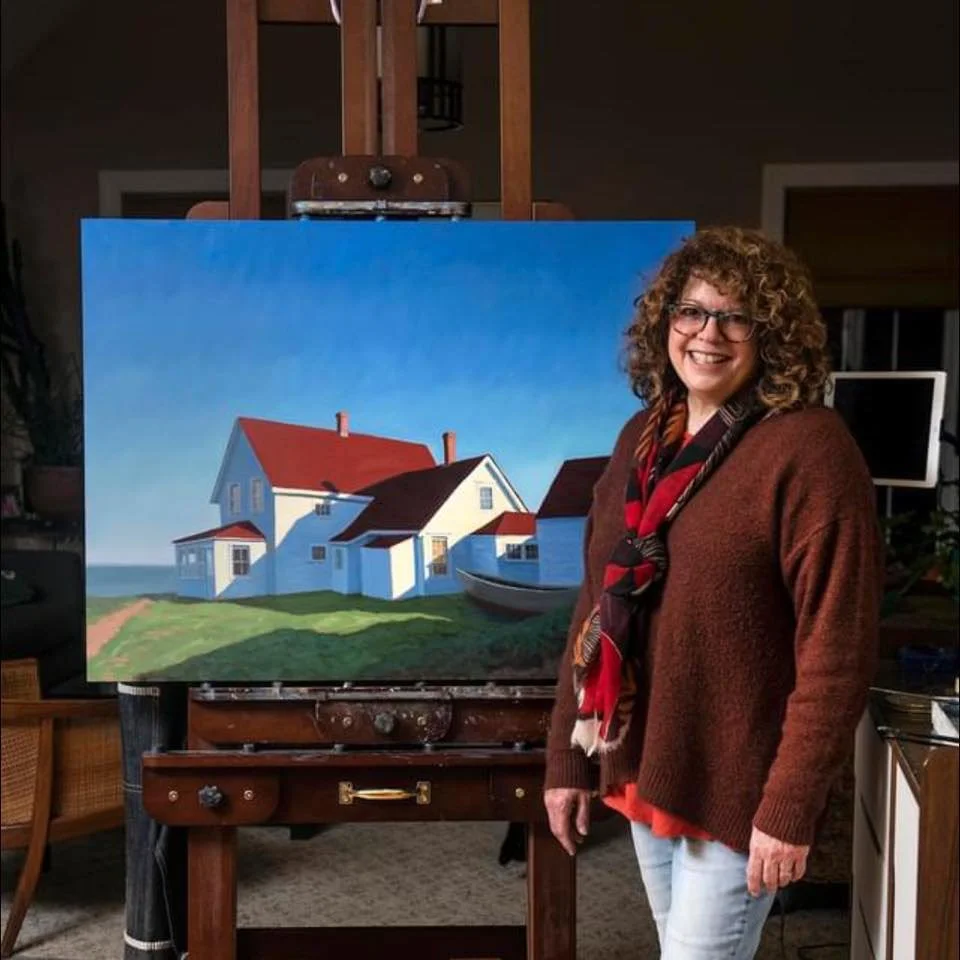
Debbie Mueller
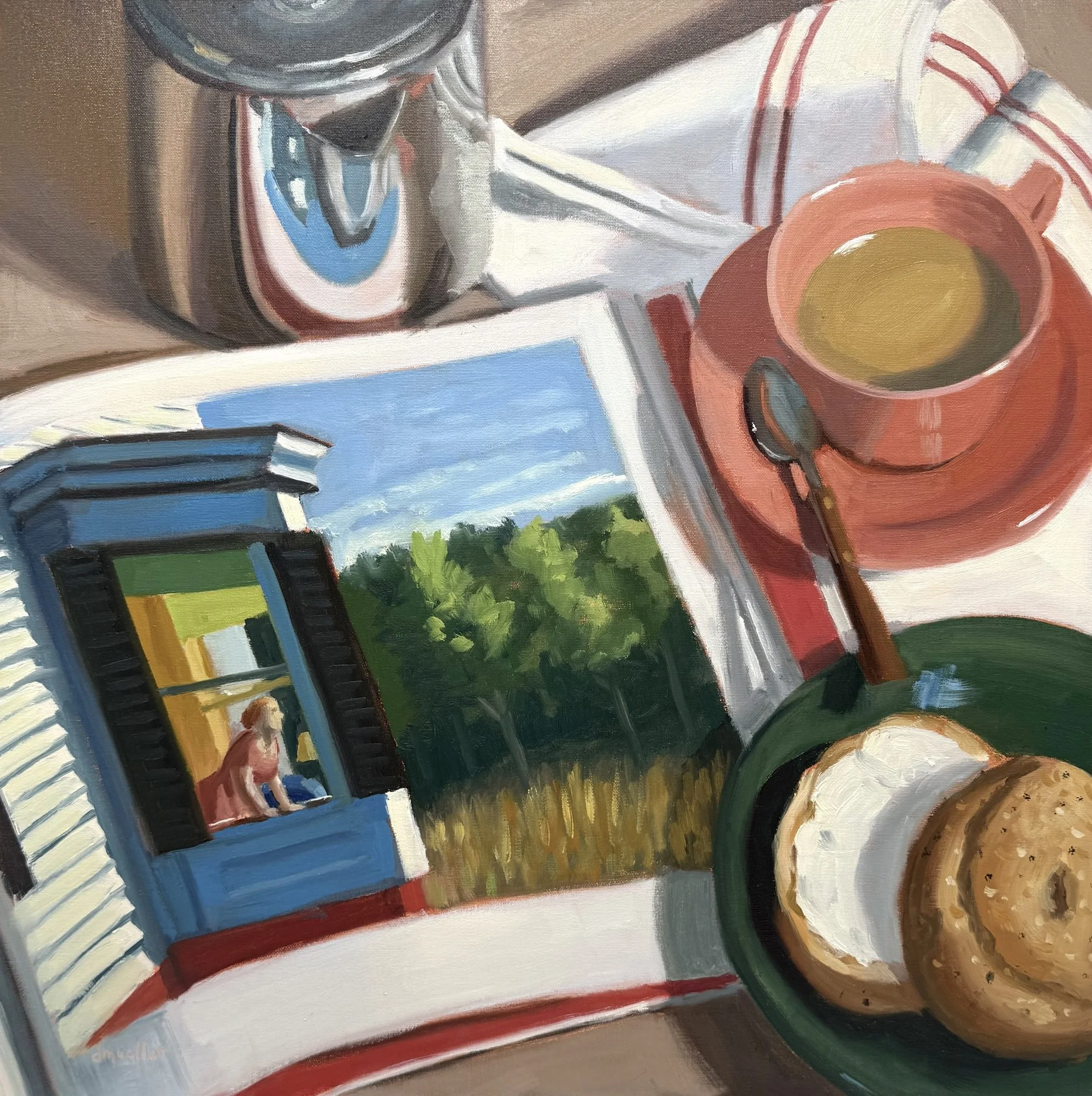
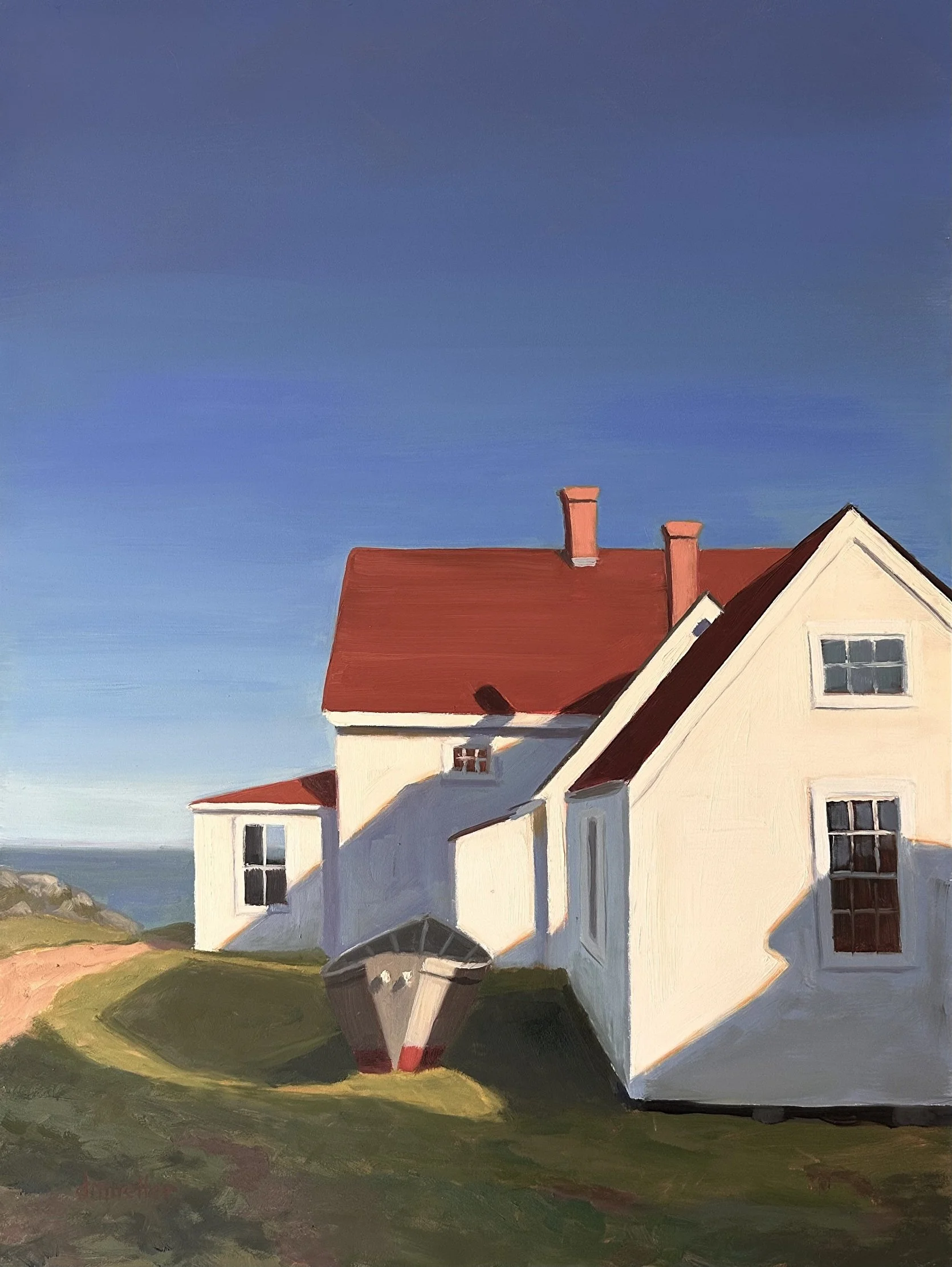
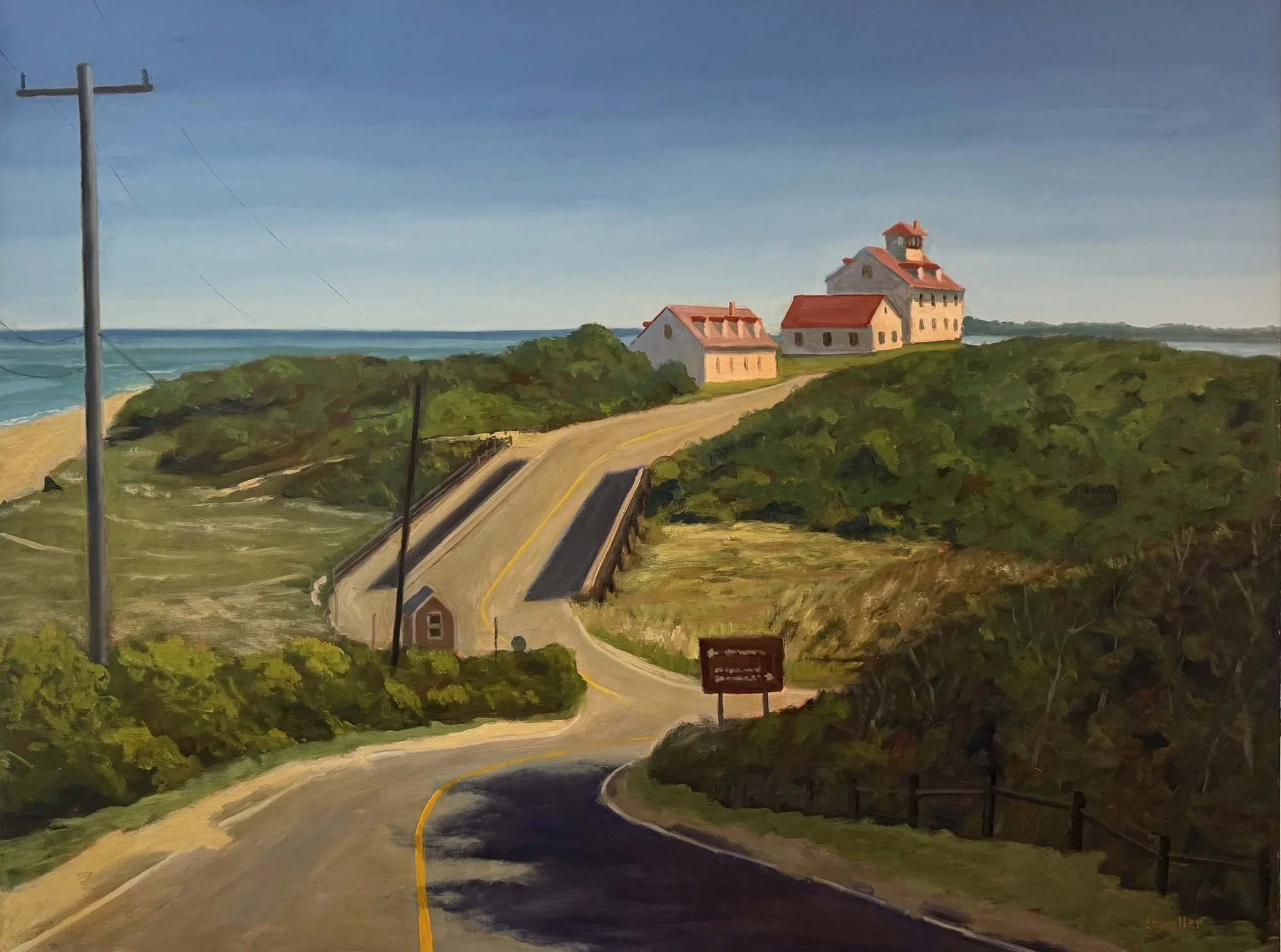
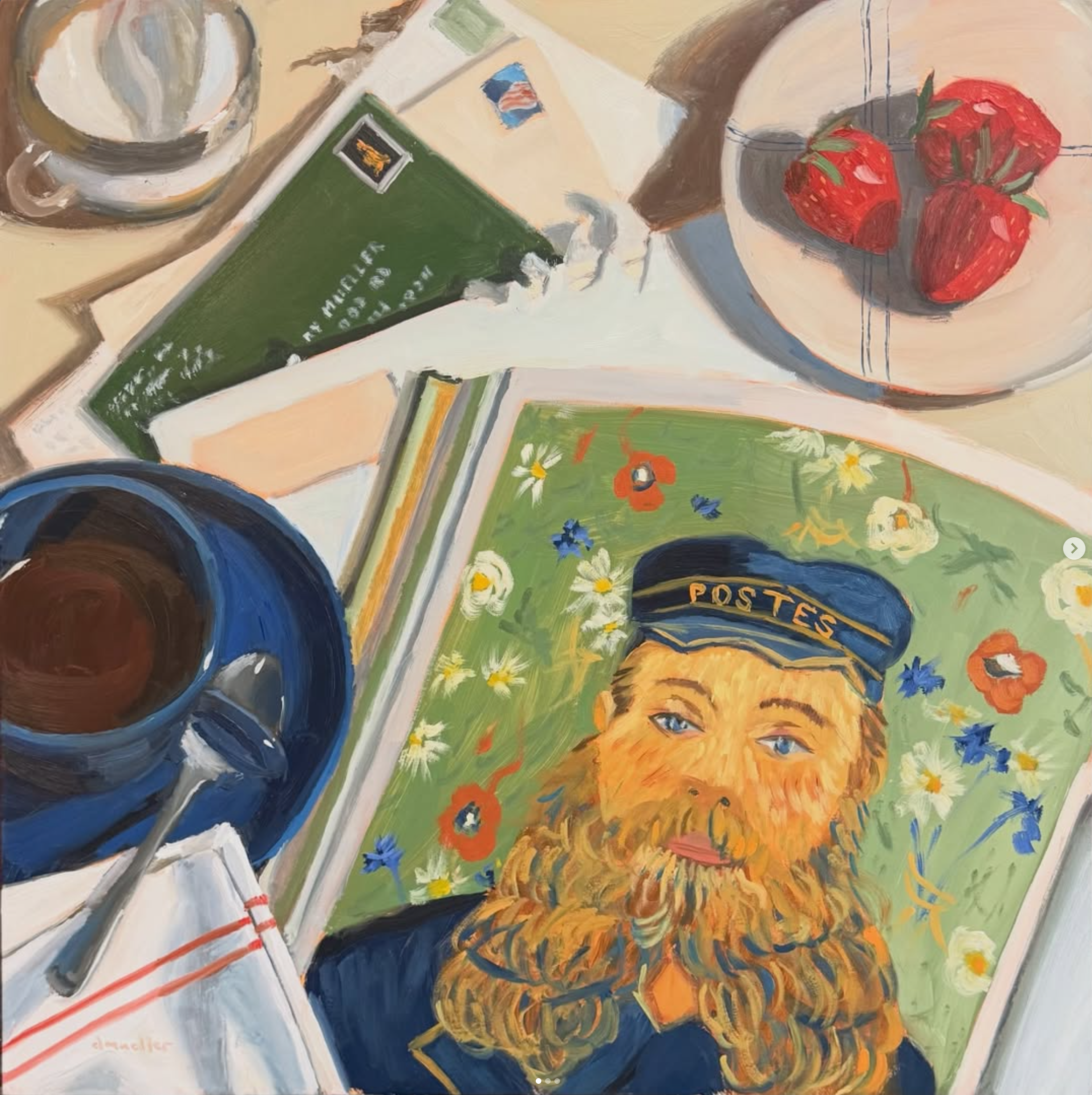
Click on the images above for a larger view.
Links
Debbie Mueller
Website: https://www.debbiemuellerart.com/
Instagram: https://www.instagram.com/debbiemuellerart/
Facebook: https://www.facebook.com/latebloomerartist/
Other Links
Strada Easel Challenge: https://www.stradaeasel.com/pages/january-2026-strada-31-day-challenge
Monhegan Island, Maine: https://en.wikipedia.org/wiki/Monhegan%2C_Maine
Oil Painters of America (OPA): https://www.oilpaintersofamerica.com/
Available on:
Apple Podcasts
Amazon Music
Spotify
YouTube
Transcript
A Note About This Transcript
This transcript has been edited for clarity. I’ve endeavored to capture the thoughts and expressions of my guest as accurately and truthfully as possible. In some cases this means completing incomplete thoughts, removing stammers and word fillers such as um, like, you know, and so forth. I’ve edited the transcript to make it easier to read. Please pardon the inevitable errors that I may have made or overlooked.
Carl Olson: Debbie, I'm long past overdue to have you on the Artful Painter. You were one of the first followers of the podcast. You were one of my supporters of the podcast very early in its history. And I have with much interest followed the development of you as an artist. So it is with great pleasure that I get to finally have you on The Artful Painter. Welcome!
Debbie Mueller: Thank you. I am so honored and so happy to be here. I love your podcast. I have listened to every episode. It's just a huge honor for me to be your next guest.
Carl Olson: Where are you based?
Debbie Mueller: I'm in Durham, New Hampshire, and I will share with you, we're recording this on April 7th and it is snowing heavily here. We moved here in 2005 from Connecticut. I've been in New England all my adult life. It's a beautiful area. We're close to the water, close to the mountains. It's lovely. I feel really lucky to be here. A lot of inspiration, for sure.
Carl Olson: Debbie, you've taken a very interesting route to art, which I think is a lot of us do. I came into it late in my life. just recently retired as a doctor.
Debbie Mueller: Yeah, a few months ago.
Carl Olson: How does that feel?
Debbie Mueller: It's been amazing. Definitely! But I have to say I didn't leave medicine because I was burned out or unhappy. I left a job that I absolutely loved. With the blessing of our financial planner, she said, this is a time that you could make a transition to being a full-time artist. So, I left on a high. I left loving what I did, enjoying my patients, enjoying my coworkers tremendously. That was really the only downside to that job. It is difficult and different to be mostly solitary now compared to when I was an OB-GYN where I saw typically 15, 20 patients a day and loved having those conversations. Now I'm mostly in my home. My studio is in my home. I can go days and days without getting in my car. So, it's a change, but I'm doing things to make sure that I'm seeing people, I'm seeing friends and creating community.
There's a really vibrant visual art community here on the seacoast of New Hampshire in this area. I tried to do this five years, six years ago, but we had a pandemic instead. I wanted to put together a monthly gathering of artists. Finally, we had our first meeting a few weeks ago and it was awesome. So, I have that to look forward to.
Carl Olson: What is the name of your group?
Debbie Mueller: Well, I don't think we have an official name yet, but it made me think of the Salon of Paris where these famous artists all coming together to commune and drink and eat and share ideas. And I wanted to sort of recreate that here. And it's happening. I'm really glad about that.
Carl Olson: The key is you took the initiative to step out and to meet people and to organize things where there could be some social interaction.
Debbie Mueller: I did. Because it doesn't happen by accident. It doesn't happen as much anymore. I think COVID made us all sort of forget how to be together in a way. It changed things. So, yeah, I was very intentional about that.
Carl Olson: I imagine history books will eventually talk about things we're still just discovering about the side effects of a pandemic that half the population thought was a hoax. I know it did me in. It's the reason I moved. It was the trigger of why I moved. The isolation was just, it was terrible.
Debbie Mueller: Humans are not meant to be alone. We live longer, we live happier when we're together. And so I understand that that's part of my new job in a way, to create community and foster that and make sure that I'm seeing people. It's not built into my day anymore. I have to make that happen.
Carl Olson: What was the genesis of your interest in art?
Debbie Mueller: It was quite by accident. So, I tell this story because there's so many people in this world that are, like, I don't have any artistic talent. I can't draw for beans. And I don't have that in me. And I truly would have said exactly the same thing.
Just about 10 years ago, we were visiting my parents who were spending the winter in Sarasota. My mom had always been a hobby artist. My dad was more of a craftsperson. And I totally knew that I took after my dad. I just didn't believe I had anything artistic in me. And it was raining one day. Everybody was bored and grumpy. And my mother said, I have some paint. Do you want to paint? And my first thought was actually to say no. I really wasn't interested. But I truly had nothing better to do. So I said, OK, very reluctantly. She had some acrylic paint. And for about an hour I painted and I made a really bad painting. I mean, I'm just here to tell you it was awful. But I loved the way I felt while I was doing it. And the next day I sort of sheepishly said, do think we could do it again? So, when I came home from that trip, I bought paint and started copying photos. I had no idea what I was doing.
After a couple months, I found a local class. And then it kind of all went from there. It probably wasn't four or five months before I knew that this was what I wanted to do for the rest of my life and do it with the same sort of passion and energy and focus that I had put into my medical career. So that was how it began.
Carl Olson: Nice! Do you still have that first painting?
Debbie Mueller: Yeah, it's right in the other room hanging on the wall. I like to show it to people because people think like I did assuming they could never do that. It is a learned skill and it is very doable.
Carl Olson: I still have my first painting. It's sitting right over here. I almost threw it away though, so I wasn't as noble as you. My wife saved it from the trash. She framed it and so I still have it. Worst painting ever!
Debbie Mueller: No, no no! Best painting ever! Because it sent you on that road. So, yeah, it’s truly the best painting ever.
Where it's been a challenge for me is that I didn't know how to draw and that's sort of my Achilles heel still. I'm still looking at paintings and going, oh, you idiot, the roof's not angled that way or the perspective's off... I'm learning ways to self-correct. I know my work is getting better, but if I make mistakes in general, it's in drawing. It's hard stuff.
Carl Olson: I would have never guessed that you would say that because a lot of your subject matter have a lot of complex lines and shapes.
Debbie Mueller: I take advantage of tools. The first tool that I use a lot is a mirror and a grid. I start with a grid in almost all of my paintings. I use my camera as a tool to make that grid from the point of view that I want. I use it to help me with cropping and just design. My first step would be to do a drawing using thin paint. Then, before I move on, I take my mirror and I look at it, or sometimes I'll take a photo and reverse it. Same kind of thing. It's like your eye seeing it for the first time and I'll look for mistakes there. Invariably I don't catch them. I do the same thing again after I've painted and I look either in the mirror, or by reversing, or both, and fix things at that point.
You talk to so many artists and they'll be the ones to tell you like, “when I was a kid, I was always drawing, I was always sketching, I was always copying” and I just never, ever, ever did those things.
I started drawing 10 years ago. I'm getting better, but I have to say, sometimes I feel a little guilty about still relying on those tools and that I can't just sort of look at a scene and sketch it perfectly. I mean, I probably could, not perfectly, but reasonably well, but it would take a long time and I'm an impatient person. So, I would rather use those tools and help me along the way and then get to the painting – to the fun part.
Carl Olson: I think one of the things that's important is to have a deep sense of self-awareness when it comes to our skills and what you're trying to do with painting. I think that's what makes a painter get even better, is having that self-awareness.
Debbie Mueller: I think one of the things we all have to learn as painters is self-critique, but without being overly critical, right? There's that fine line, you know. So many people are, like, “it's terrible! I made a horrible painting. I'm going to throw it out!” That doesn't help you grow. You really have to learn to be able to look at what your work in progress or even once you think it's done and ask, “Is it done? Are there things that are not reading the right way?” And then, of course, avoid overworking it too. I've been guilty of that as I'm sure everybody has, just trying to get that one spot perfect and then you look at it and it's like, ugh, it's just a mess.
Carl Olson: Yeah, I get it. I feel that way too. I probably do swing a little more to the heavy self-critique. I'm not where I want to be. I see what I want to do and then in the execution it's not quite where I want it to be. So, I just keep doing it.
I did a series not too long ago, painted nine little (6x8in) paintings of the same subject. I figured, well, it’s like a musician practices scales – we likewise need to practice drawing and painting.
Debbie Mueller: Did your paintings get better as you went on in that series? Do you feel like they improved?
Carl Olson: Some did, while some were over corrected. It was a surprising finding. I thought each one would be progressively better. That wasn't the case. The first one was OK. The second one was really bad. The third one was kind of in between. The fourth one was OK – I'm getting there. But I did nine of them. I was going to do ten, but they wouldn't lay out nicely on a table. It was an instructive exercise.
Debbie Mueller: One of the things that's been really good, I think, and I recommend it to so many people, is doing, the Strada Easel challenge. For people not familiar with it, the Strada Easel company, owned by Brian Mark Taylor–who is an amazing artist–started this challenge. They run it twice a year in September and January.
In the challenge, artists need to either draw or paint from life (from life, big underline) every day for the month and then post their work. You don't have to finish a painting every day. I do. It's just the challenge that I've given to myself. But boy, that's been a game changer for me. I mean, first of all, it's the whole reason I'm a still life painter. I hadn't done any still life before I did my first Strada Easel challenge. It made me fall in love with painting from life.
And it made me fall in love with what still life could be, which previously I had always thought of being like dusty wine bottles and old grapes and just, you know, not at all interesting. So, the fact that I've sort of landed there in a large part is very much due to that. But for sure, your skills will advance by doing a painting every day. And it's a great opportunity to focus on just maybe one thing. For example, maybe you're going to use a limited palette all month. I pulled out, for example, manganese blue, terra rose and all these weird colors that you might not typically use and ask: “what if I put these three together with white and come up with kind of a fun painting?” After doing that for a month it made me absolutely fearless about using a limited palette. Now I know I may not be able to make every color, but I can always make a painting. And so, it's just a great thing. Or maybe you think about edges. Or maybe paint the same subject all month long and do it a different way each day. There's so many ways to play with it, but it absolutely will help people grow as artists.
Carl Olson: How many times did you do that Strata challenge?
Debbie Mueller: I think I've done it eight times now. I only do it in January. I know some people who do it twice a year every year. They are absolute champions! January here is a long, cold, dark month so the challenge gives me something to look forward to. It's a great feeling to have a body of work at the end of the first month of a year and be able to look at that and feel good about that.
And then for me, it's been fodder for what do I want to explore further? For instance, there's a painting behind me. I had done a smaller version of that in the Strada challenge and then decided to make it into a larger painting. So, it's a good way to explore themes or things that you want to come back to and explore.
Carl Olson: I think an attitude I had to overcome was the feeling each painting had to be a masterpiece. But you can't have a masterpiece of the first attempt You've got to do it over and over again until you get there.
Debbie Mueller: If I do 31 paintings in the month, I'm really happy if a couple of them seem really strong to me. And there's always at least one clunker that you just want to hide away. But the rules are you must post it.
People have asked me, “How is being a physician informed your work as an artist?”
I do think after truly dealing with life and death decisions, [that clunker] is just a bad painting. It just doesn't compare in terms of the magnitude with what I've dealt with in my life as a physician. And so, if I make a bad painting, well… I'll tell you, it feels really great to scrape one off and paint over it and make it into something new again. It's a liberating feeling.
Carl Olson: Well, I appreciate you sharing that. I was going to ask you if there was any influence or impact from being a physician to how it shapes your approach to art…
Debbie Mueller: I do think both professions are very much right side, left side of the brain. There's this huge analytical piece, where you're trying to make a diagnosis or understand how to treat someone or calculate a medication dose – there's a lot that's analytical. But for me, there was also a lot that was more emotional. I had to have the ability to connect to people who are sometimes in their most vulnerable place and maybe revealing things to me that they had never told anybody, felt shame about. The conversations I would be privileged to have with people definitely were very, very emotional.
Art is the same way. Our analytical side is asking should our painting be lighter, darker, warmer, cooler. Is my drawing correct? All that analytical side.
But then there's ultimately how do I want this painting to feel? How am I going to manipulate it so that the viewer has an experience that gives them a moment of nostalgia or emotion or a recollection that hits home. So, I do think that they have that in common.
Carl Olson: You must have been and are a very empathetic person to your patients, the people that you talk to, and your friends. You seem like a person that would be very empathetic. That certainly adds depth to the emotional response to what you create and what you share.
Debbie Mueller: I think people's personalities come through in their work and I just don't think you can avoid it. It's funny because from maybe just a year or two after I started painting, people would say, your paintings make me think of Edward Hopper. And I was drawn to this sense of illumination. I think that's what they were keying in on. But when I look at his work–and I love a lot of his work–I've used a lot of it as I’ve seen in a lot of art books [about Hopper]. In fact, I have one over there. I'm always going back to his work. But I think there's a big difference. In his work, people talk about how lonely it feels and desolate and isolated and sad. And my work doesn't feel that way because that's not who I am. So,
I really do think that we can't really avoid our personalities coming through in what we do.
Carl Olson: There is a certain darkness to Hopper's work. When we think of Nighthawk, we wonder what is the conversation that's going on in that? There's a certain melancholy to his paintings. Whereas with your paintings, there’s a certain lightness, warmth to them. There is certainly a difference in your paintings compared to Hopper.
Debbie Mueller: Another difference is I don't put a lot of figures in my paintings. He obviously includes figures and they always look, I think, sad and somewhat awkward, so it's not my favorite aspect of Hopper’s work.
I've put figures in a few of my paintings, but I always feel like if you put a figure in, the painting becomes about that person's experience and that person's perspective. Whereas if there's no figure, it's all about the viewer. The viewer then takes ownership of that. The vista becomes part of the experience of viewing. I think that's part of why I like that sort top-down view that I use for a lot of my still life paintings. If you look at a traditional still life painting that say was at eye level on a shelf or something, someone could be standing to the right of you, someone could be standing to the left of you, and you all end up sharing that experience or that view. But if you're looking down on something, it becomes your own personal story, your own personal narrative, that that's your experience. Nobody else can really see that because you're right over it. So, I think that's why I'm drawn to that as well.
Carl Olson:’ You said you started painting about ten years ago. Did you have any guidance or training to help you shape your skills as a painter?
Debbie Mueller: Absolutely, and have continued since. At the very beginning, I found just a local introduction to painting class. And then I was able to find instruction with some local artists. And then I discovered workshops. My gosh, those were like summer camp for grownups! It is so fun to go someplace beautiful, learn to paint, be with other artists, and talk about art. My first workshop was on Monhegan. I think of it almost as my painting birthplace and I've gone back there almost every year since.
I would say that among the artists that had a really big impact was, first of all, Tim Horn. He's such an exceptional painter, and he's a really, really good teacher. I took several workshops with him, and then I studied with him for about a year via Skype to further develop my skills. And then the other person that I worked with just until recently is Sarah Sedwick, who is just a brilliant still life painter and an exceptional teacher. She has a mentoring program and I did that for a number of years. She’s got such a good eye in terms of offering critiques. I learned a lot through her.
I would like to up my landscape painting game a little bit. So in the next couple of years, I will try to find a good landscape workshop from someone who I want to learn from and obviously go to places I also want to go and visit – kind of two birds, one stone.
I can't imagine a time where I'll ever say I'm done learning. You know, we're always learning. And oftentimes it's really helpful to have someone's expertise that's different.
Carl Olson: I think that's important. Where I live now, I have close access to artists I have deep respect for, and they've been very helpful offering suggestions. We're just friends having coffee and comparing notes. That's really helpful. And it's without the pressure of being around a bunch of people in a workshop setting.
Debbie Mueller: Everybody's different about that. In that regard, I tend to have a thick skin. I don't mind being in a workshop. We're all there to learn. I also started teaching workshops about two years ago. So, I'm very aware that people have different learning styles and different emotional responses to that sort of thing. And you have to be really careful. I mean, we've all heard these horror stories, right, of artists whose soul was crushed by an awful teacher. I never want to be that teacher. You must find compassion and help somebody without knocking them down.
Carl Olson: I had one of those experiences. I think I've mentioned it on the show before where I wanted to be a trumpet player and I was taking lessons from one of the trumpeters of the Atlanta Symphony Orchestra. He just told me I had no talent. I was crushed so I went home and never played again. To this day I don't like being in public. I have to practice almost privately. I know I need to overcome that insecurity. I'm exposing my soul to the world, but here you go.
Debbie Mueller: That's okay. Rejection is a part of what we do and it's hard and some are harder than others and yet you still have to pick up have a 24-hour pity party and then move on. That is one of the bigger challenges.
Carl Olson: I certainly throw a good pity party!
Debbie Mueller: My last one involved limoncello cake!
Carl Olson: Limoncello cake sounds good, but how did that pity party for you come about?
Debbie Mueller: Well, okay, I’m bearing my soul... So, I've been involved in Oil Painters of America for quite a few years now. And I've been fortunate enough to have enough acceptances into their national and regional shows that I earned signature status this year. I feel extremely proud of that. I'm just like this [OPA Signature Status] and graduating medical school are like the two things that are on a par with each other. Exciting!
And so, I was planning on going out to Steamboat Springs, Colorado, to go to the Oil Painters of America National Convention this year. And I thought it would be so awesome to have a painting accepted into that national exhibition. But my painting was declined, rejected! I did not get into that show. And that was the one I really was excited about for this year. And so that brought about the limoncello cake. And then I got a couple of other rejections in the same week. It was disappointing and you move on. But the OPA rejection stung. I'll keep applying. I'll get in someday. It's not going to knock me down for good. But I was, you know, I really wanted that.
Carl Olson: Well, you learn from these, right? There's a lot of subjectivity to these things too.
Debbie Mueller: I don't know if you've ever seen the shows. The quality of the work is just exceptional. So, it's not like I would never say they made a bad choice. I am sure that the work that they accepted is absolutely amazing. And I just understand that I have to submit better work, that I have to work harder. And I will.
Carl Olson: I imagine if they had 250 submissions and they're going to display 100, those 250 submissions were probably pretty good.
Debbie Mueller: I think they get thousands of submissions and they probably take 150 or 200. I've always known that they could probably double the size of the show and there'd be at least another same number that are of adequate quality that could have been in two. Ultimately, there's something subjective, but like I said, I'm sure that the work is going to be just absolutely inspiring. It always is.
Carl Olson: When is that show?
Debbie Mueller: That is at the end of May.
Carl Olson: I may have to swing up there and see that.
Debbie Mueller: Oh, you should take a drive. Yeah, do a little overnight.
Carl Olson: Have you ever been to Colorado?
Debbie Mueller: Yeah, years and years ago I skied out there, but I went to Vail for a medical conference. I haven't been back in many, many years. So I'm looking forward to it. I told them I would help set up the still life room, but I've got to get outside and paint. I have never painted mountains like that. I know that you've talked about how much green there is in Georgia, and there's just about that much green in New Hampshire. There are almost no places where there are these long vistas of where you see aerial perspective. There are very few places here where you see that. Mostly you just see green. Unless you're at the ocean and then you see green and blue. I'm excited to just be in a completely different landscape and hopefully get outside a bit and paint plein air.
Carl Olson: Do you do outdoor painting a good bit?
Debbie Mueller: I love painting from life. I really do. And I think that's why I like the still life so much because not only can I paint from life, but it doesn't change after two hours and I can move things where I want them and that sort of thing. Plein air painting is so challenging. My very first plein air painting - I lugged my full-size French easel out into Portsmouth and dragged it far from my car. I was such a newbie! And I set it up and I decided I was going to paint this view from what's called Pierce Island. It's part of Portsmouth. And there was this island in the middle of the water and a bridge and a house beyond it. I looked up at one point and the island was gone! The tide had come in. I'm looking at my painting and thinking what do I do? There's no more island!
However, I really do enjoy plein air painting. Increasingly, I'm thinking of them as studies more than finished paintings. I mean, some of them are good enough to be able to call finished. But my goal is have that full sensory experience of being in a place, hearing it, seeing it, tasting it, remembering the temperature and the wind, and who I was with and capturing that in paint.
So, I talked about Monhegan. Painting there is just one of my absolute favorite things to do. Now, I go back every summer with a group of friends and we paint three, four paintings sometimes a day. The amazing thing about being there is it's this tiny island. It's 10 miles off the coast of Maine. It's about a mile and a half long and maybe three quarters of a mile wide. There's no pavement. The only vehicles on the island are the trucks that are owned by the businesses that are on the island. They bring them there by a special boat. You can get to it by ferry, but there's no vehicles allowed on the ferry. It’s completely walkable. The mainland side of the island has a harbor where the ferry comes in and fishing boats are there and there's a little beach for swimming. On the ocean side of the island are these tall 200 foot cliffs that are just spectacular with the surf breaking at the bottom. There's a network of trails so hikers go there, birders go there. And for painters, it has hardly changed in the last 150 years. You can find paintings by Edward Hopper, Rockwell Kent, the Wyeths. Jamie Wyeth actually has a home on the island and spends time there. There have been so many different, just exceptional artists, that have painted it. You look at their work and you're, like, yep, I was on that spot. I stood right there. You truly feel like you are in the footsteps of your idols and your painting heroes when you go there and make these paintings.
Carl Olson: Have you ever been to the Olson House?
Debbie Mueller: In Cushing, Maine? Yes. After taking a workshop in Rockland, Maine, I decided to go see it. It was almost a spiritual experience, I have to tell you. I drove down there but it was closed. I guess it's been open at times in the past for visitors, but it was completely closed up when I went. I could look through the windows and just sort of see these empty rooms. There was a very old couple – they had to be in their 90’s – that were there when I first arrived and they were picking up apples that had fallen from the orchard right outside the house. I wondered had they known Andrew Wyatt? They were contemporaries, probably. It just made me wonder about them. And then I wandered down into the field from where he had painted Christina's World. At the base of that, close to the water, is a graveyard and that's where he's buried. I spent some time there looking at the gravestones, the Olson family, and the Wyeth’s and looking back up towards the house which looks exactly the same. And then I came home and I did a painting. I mean, it included his gravestone and then the house in the background and sort of the same view and. I did the painting to mark that memory for me. It wasn't that I thought anyone would ever want that. But it really gave me a sense of how honest he was in his work, how personal it was, and how important that is to have that integrity in what you do. So yeah, it was powerful. I recommend people visit.
Carl Olson: My wife and I visited it many years ago and we found it much the way you did. The only difference is there was a great big horse standing right there at the entrance of the house. I got pictures of that horse next to the house. We did the same thing, looking in all the windows and walking the field and the graveyard.
Well, you've come a long ways in 10 years with painting. So I just saw that you were in American Art Collector Magazine.
Debbie Mueller: Yes. I've also had some paintings in Plein Air Magazine and Fine Art Connoisseur as well. Yeah, it's exciting! I always tell people no one's more surprised about this than me.
There's a little bit of imposter syndrome, of course. I guess we all have it. I'm learning that, that everybody goes through it and it's like, someone made a mistake. It's just me. But yeah, some really, really wonderful things are happening. For example there was a still life story in American Art Collector in January and the artistic director of the Quinlan Visual Arts Center in Gainesville, Georgia, saw that and contacted me. I'm going be doing a solo exhibition there in the summer. So, I'll head down there and have a show and teach a workshop and do an artist talk. Good things have happened from this kind of publicity. It feels lovely to see your work in print, but then opportunities come and that builds experiences, builds your network, gives you a chance to see new parts of the world. And it's just all been truly lovely.
Carl Olson: Well, I'm happy for you. I really am. I just think this is amazing. It's been fun following your story. It's been inspiring to me.
Debbie Mueller: Thank you. I want people to know it is never too late. People should always feel like if there's something they want to try that they go ahead and do it.
Carl Olson: You said you going to teach a workshop in Georgia. What will the workshop be about?
Debbie Mueller: I'll do a still life workshop. Learning to paint is sort of like learning how to ski. They tell you 17 different things to keep your mind on and to make sure you're doing. And of course, you can't keep them all in your head at the same time.
My process when I paint is to really focus on one thing at a time. First, I think about design.
I never design on the canvas. I do all the work through photography. Not so much like Photoshop. I'm not smart enough to use Photoshop, but I set up a still life. I take a picture. I decide what's working and what's not. And then I change something. And then I take another picture and I just keep working in that way. Then I focus on drawing. And like I said, I'll draw a grid and do a drawing on the panel.
Then I think about values. I use transparent red oxide to denote the values in my painting so that I have sort of a guide map to follow. Then I think about color. I premix my color. I do sort of the light and shadow shade of all of the major shapes that I'm painting.
After I mix, then I'm thinking about brushwork. And so then I'm applying paint and being thoughtful about how I apply it. And then I take time at the end to really think about edges, because edges, I think, are what make the biggest difference in terms of sort of elevating a painting. And if you don't think about them, most edges go down hard. And it's just not as interesting an experience to look at a painting with all hard edges. So, I take that time to then just think about my edge work.
In my workshop I break that process down for students. They do a still life painting the first day that I've set up for them. We go through all of that in a PowerPoint, too. On the second day, they do their own composition with objects that we'll supply. They then create a painting from beginning to end on that second day. Afterwards we'll do a little critique. But using that kind of like monotasking instead of multitasking. It's just been a good process for me.
Carl Olson: I think your students will benefit from the lessons that you share with them there.
Debbie Mueller: I hope so. And of course though we do it with still life, it can also be done for landscape, for portraiture. It can be used for any subject.
Carl Olson: Exactly. I hope while you're down there that you might have enough time to go to the Booth Western Art Museum. I think Cartersville is about 60 miles from Gainesville. It's worth a side trip.
Debbie Mueller: I'd very much like to do that. I've heard so much about it. That would be well worthwhile.
Carl Olson: And while you're there, you can check see some of the workshops the Booth hosts. I think it'd be nice if you became part of their roster.
In Newnan, Georgia, there's Three Heart Farm. They also do classes. The owner - Meredith - has actual paintings by Wyeth in her home. A few years ago, she showed me some of the paintings in her collection and I thought, man, this is incredible. I'm seeing some of Weyth’s work in a non-museum setting. And she had Mark English paintings in her collection and, well, I'm getting carried away…
Debbie Mueller: That's amazing. That's extraordinary. Wow. I was never much of an art collector until I started painting and now I love buying other people's work.
Carl Olson: I have a small collection, too. I get two things out of it: First, is inspiration. And second, I get an art lesson every time I walk by it. I love being able to see how other artists speak through their paints.
So, what's next for you as a painter?
Debbie Mueller: Well, this year is a little bit, like I said, of an experiment because it's only been a few months since I stopped working at my medical job. I'm trying to understand what the right balance is of teaching and painting. I have three new galleries this year. I’m trying to decide how to balance everything.
I love plein air painting. I'll be doing a plein air painting competition in June up in Nova Scotia. I've never been before, so I'm very excited to do that. There are a couple of other smaller plein air events that I’ll participate in. So, I’m just trying to understand how to use my time. I'd like to expand gallery representation to places that don't get really cold and nasty in the winter. Most of my galleries are in New England.
I'd certainly love to be in Florida or Charleston or Santa Fe or California just because the galleries that I'm in are very much seasonal. Some of them even would close in parts of the winter. That's a goal. I feel like I'm going to give myself this year to kind of do what's happening and then reassess and figure out if I have the balance right.
I feel so blessed. I feel so fortunate to be doing what I love. And I'll tell you a secret, artists in general are way nicer than doctors. Like I have met so many nice people. I have made such amazing friendships since painting. And so life just seems really rosy, like really, really good.
Carl Olson: That’s wonderful to hear. I'm still adjusting after all these years of giving up my business and moving to Colorado. It is a challenge, but it's a rewarding one. I'm telling you: you're in for the ride of your life. It's a good one!
Debbie Mueller: I haven't been bored yet, so there's plenty, to keep me going and no lack of inspiration.
Carl Olson: Debbie, there's so much more we could talk about, and I’ll have to save that for another time. I'm a little bit starstruck here talking with you.
Debbie Mueller: Well, me too, because I just love your, the way that you can guide a conversation in such a skillful way with the people that you talk to. It's just, like I said, I was sad when the podcast went on pause and I was delighted when it started back up again. So yeah, thanks for being here. And thanks for having me.