Inherited Legacy
Episode 80
Episode length: 1 hour and 21 minutes
I originally invited Clint McCall on The Artful Painter because I wanted to talk about the preservation of Edgar Alwin Payne's legacy—and particularly the extraordinary work his father, DeWitt McCall, did to preserve Payne's work and ideas. But like many things I start to explore, things took an interesting, unexpected turn. What really surprised me was Clint himself. I was struck by Clint’s humility and modesty. Often I would ask Clint a question, and he would humbly defer to his father as the real expert and authority. He readily acknowledges that his father was the real art expert. As we talked I began to realize that Clint’s story is just as important as that of his father.
You see, art wasn't in Clint McCall’s wheelhouse. Even though he as a child was thoroughly exposed to the art world by his father and his father’s gallery DeRu’s Fine Art, he chose to follow a different path. Initially, he had no intention of following his father into the art business. He spent his career in law enforcement on rose through the ranks. Indeed, he could write a book on his many exploits and accomplishments in law enforcement!
Clint’s father was unexpectedly hospitalized in 2020. Sadly his father did not survive. Upon his father’s sudden death, Clint inherited an extraordinary legacy built by his father over the course of several decades. He could not turn his back on what his father had built. So, Clint now found himself becoming the steward of his father’s legacy. That remarkable legacy included all of the paintings, books, photography, and detailed records that DeWitt McCall had gathered and curated. For more than five decades, DeWitt McCall was deeply involved in the preservation, restoration, authentication, and promotion of Early California Impressionist art – including Edgar Payne. His relationship with Edgar Payne's daughter, Evelyn Payne Hatcher, eventually led him to become the representative of the Payne estate and the steward of Payne's influential book, Composition of Outdoor Painting. For Clint, it was a huge, daunting job! However, Clint quietly stepped into that role, not by pretending to be his father, but by figuring out how to preserve what his father built.
In this episode, my conversation with Clint ranges from his father DeWitt McCall’s beginnings as a framer and craftsman to his work as a restorer and art dealer; from Clint's childhood memories of the De Ru’s Fine Art gallery to his first meeting with Evelyn Payne Hatcher; and from the challenges of authenticating Edgar Payne paintings to the responsibility of keeping Payne's teachings alive for another generation. Clint shares some wonderful personal stories—including the story of an Edgar Payne painting he encountered as a young man without fully realizing what he was seeing, the index-card archive his father kept on thousands of paintings, and the remarkable collection of objects from Edgar Payne's studio that Clint still has today.
So in this edition of The Artful Painter, while my original focus was to talk about the legacy of Edgar Payne—I end up exploring something much deeper and personal: what happens when an unlikely person inherits the responsibility for keeping an artist's legacy alive. These unexpected turns in conversation are the gems I look forward to uncovering when I interview someone. Talking with Clint was no exception. This episode is a human story. It’s about inheritance, responsibility, an unexpected calling finding yourself the custodian of something much larger than you could have ever imagined!
This is Clint McCall’s story.

Clint McCall
Links
Clint McCall
Website: https://derusfinearts.com/
Instagram: https://www.instagram.com/compositionofoutdoorpainting/
Books
Composition of Outdoor Painting | Edgar Payne: https://amzn.to/4ggj9ty
Edgar Payne - The Scenic Journey | Scott Shields, Lisa Peters, Peter Hassrick, Jean Stern, Pat Trenton : https://amzn.to/4xjTE26
The Payne's: Edgar and Elsie : American Artists | Rena Neumann Coen: https://amzn.to/4gkpdkU
The Drawings of Edgar Payne, 1883-1947 | Evelyn Payne Hatcher: https://amzn.to/4zqZ9NH
Edgar Payne, 1882-1947 | Goldfield Galleries: https://amzn.to/4hNOVRb
Edgar Alwin Payne and His Works | Antony Anderson, Fred Hogue, Stendal Art Galleries: https://theartfulpainter.com/edgar-alwin-payne-and-his-works
Other Links
DeWitt “De” McCall III: https://derusfinearts.com/dewitt-de-mccall-iii-bio/
Elsie Palmer Payne: https://store.sternfinearts.com/elpapa1.html
Eva Matysek | Fine Art Restoration: http://www.evamatysekartrestoration.com/
William Wendt: https://lagunaartmuseum.org/in-natures-temple-the-life-and-art-of-william-wendt
Frank Cuprien: https://lagunaartmuseum.org/frank-cuprien-for-the-love-of-the-sea
Carl Moon: https://americanart.si.edu/artist/carl-moon-3386
Mason Cole Williams: https://skidmorecontemporaryart.com/about-mason-cole-williams/
Alfred R. Mitchell: https://en.wikipedia.org/wiki/Alfred_R._Mitchell
Laguna Art Museum: https://lagunaartmuseum.org/
Los Angeles County Museum of Art: https://collections.lacma.org/
Pasadena Museum of California Art: https://en.wikipedia.org/wiki/Pasadena_Museum_of_California_Art
The Huntington: https://www.huntington.org/collections/mus-290
Mason Williams: https://www.masonwilliamsart.com/
Matt Smith: https://theartfulpainter.com/artful-painter/matt-smith-2
Ralph Oberg: https://theartfulpainter.com/artful-painter/ralph-oberg-1
Frank Serrano: https://theartfulpainter.com/artful-painter/frank-serrano-61
Len Chmiel: https://theartfulpainter.com/artful-painter/len-chmiel-12 and https://theartfulpainter.com/artful-painter/len-chmiel-42
Christine Lashley: https://theartfulpainter.com/artful-painter/christine-lashley-9
Available on:
Apple Podcasts
Amazon Music
Spotify
YouTube
Transcript
A Note About This Transcript
This transcript has been edited for clarity. I’ve endeavored to capture the thoughts and expressions of my guest as accurately and truthfully as possible. In some cases this means completing incomplete thoughts, removing stammers and word fillers such as um, like, you know, and so forth. I’ve edited the transcript to make it easier to read. Please pardon the inevitable errors that I may have made or overlooked.
Carl Olson: Where do you live, Clint?
Clint McCall: I live in a rather newly developed area and it's so hard to explain to people if you don't really know Orange County. But it's off the Ortega Highway inland from the mission is probably the best way to describe it.
Carl Olson: I see there are paintings behind you. Are they part of your collection?
Clint McCall: Yes. The the one on the wall is an Edgar Payne that I picked up about six months ago. It came out of Jerry Bruckheimer's collection. My dad actually sold a lot of paintings to Jerry Bruckheimer and he has a ranch in Ojai. I found this at an auction house and actually my dad knew the auctioneer. I was fortunate enough to get it. They told me this painting came from the Bruckheimer’s.
And that little one up there is an Alfred Mitchell. It's Montezuma's Canyon where the Indians built caves into the rocks.
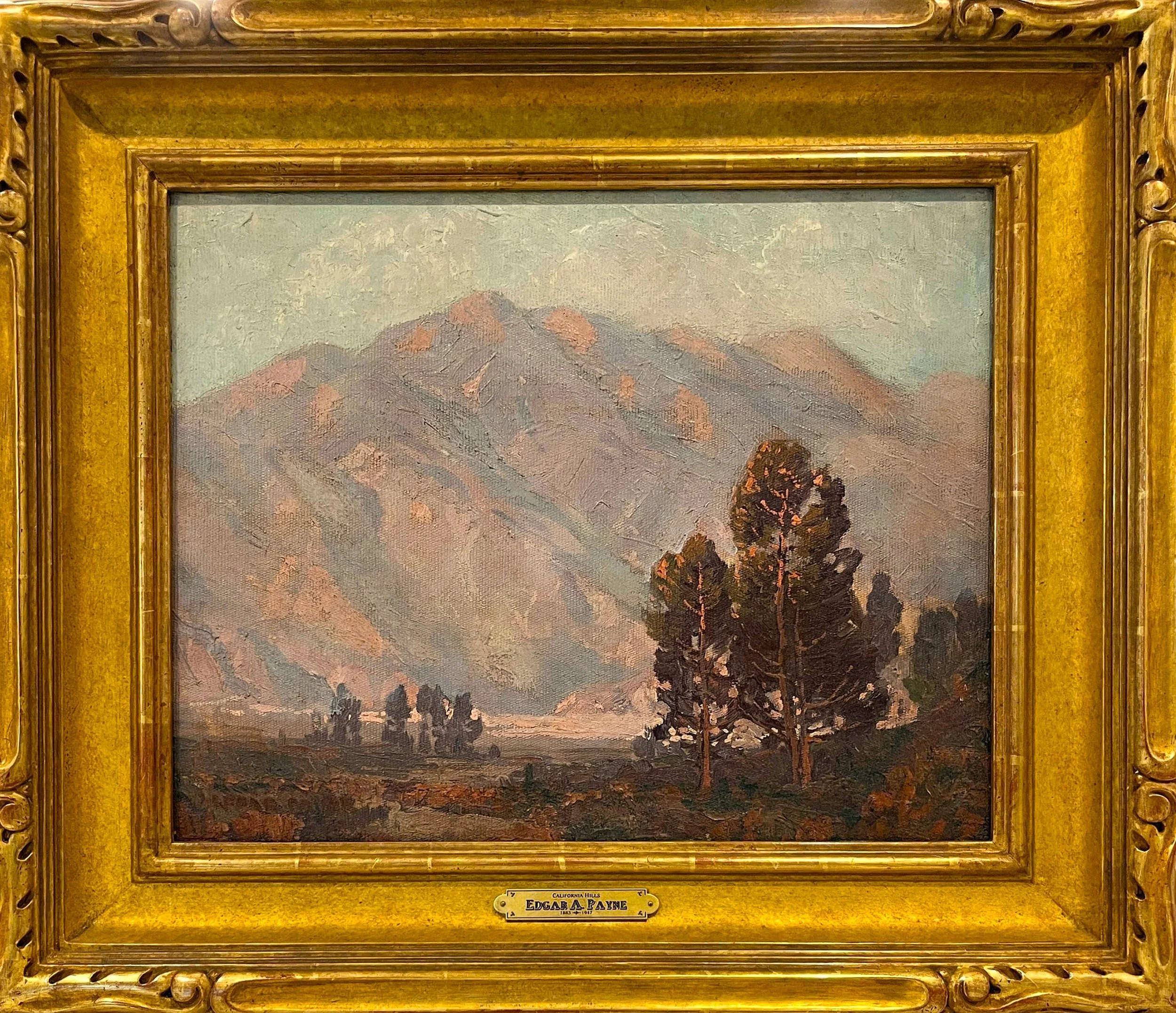
California Hills | Edgar A. Payne | Collection of Clint McCall. Originally from the collection of Jerry Bruckheimer.
Carl Olson: Those look beautiful just from my Zoom window here.
Clint McCall: I learned a talent to clean them up and find the right frame. So I'm fortunate that I learned that from my father.
Carl Olson: Your father was an interesting man and I'd like to talk about his heritage – especially his preserving the California Impressionist painters and especially Edgar Payne's legacy. You have since inherited that since your father's passing a few years ago. Now you're carrying the torch.
Clint McCall: I'm carrying the legacy on, hopefully, the best that I can.
Carl Olson: Tell me about your father and what you remember of him being involved in the arts.
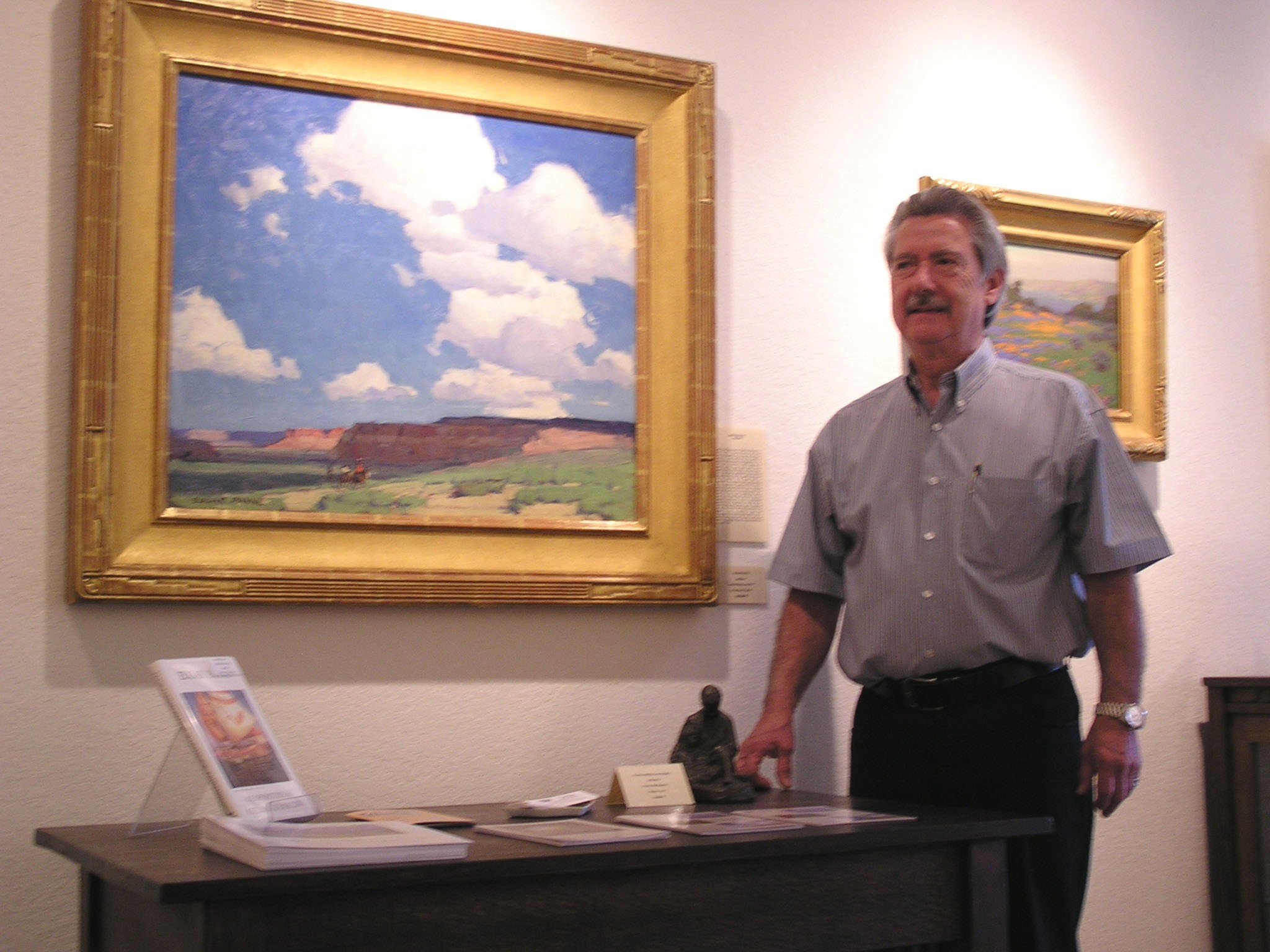
DeWitt McCall, founder of De Ru’s Fine Art
Clint McCall: He had an artistic skill. My dad was born in 1936 in a suburb of Los Angeles, in the post-depression era growing up. He served in the army when the United States was occupying Germany post-World War II. We lived near Long Beach, which there were a lot of defense contractors there.
He got a job at McDonnell Douglas where he carved the wood interiors of planes.
Carl Olson: What do you mean? You mean like the interior furnishings or was it structural?
Clint McCall: It was the the finish work, the wood where you would sit in the cabin – that's that's what he did. He carved a lot of the wood and built the interiors of the airplane. From there he became a taxidermist. I don't have any of his mounts, but I have photo albums of all the the mounts that he did. And again, that's an art, too. It's an art form. This was back in the sixties and it was a lot more popular then, of course, than it is today. You virtually don't see that anymore in California.
From there in 1968, he started the business, De Ruse Fine Arts, out of the garage of our home. I was three years old. For several years, he worked out of the garage, framing paintings and pictures. If he could put something in a frame and sell it, he would. That's how he got his start.
And he met one of our neighbors named Ken Jones, and the two of them formed a partnership, and they went in together and invested in a commercial building in the city of Bellflower. We were living in the city of Bellflower at the time, and the commercial building was about a mile from our house.
They started out in a small building and over the years purchased additional properties, including a residence. It was essentially by the time he passed in 2020 a large compound of buildings that became DeRu’s Fine Arts. In the mid-nineties, he purchased a commercial building in Laguna Beach and opened the Laguna Beach location of DeRu’s Fine Arts.
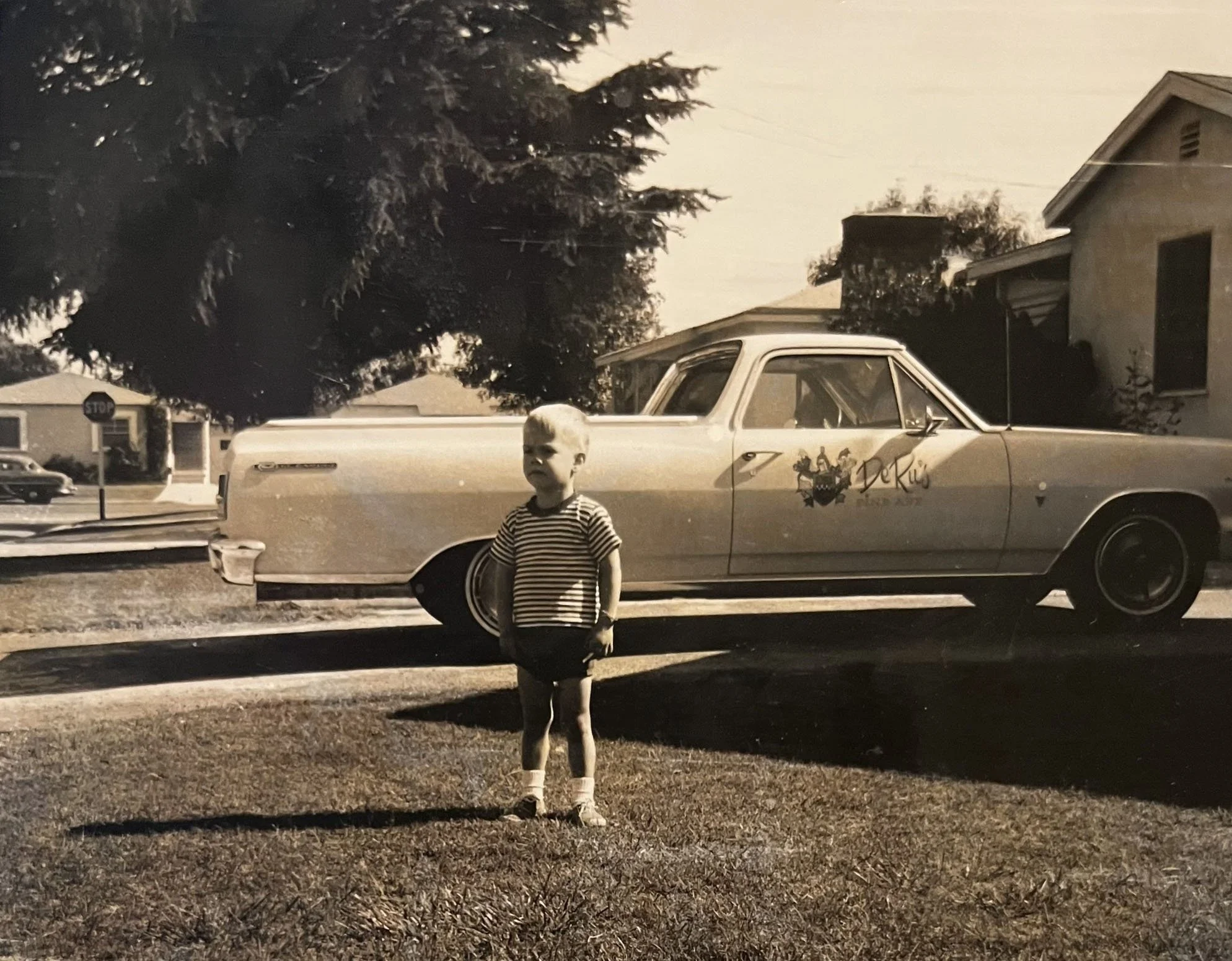
Clint McCall
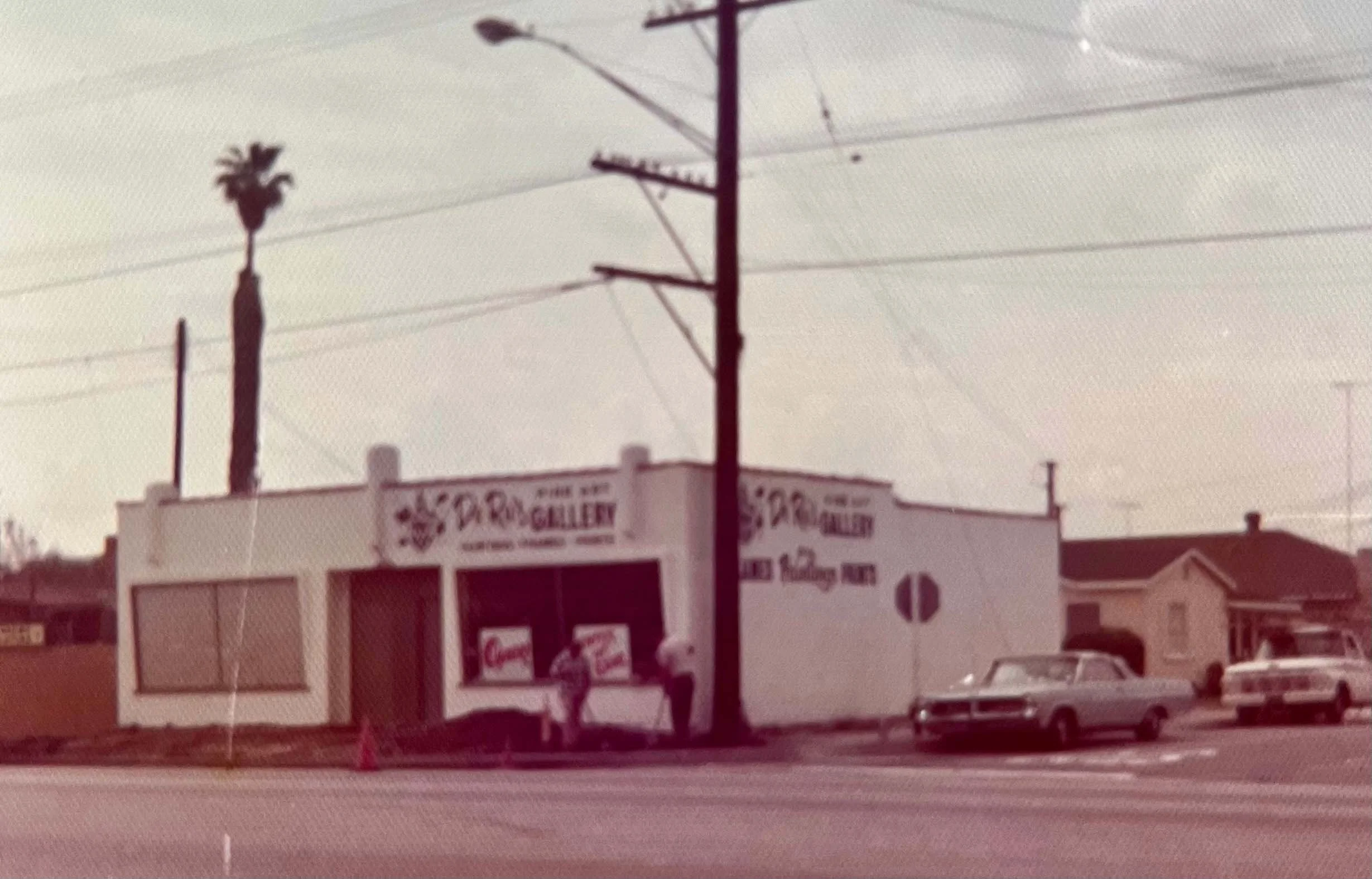
DeRu’s Fine Art in Bellflower, California.
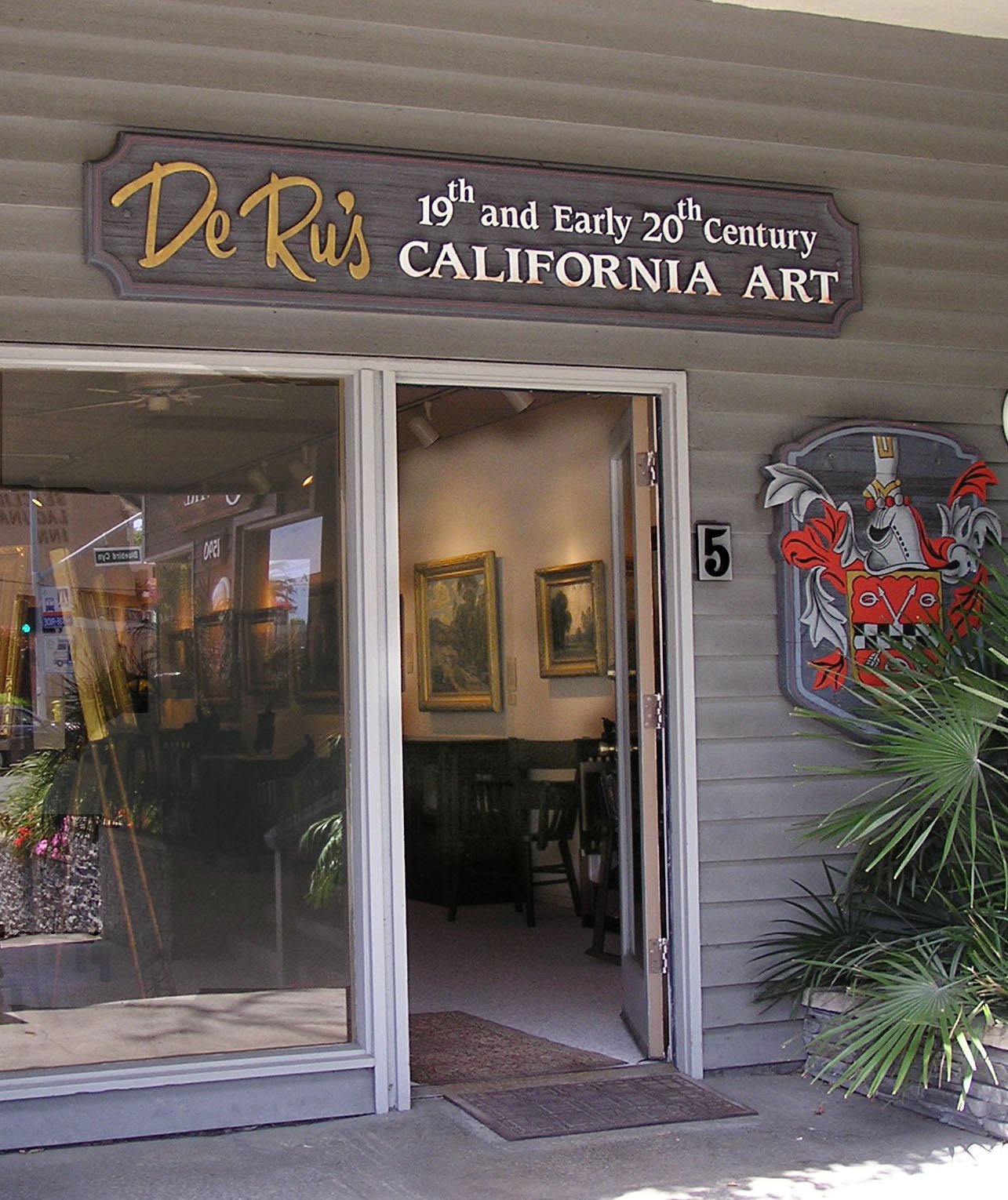
Storefront of Laguna Beach Location of De Ru’s Fine Art
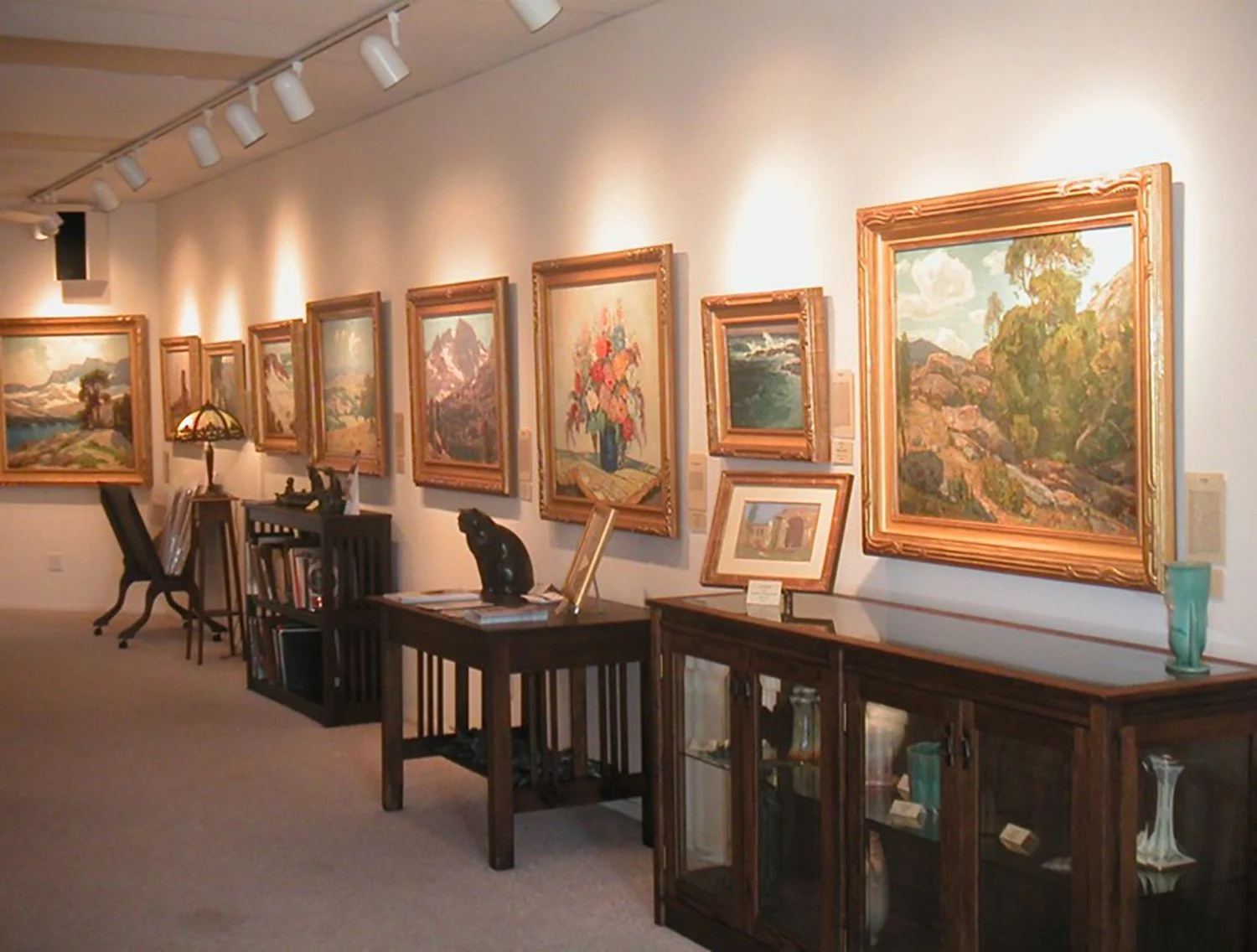
Interior of Laguna Beach Location of De Ru’s Fine Art
Carl Olson: The Laguna Beach location was probably the one that most collectors would have thought about?
Clint McCall: Well, I think the Bellflower building stayed iconic. So the Laguna Beach location served more to local traffic because Laguna Beach is such an iconic artist village. But the Bellflower location really served as the nuts-and-bolts location.
One of the buildings he developed into the restoration room where he would restore paintings – paintings that were just completely thrashed and destroyed. He could bring those paintings back to life with a state-of-the-art restoration technique he learned from a master many years ago when I was a child. His restoration technique is an art in and of itself.
Carl Olson: Clint, did you ever stand beside your father and just watch him do this work or participate in what he was doing?
Clint McCall: Well, much like many family businesses, on Saturdays and most Sundays, I would work down at the gallery. I started sweeping and cleaning. I learned how to cut mats. I learned how to cut glass. I learned how to build frames. And, I learned how to frame pictures and paintings. But, I never learned the restoration technique.
I still have vivid memories of when I was a child of the master that he learned from: Clive Hollinshead. We lived in Bellflower, and Clive lived in San Juan Capistrano in a ranch-style home. I would drive down with my father while my father learned from Clive. Clive had a big property with lots of animals and I would go out and play with the animals. Then I would come in and watch my dad and Clive for a while. So, I have very vivid memories still.
Carl Olson: Sounds like you were never bored!
Clint McCall: No, I've had an interesting growing up in life.
Carl Olson: How about how old were you at that time?
Clint McCall: Well, my dad first started the gallery when I was three years old. Then as a young man, probably in my preteens, is when I would travel down to San Juan with him.
Carl Olson: But you didn't follow in your father's footsteps initially...
Clint McCall: My father – I wouldn't say he had a free spirit like most artists – but he he developed a passion. You know the old saying: develop a passion for a profession and you'll never work a day in your life. I truly believe that. He had two passions: first was art. And his outlet was going up to the Sierras to many of the same places that Edgar Payne painted. He also had a passion for trout fishing. We had a cabin in Big Pine for about 10 years.I’ve spent a lot of lot of time up there in those mountains.
I never had the personality where I could not rely on a paycheck or insurance. So early on I decided – though I enjoyed being around the art people – that I wanted stability in my life.
So my life, I took a different path.
Carl Olson: Do you mind sharing what that path was?
Clint McCall: I took an aptitude test when I was in junior high. The council recommended that I become a forest ranger. I looked into the profession, but I thought, You know, it might be tough raising a family [as a forest ranger]. And obviously I would have to live in the mountains. I guess I'm more of a beach person when it comes right down to it.
So I went the path of law enforcement. Starting at sixteen years old, I was involved in law enforcement continuing up to five years ago when I ultimately retired. I started at the very bottom as sixteen year old volunteer. I worked with different jobs and agencies throughout the years. And, then, I retired as the senior member of my organization where I was a high ranking official.
Carl Olson: You certainly gave yourself to the public service.
Clint McCall: It was public service and andI'm blessed that now I collect a retirement – which was my goal in the first place. I have health insurance for the rest of my life, which was my second goal. And, even more important, I've come full circle where now I'm essentially working full time in the art field.
Carl Olson: I think that's wonderful. So here you are full circle. You met a need, a fundamental need that you had. You wanted security which is a reasonable thing to want. And now you're able to carry on the work of your father preserving the legacy of De Ru’s Fine Art and especially its connection with Edward Payne.
And it was through De Ru’s Fine Art that I contacted you initially. I bought Edgar Payne’s book Composition of Outdoor Painting from you 2016, or 2017. And, you helped me to identify the copy I have as being the seventh edition. You can tell from the photo on the cover of the book which edition and printing it is.
Composition of Outdoor Painting was recommended to me by two artists that I really respect: Matt Smith and Ralph Oberg. They recommended that I purchase this book When I was first learning how to paint.
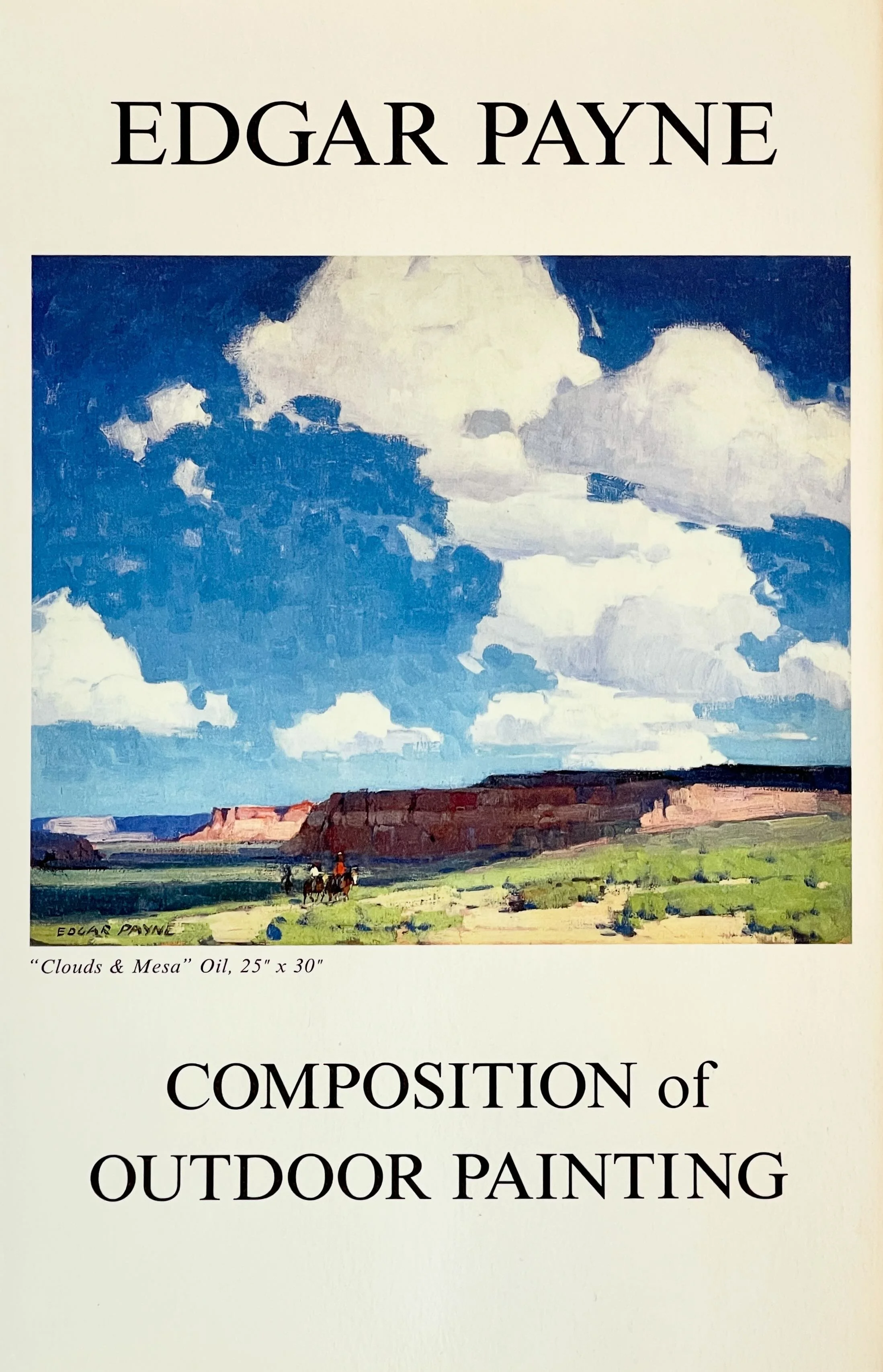
Composition of Outdoor Painting (7th Edition), by Edgar A. Payne
Clint McCall: Interesting fact: there are only three known paintings that Edgar Payne did of flowers. One of those paintings is on the back dust jacket of the book. That painting is called Sunflowers. And when I visited Edgar Payne's daughter many years ago, she had that painting hanging in her house and I took a picture of it.
Carl Olson: It must have been impressive to see that on her wall in her home.
Clint McCall: The paintings that were in her house were very impressive, although they were all in much older frames. And when my dad assisted her in liquidating the Payne estate, those were all changed out and and my dad sold many of those paintings.
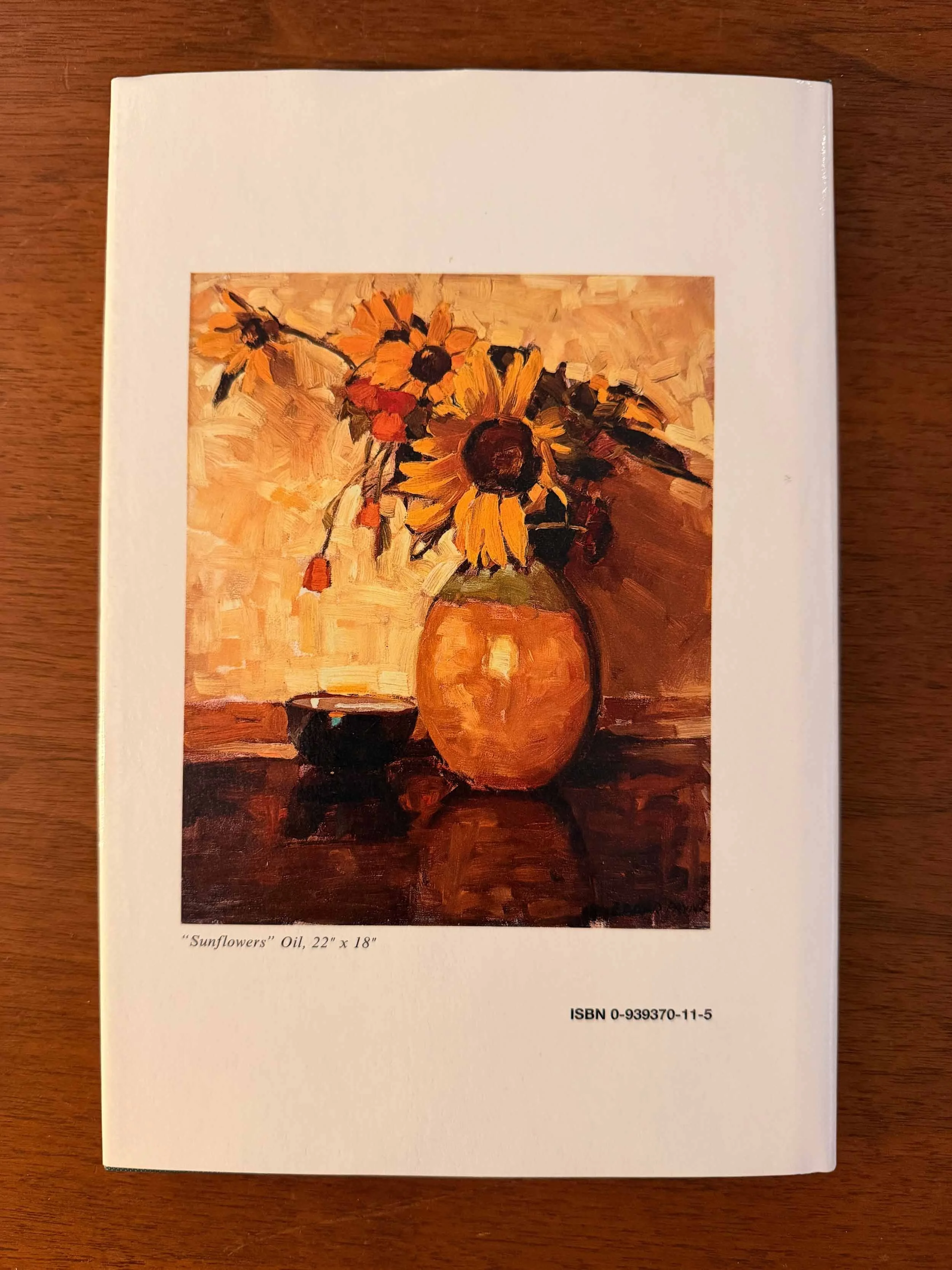
Back dust jacket cover of Composition of Outdoor Painting, featuring Sunflowers, by Edgar A. Payne.
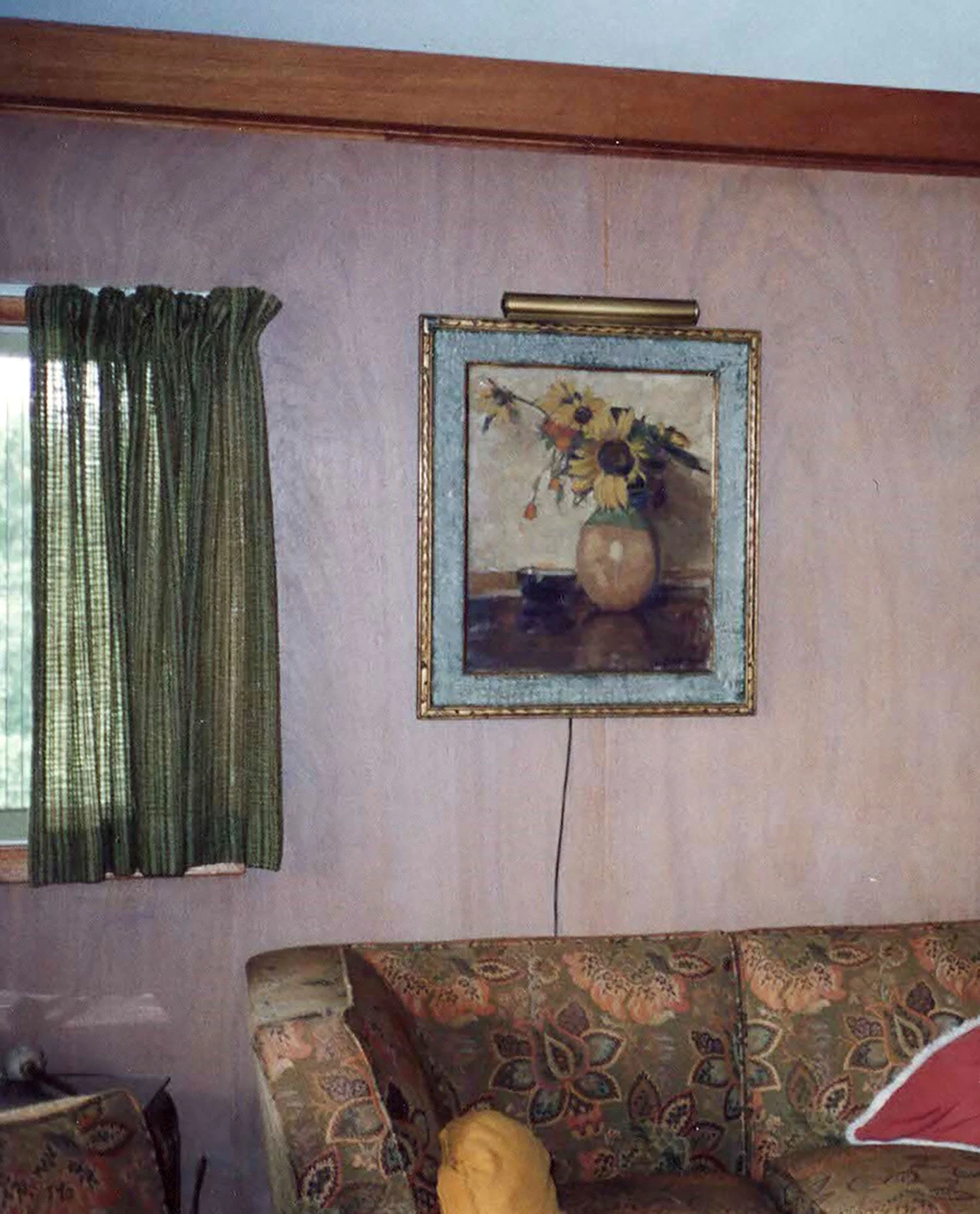
Edgar A. Payne’s painting, Sunflowers, on display in the home of his daughter Evelyn Payne Hatcher.
Carl Olson: I want to back up... This is an interesting part of your story, especially you meeting Evelyn Payne Hatcher and then going into her home and seeing that painting. That relationship, that connection with her and the Paynes, started with your father. How did he first meet Evelyn?
Clint McCall: Well, it goes back even further than that to when my father developed a passion for Edgar Payne. He had told this story in the past that he was driving down the street and past an antique store, and there was a painting hanging up in the window. He stopped and he looked at it and he ended up buying it. It was an Edgar Payne painting. He started doing research on Edgar Payne and ultimately located Edgar and Elsie's daughter. Her name was Dr. Evelyn Payne Hatcher.
She lived in a suburb of Minneapolis. My dad reached out to her and ultimately went back and met with her. She had a warehouse full of both of their paintings and many, many items from Edgar Payne's studio. As the relationship developed, Evelyn said to my father, “Over the years I've been ripped off by unscrupulous dealers, but you're a straight shooter. I would like you to serve as the executor of my parents' estate.”
So they worked out a business relationship, and my father, through DeRu’s Fine Arts, became the official representative of the Payne estate. Over the years, he sold many paintings for her. She wanted the legacy of the book Composition of Outdoor Painting to continue so she signed over the copyright to my father. Their business relationship lasted until her death. Her and her husband, John Hatcher, never had any children. She had no heirs, essentially. So everything that she had was was ultimately left to my father. You know, I'm fortunate that upon my father's passing, he left the copyright to the Composition book to me. I reached out to an intellectual property attorney and had the copyright officially transferred over. I'm also fortunate that I inherited many of Edgar Payne's belongings that went through my father. So, I’m blessed.
Carl Olson: Wow! I'm truly happy for you.
Clint McCall: If I can circle back... when growing up I had an appreciation for art, I would call it, but not necessarily a passion. As I got into my later teen teen years I developed a passion for law enforcement. I really put everything into law enforcement and education. That's the path that I took. And so my travels to the gallery were less and less. That world was going away from me while law enforcement was coming towards me.
When I was twenty two, I had a friend I met who through law enforcement who was originally from Minnesota. He and his wife decided that he was going to relocate back to Minnesota with their family and become a police officer, which he did.
About six months after he moved back, I took a trip to see him. And I was speaking with my father before the trip, and my father wrote down on a little pad and said, “Hey, why don't you stop by and and and see my friend Evelyn while you're in Minnesota?” And I said, “Okay.”
When I got back there, I looked up the address and she lived caddy corner from my friend's in-laws. Amazing! Exact same street. It was just across the street and a couple of doors down. My father had spoken to Evelyn and I went across the street and we sat and had lemonade on the front porch. I had a little 35mm camera. She said, “Would you like to come in and see some of Daddy's paintings?” And I said, “Of course I would!”
I snapped photos of different paintings, which now I've since identified those paintings. But boy, you know, coulda woulda shoulda. I didn't have the passion at the time to fully appreciate what was there in front of my eyes.
Carl Olson: But you have since come to realize it.
I think your path is not is not dissimilar to mine, though I didn't go into law enforcement. I was in technology. I was a software developer and had a software development company. So art was the farthest thing from my mind for decades. It was only later, as I approached retirement, that I became more interested in it. But I didn't have the exposure that you did. And your father – he planted a very powerful seed.
Clint McCall: The Edgar Payne paintings were essentially a very small part of my father's legacy and the DeRu’s Fine Arts’ legacy. For example, he had a catalog card system that he started when the gallery started. With every painting, he had an index card that he filled out and he took a picture of that painting. He put on that index card all the information on the painting. He put on there when he purchased it, and how much he purchased it for. And then when he sold it, he would write in red pencil ‘sold’ to whoever and what the price was.
When when my father passed, I cleaned out those index cards and I have thousands of images of paintings that went through his hands over the years. And as an example, the Laguna Art Museum has a Frank Cuprien show right now. The curator from the show reached out to me and gave me a personalized tour. In the show I saw there were three paintings that went through my dad's hands.
Carl Olson: How did that make you feel to see?
Clint McCall: It yeah, it's a great feeling. So I knew what a great father I had, but being in the art world, the praise that I hear about him constantly, it's reassuring that his legacy will carry on.
Carl Olson: I am glad that you have that. That card catalog of your father’s and the record of everything that went through his hands is a tremendous record of providence for many of these paintings.
Clint McCall: As a side note, I bought a Edgar Payne painting a few months ago. And it's either an Arizona or New Mexico desert scene. I was able to see that my dad sold the painting in 1995, and who he sold it to, and how much he sold it. I was fortunate enough that I didn't pay much more than what my dad sold it for. I was able to track down that the painting had sat in a warehouse for the last 13 years in San Francisco. I bought the painting out of the San Francisco Bay Area. The painting was filthy. And so I've since had it professionally cleaned. I cleaned up the frame and now it looks fantastic – like the day my dad sold it.
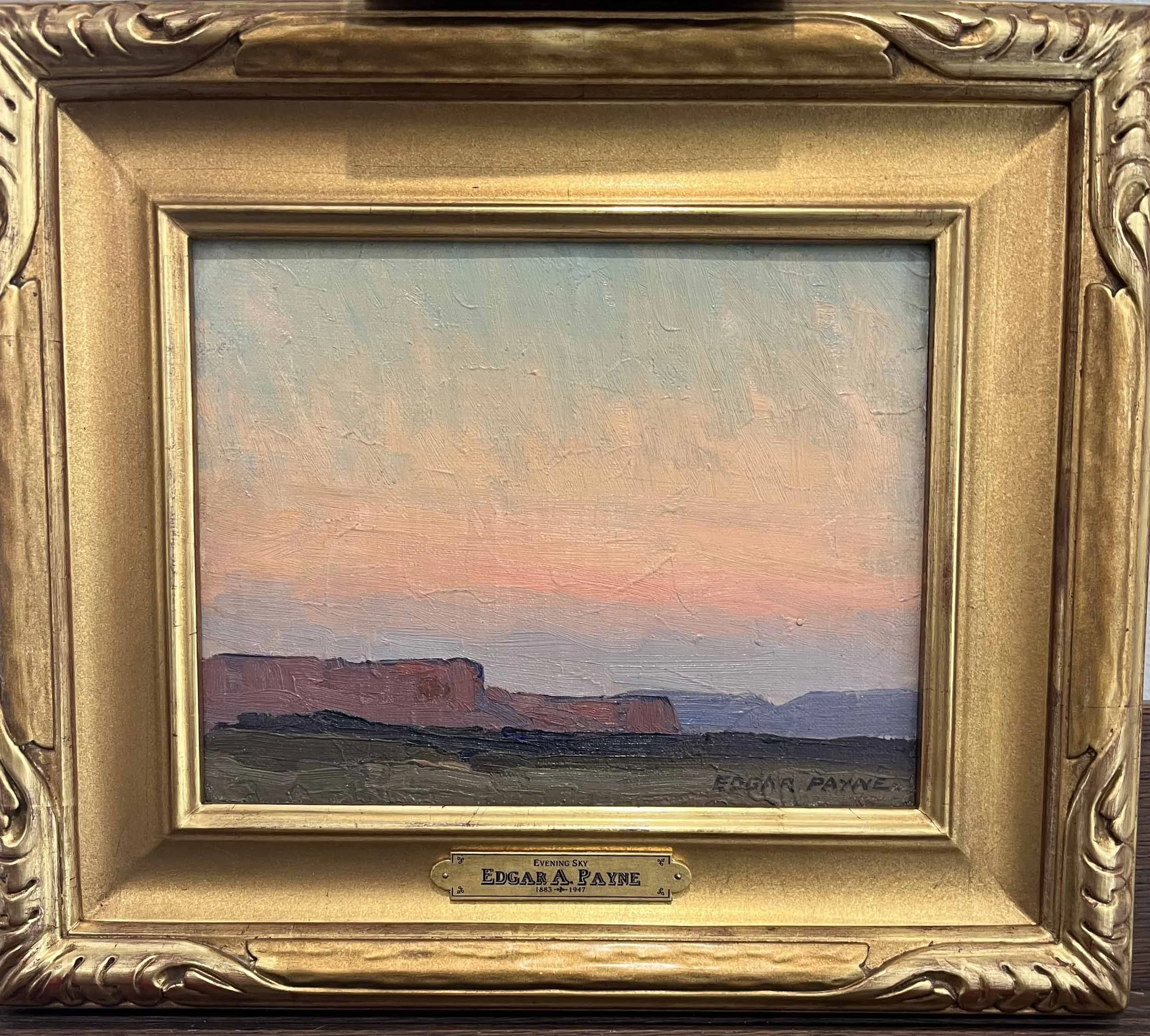
Evening Sky | Edgar A. Payne | Collection of Clint McCall
Carl Olson: So your father, use to do art restoration, but now that he's passed away, who did you choose to use to restore that painting? I mean, that's just a tremendous amount of trust to hand over a painting like that to someone to have it restored.
Clint McCall: So my dad mentored several people over the years and one of the people that he mentored, there is one who's a fantastic restorationist that I've reached out to on a number of occasions since my father passed away. I have had her restore paintings for me. And I've also recommended other people to her.
Carl Olson: Do you mind sharing who she is?
Clint McCall: I would butcher her name if I said it. I've always called her Eva. I've known her for for many years.
Carl Olson: [Eva Matysek]
Clint McCall: Growing up with my father – he started off in the Bellflower Gallery the early 70s and it was attached to a liquor store next door. When I worked at the galleries, he subsequently ended up buying the liquor store next door. Then also next door to that was a carpet and tile store. He bought that building as well. Then he bought the residence behind and turned the residence into a kind of mini-gallery. In that gallery at any one time over the years, there would be hundreds of paintings. My father sold up to 50 different titles of books. The books proved very profitable for him.
Growing up my whole life, there were always different paintings and I could go and just marvel and walk through and kind of refine my appreciation. Edgar Payne's work, although it was prolific in the gallery, it was just a small part of it.
Carl Olson: Who else was a part of his menagerie of incredible impressionist artists?
Clint McCall: William Wendt was one of the great California masters he had. Really I couldn't do it justice recalling all he represented. As I mentioned before with the index cards, I went through and I categorized the index cards. Now, ff somebody was to reach out to me and say, “Hey, can you tell what can you tell me about this painting?” You know, I can grab the card index. They're in banker's boxes in my garage.
Again, when I saw that Edgar Payne desert scene was coming up available, the first thing I did was go through the index cards and to find out about this painting. So he literally had hundreds, if not thousands, of different artists, mostly masters, but there were several contemporary artists over the years that that he sold as well. And then same thing with the Laguna Gallery. He always rotated paintings through the the Laguna Gallery.
Carl Olson: He seemed to have, just from what little I know about him, though he enjoyed the ‘greats’ like Edgar Payne and Wendt, he also seemed to have a soft spot for relatively unknown artists who also had amazing art.
Clint McCall: He did! He had a talent to promote them and and that's certainly something he passed on to me. I have a number of contemporary artists that I've developed relationships with over the years.
I still run the website for Deru’s Fine Art. After my dad passed, I transfer it’s domain name (derusfinearts.com) over to me.
I use the website as a vehicle to sell the Composition of Outdoor Painting book. And I've also reached out to a number of contemporary artists who gave video testimonials about the book. All of those artists I try to promote as as much as I can. And I admire their work. They are artists that I have their paintings.
Yeah, and I'm blessed that I inherited many paintings from my father, but I also collect contemporary art as well because I enjoy those and I'm to a point I guess where I'm fortunate enough that I have an art room where I can rotate paintings throughout the house. One will go in storage where another one will come out to be enjoyed.
Carl Olson: I imagine with your experience and your father's experience with properly caring for paintings when they go out in storage, they will not get dirty and grimy!
Clint McCall: Right! That's my father's talent. It is an art to restore these paintings. It's an art form in and of itself. He developed these relationships over the years to where there were many gallery owners who came to my father and said, “This painting is a mess! What can you do with it?” And sometimes my dad would say, “Throw it in the trash! It's beyond repair!”
I know there were a number of Edgar Payne paintings that were so far gone that my dad said to his daughter, “You can't do this painting justice by attempting to do a bad restoration job on it. It's not fair for the collector out there. It’s too far gone.” So he drew up an agreement whereby those paintings were destroyed.
Carl Olson: I have mixed feelings about that.
Clint McCall: I do as well, but he was the expert. So I have to defer to him.
Carl Olson: It wasn't my decision or yours, was it?
But I do think if you could just see even the dirty beyond repair paintings, there's something to be learned. But, on the other hand, it sounds like your father was wanting to protect the reputation of the artist.
Clint McCall: Absolutely!
You know, as a side note, I follow a lot of auction houses, a ton of auction houses. And with my stepmom, it's kind of a running joke, that there are a number of Edgar Payne forgeries out there. I'm gonna be the last person to call myself the expert because my father was the expert.
Though I've developed some knowledge, I'm certainly not going to go on social media and say, “Hey, don't buy this painting because it's it's not authentic.” But I can joke privately about it. I mean, some of these paintings that bear his name do not even have a correct signature. There are horrendous paintings out there.
Of course it’s not just about forgeries. I was looking in an auction house and there was another artist that I saw this week. Written on the back of the painting in a second artist's hand – both artists were identified – said the colors are all wrong. The artist never intended this painting to go out in public. It was one artist critiquing another artist. Sometimes I do see out there things for sale and I wonder if the artist at the time ever imagined that representation of their work would be on the market.
Carl Olson: I've had art artists tell me that they don't want all their art to be seen publicly. They do want the bad ones to be destroyed because it can affect their reputation. Me, I'm not going to judge them. I have my own collection of bad paintings that I've done that I should burn.
Clint McCall: I do know of one contemporary artist who will sell you a painting but he won't sign it because he it’s a practice painting. He says, “If you want to buy a practice painting, you can, but I'm not gonna sign it.”
Carl Olson: So if I'm interested in buying an Edgar Payne, what steps as a buyer of that work could I take to ensure that I'm getting the real deal?
Clint McCall: That's tough because as my father said before he passed, the internet's has changed everything. The internet has changed in the art world the whole business model. Maybe for the positive, you know, and there may be some negatives out there. But again, I see things popping up out there that I would never touch. It really takes an expert eye and I don't think I've developed that expert eye. I probably will never develop the expert eye that my father had. But I know enough to where I'm gonna stay away from styles, the way the painting is done, even just the look, and the signature. I mean, Edgar Payne's signature changed at least three times over the years. And based on the genre or where the painting takes place, if the signature doesn't match to what he was painting at the time. That's obviously a huge red flag.
There are great auction houses out there to buy paintings, and there are other auction houses buyer beware. I know there were a number of auction houses that if they had a question on an Edgar Payne and and sometimes other artists, they would call my father and say, “Hey, can you come down and look at this painting?” And he would go down and give them his expert opinion.
Carl Olson: So he was looking at the signature seeing if the signature matched the style Payne was using at that time?
Clint McCall: And the brush strokes. There was so many things that he looked at to determine if it was a legitimate painting or not.
Carl Olson: Payne's style did change over time. The brush brushwork in his early works are very different from what you would see later in his life.
Clint McCall: When when he was younger, there was a lot of attention to detail. There was a tree and you would see every branch. I have a painting that he did later in life, up in the Sierras, and the brush strokes are very wide. After he went to Europe and came back, he was doing paintings much faster and less attention to detail – but a different style.
Carl Olson: Who are producing these fakes of Edgar Payne paintings?
Clint McCall: Somebody trying to make a quick buck. It may be a painting from that era that doesn't have a signature on it, so they're adding a signature. Edgar Payne didn't paint many watercolors. I'll see Edgar Payne watercolors pop up that that are are not Edgar Payne's. He gave a lot of gouache. There was a time that he Edgar Payne had pneumonia and he was confined to his house. Most of his gouache paintings were done at that time. So Edgar and Elsie Payne were married for a number of years. During the time they were married, Elsie painted mostly gouache. And Edgar Payne being essentially the master, he painted oil. And it wasn't until after Edgar passed from cancer that Elsie really embraced oil painting. She essentially changed her painting style from one medium to the other. It was after he passed that she developed a passion to push his legacy. She carried that passion on eventually passing it to her daughter for the remainder of both of their lives.
Carl Olson: I think that's a point we sometimes forget is that Elsie was also an artist. Do you have any of her paintings?
Clint McCall: I have an oil painting, a Southwest still life oil painting. And then I have a gouache eucalyptus painting that came from her daughter. When my dad was working with the Paynes’ daughter, liquidating everything, Elsie had made little clay statues, and the statues were very delicate.
My dad suggested that they be cast in bronze. So he made a limited series bronze casting of the statues. And I see them pop up for sale every once in a while.
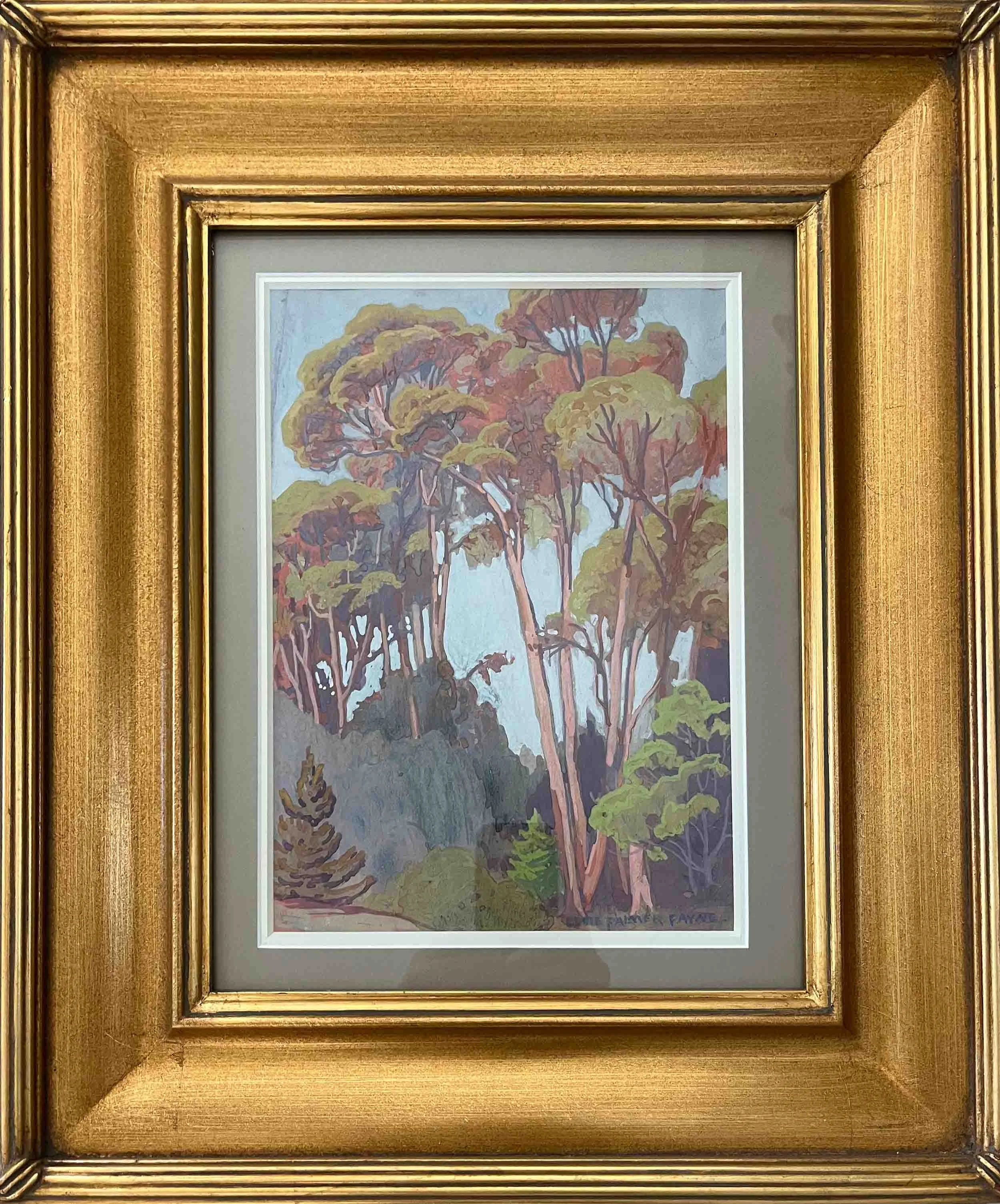
Eucalyptus Trees | Gouache | Elsie Payne | Collection of Clint McCall
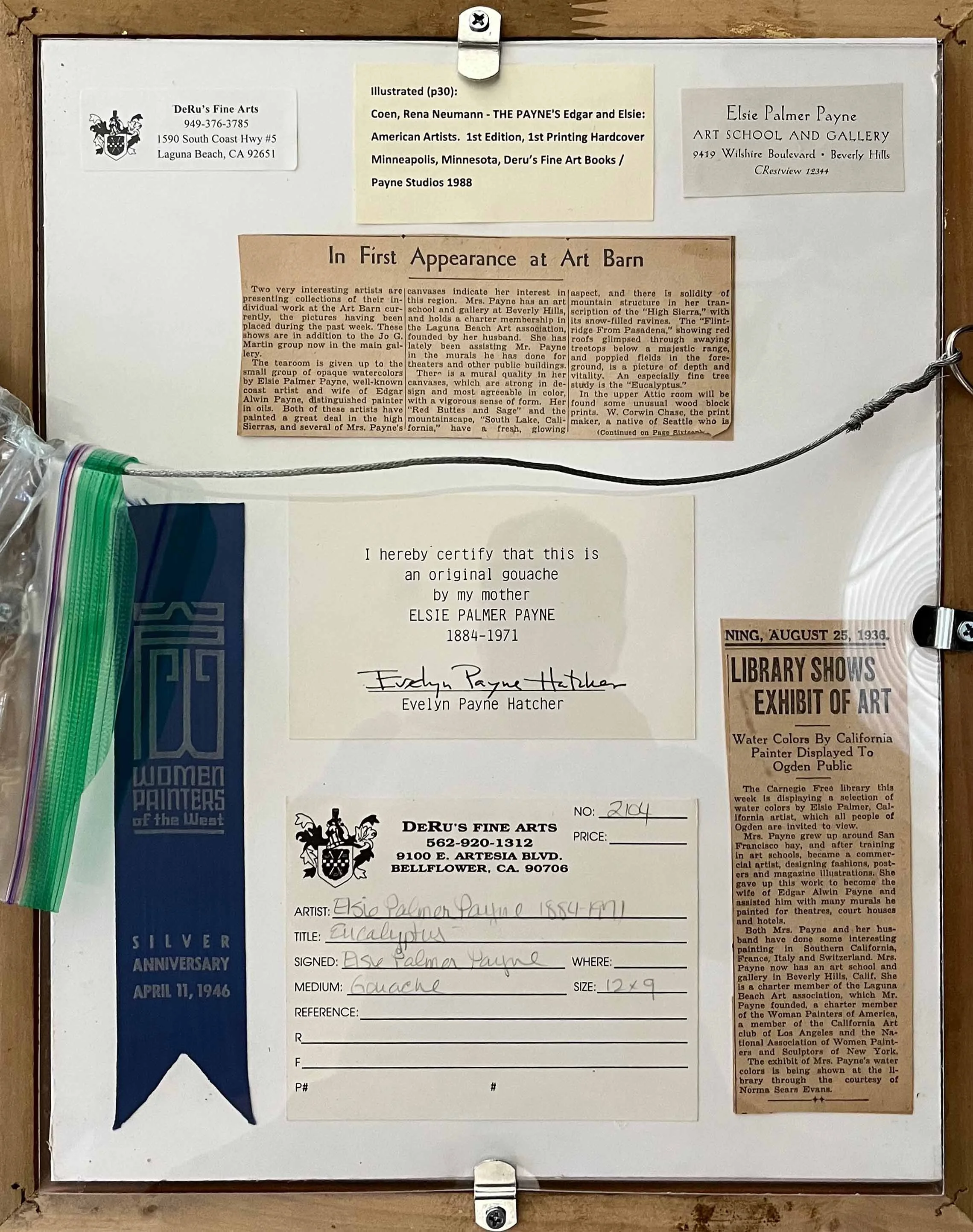
Back of frame of Eucalyptus Trees
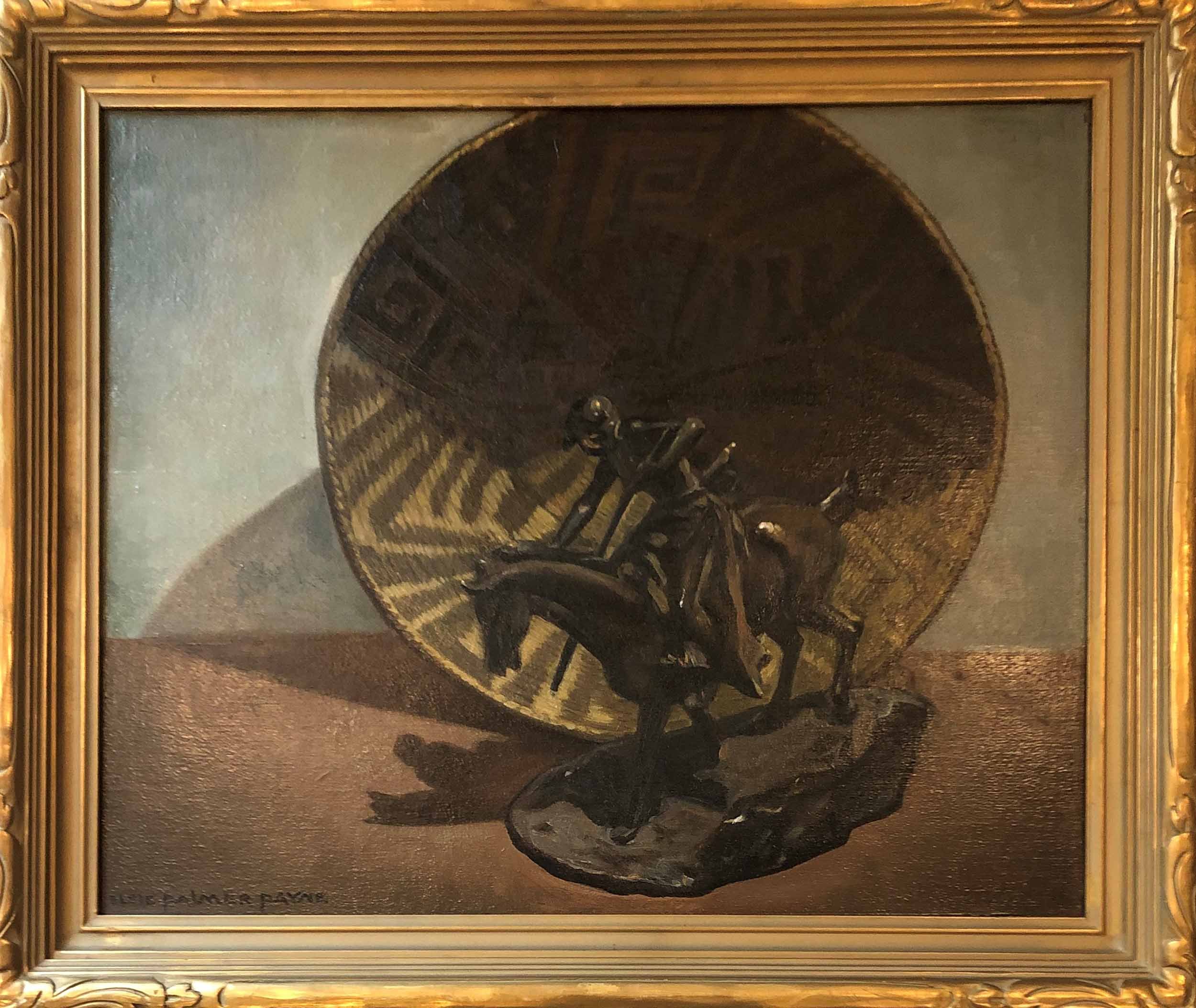
Elsie Palmer Payne | Oil | Collection of Clint McCall
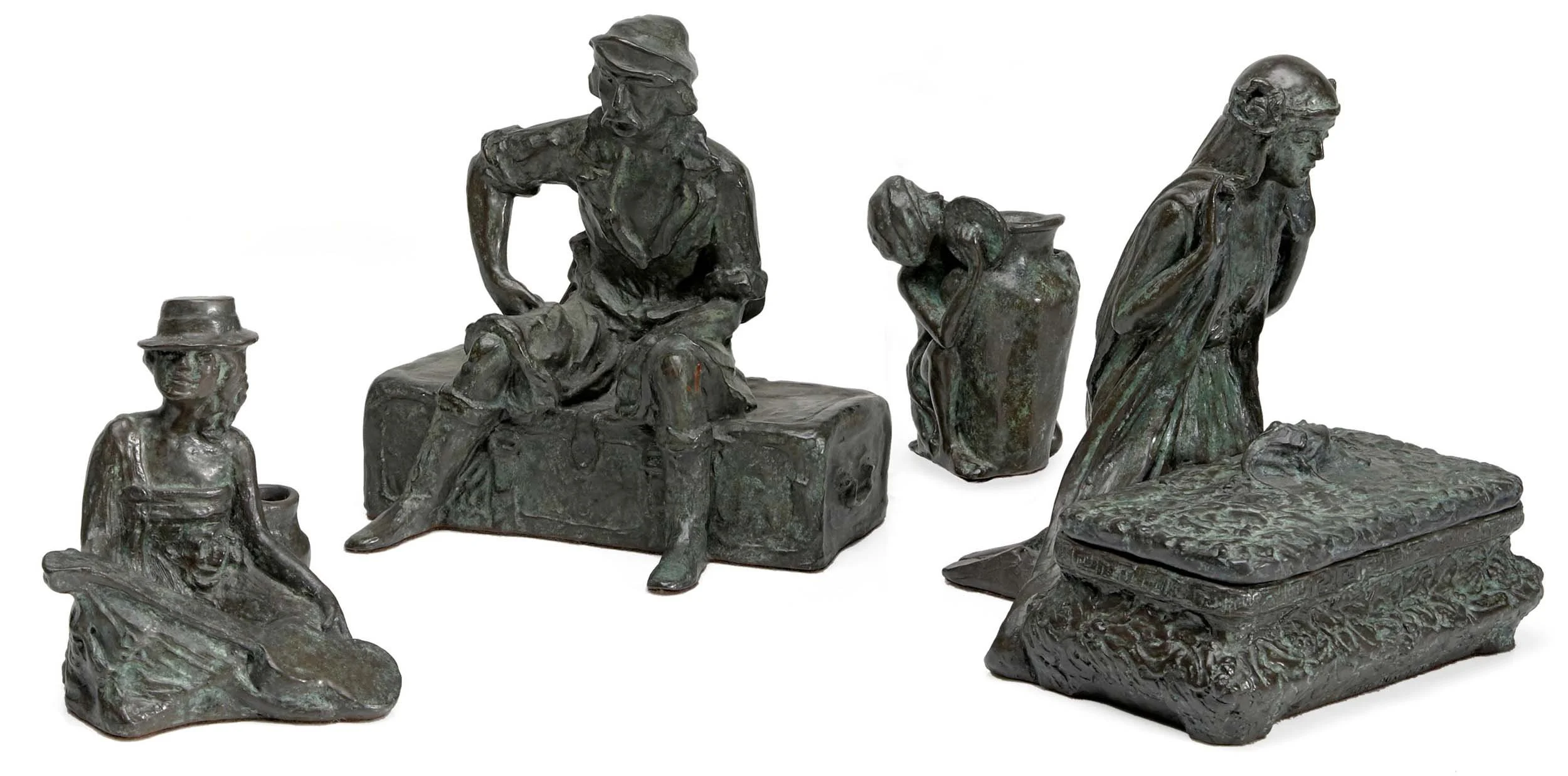
Collection of statues created by Elsie Palmer Payne
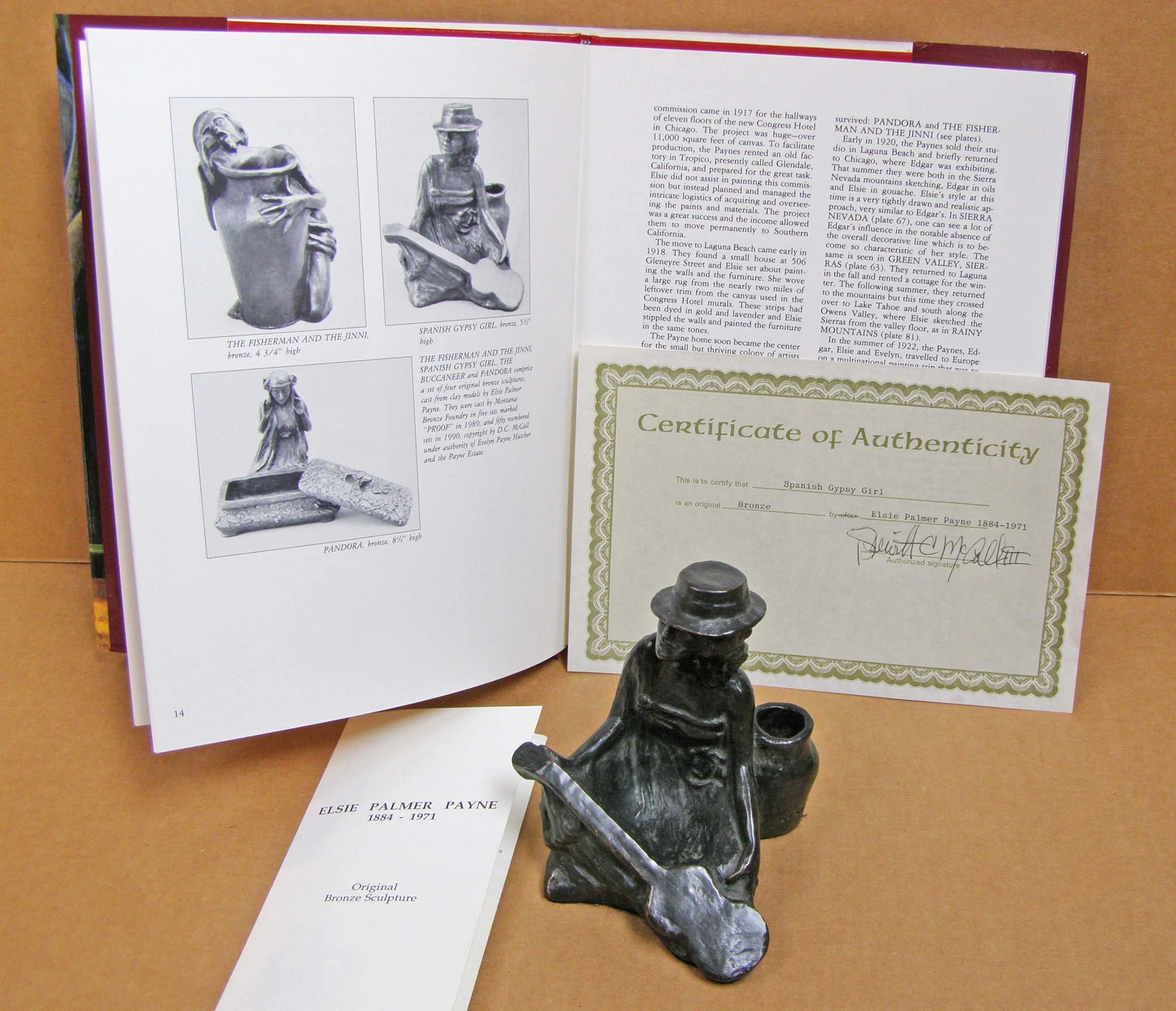
Spanish Gypsy Girl | Bronze | Edition 24 of 50 | Elsie Palmer Payne
Carl Olson: I haven't seen Elsie Payne’s art first hand. I have the book that Rena Coen did on Edgar and Elsie, which is a fantastic find. It’s titled: The Paynes - Edgar and Elsie - American Artists. I always think it's interesting that she was the mother of the Coen brothers.
Clint McCall: I was just gonna mention that.
Carl Olson: Coen is an excellent writer. I enjoyed her biography of the Paynes. I bought it several years ago.
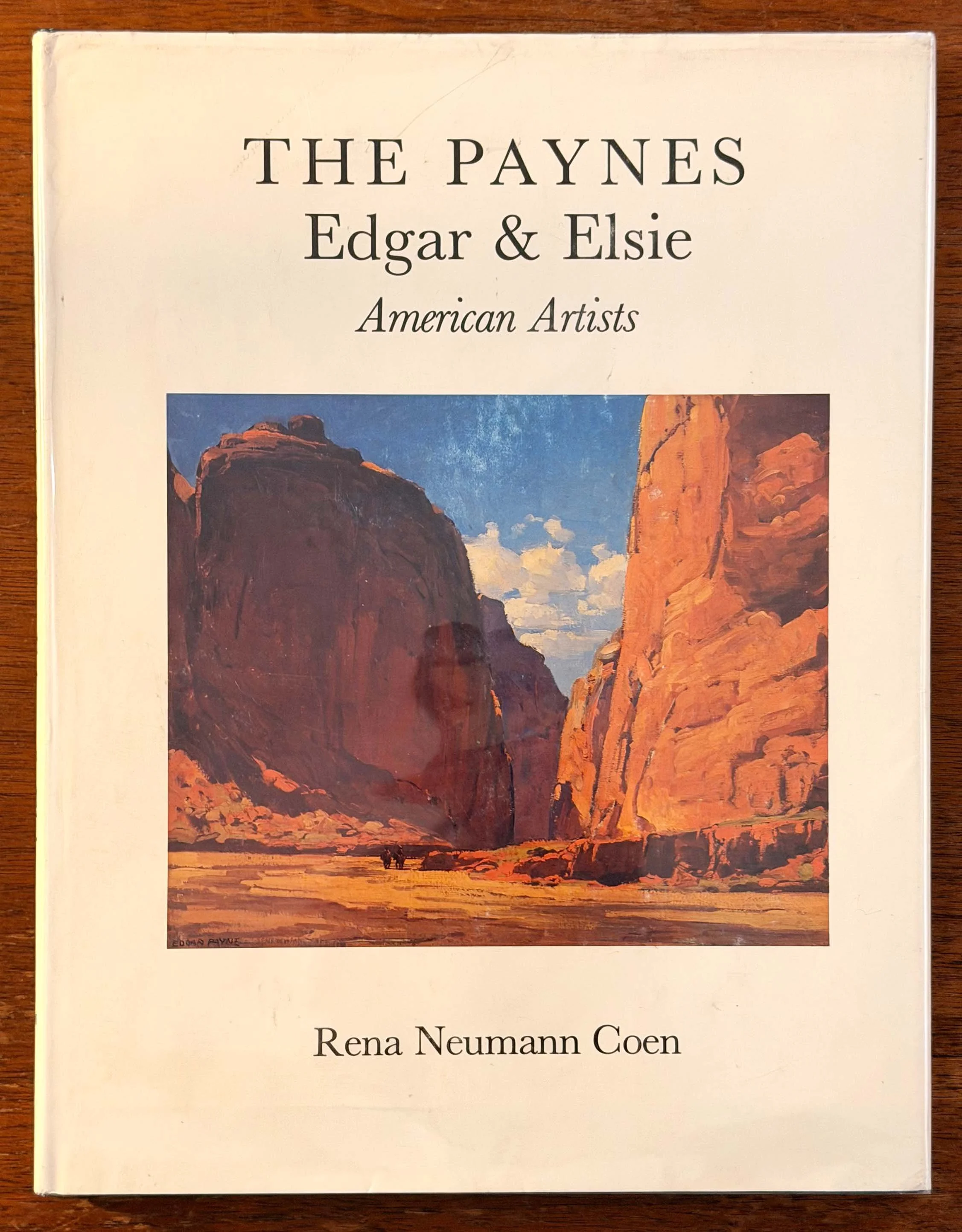
The Paynes - Edgar & Elsie - American Artists, by Rena Neumann Coen
Carl Olson: When you think about your father's legacy, when did you start sensing that this legacy would become one that you would continue? Was he grooming you for that? Was there ever a discussion?
Clint McCall: The discussion was early on. I really believe that as a teenager he wanted me to become part of the business and take over the business. But at the time it was a hard no. For the reasons I said before, I wanted financial security. However, I knew in the back of my head that one day I going to inherit some art.
But then it really was thrown into my lap kind of unexpectedly because my career was going strong. I had finished a master's program three weeks before my dad passed away. I had no idea how ill he was, and it just kind of suddenly happened he's in the hospital. And then, he's passed away.
To walk into a compound, the Laguna Gallery, a house, with literally 60 years of collecting...[sighs]. As my friend told me, it's kind of like taking apart a nuclear bomb. You just have to do it, you know, one bolt at a time, and you have to be careful. I was dismantling the estate which continues to today six years later. As we're sitting talking it certainly brings up a lot of childhood memories. I had a blessed career but I knew I was at the end of my career. With an estate this size it is a full-time job. I did both for for a year, but working two full time jobs, well, something's gotta give.
I decided at that time that I had a noble career, but it was it was time for me to choose a different direction.
Carl Olson: As you were going through the estate, did you learn something about your father that you hadn't known before? Was there something that just jumped out at you and you said, Wow?
Clint McCall: I guess it would be many things, but again, I realized his passion for art was maybe surpassed by his passion for fishing. He would make his own – ever the craftsman – fishing lures. He had a whole office set up at his house for making fishing lures. When he wasn't at the gallery, he was in the Eastern Sierra. So I didn't realize the the enormity – even though I had grown up around it – I didn't realize the enormity of everything that he had. He had signed books by Edgar Payne. Signed books by William Wendt. And all the things he collected over the years.
When I was a child at the gallery – and this was way before the show American Pickers came on – there would be a steady cast of characters out of a television show that would come by every Saturday. Saturday was the day. And my dad would buy things from them. My dad called them pickers. “Hey, the pickers are coming by today!” And they would stop by for lunch. There was one older gentleman that would sit and smoke his pipe in the gallery. And they were a regular cast of characters. My dad would buy things from them.
They would go out to garage sales and antique stores and estate sales. Sometimes I felt like even if my dad didn't need something, he would buy it from them so they would keep coming back.
Carl Olson: So he liked the pickers coming by.
Clint McCall: He loved it! He would buy things and they may sit 20 years before he resold it, or they were still sitting there when he passed and and I ended up selling it on eBay. But it's just thousands of different things, you know, ashtrays, brass ashtrays, collectibles from the twenties and thirties, statues, bronzes.
One of the items we found was a blueprint for an electric chair. I believe it was it was from the 1850s. I believe it was from North Carolina. We ended up shipping it to an auction house in that region and selling it.
There were about 30 hand carved wood decoys. He was an art dealer, he wasn't a decoy dealer! But these were the things that people sold to him over the years.
Ss I became older working full time, raising a family, I lived far from the Bellflower Gallery. So I wasn't in the Bellflower Gallery a lot. I visited my dad in the Laguna Gallery. But the Laguna Gallery didn't have all the toys and unusual items. But every time I went to Bellflower, there were always new fascinating items there. Stuff you'd never even think of unless maybe you went to a flea market and you'd see these things from a dealer.
Carl Olson: It's fun to go to these little shops. We’ve got places near where I live and we find a lot of kitschy stuff. But every once in a while while I'll find something that I want. I have found things like old slide rules, fold-out rulers and stuff like that.
Clint McCall: [Clint holds up an old folding ruler] Guess who that belonged to?
Carl Olson: Who did that belong to, Clint?
Clint McCall: Well, we've been talking about him.
Carl Olson: No way! That was Edgar Payne’s?
Clint McCall: Yes. I also have Edgar Payne’s ginger jar and some of his paintbrushes and pencils. He used the ginger jar to hold his paintbrushes. And there is a painting where he included the ginger jar in his painting. I have an image of that painting.
Carl Olson: I wanna see that! That is pretty neat.
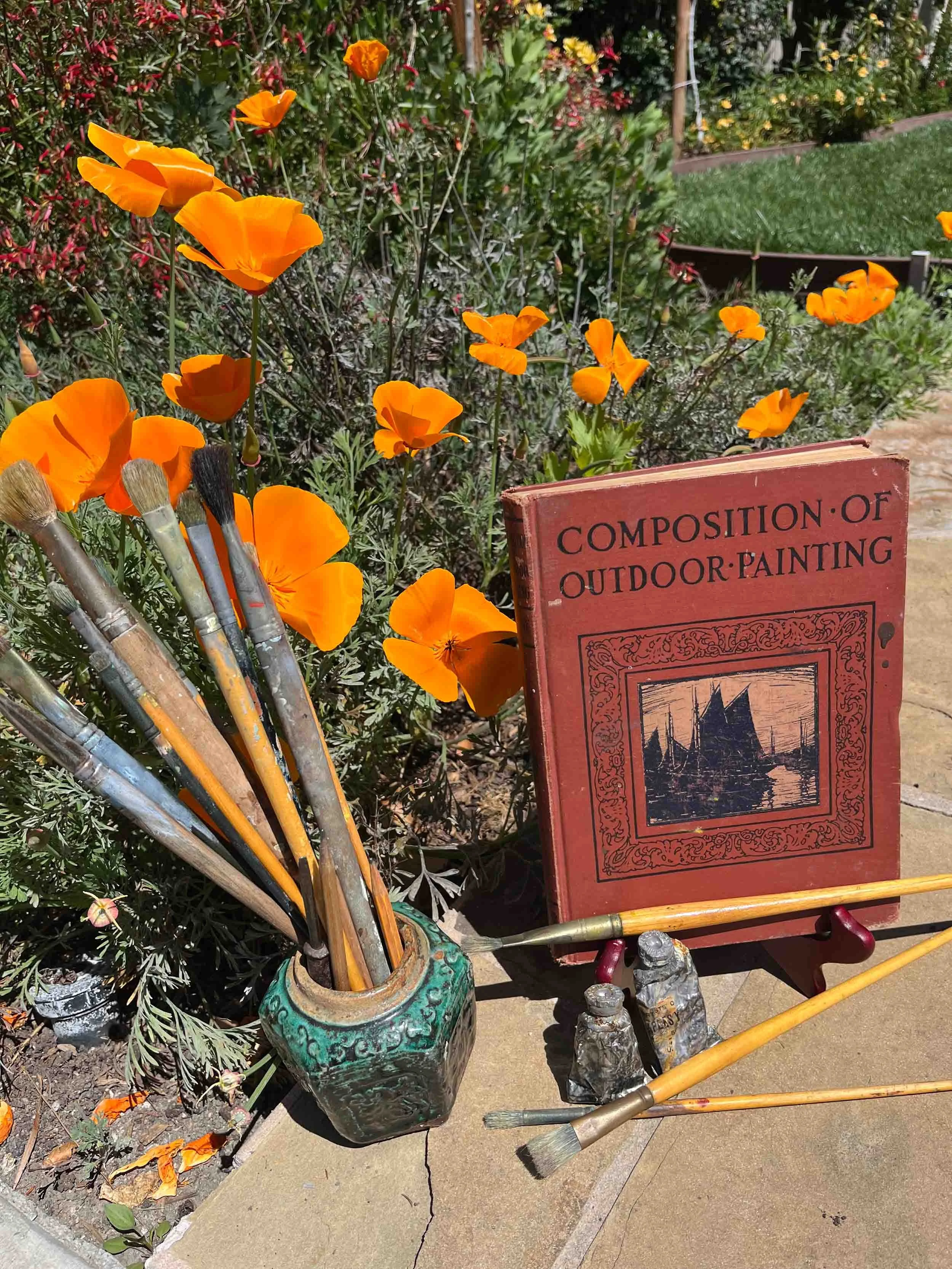
Edgar Payne’s ginger jar with some of his brushes and tubes of paint. Also shown, and early edition of Composition of Outdoor Painting.
Carl Olson: I understand Edgar Payne was also a woodworker. He made his frames and things like that.
Clint McCall: Yes. He carved this chest [Clint points to a chest carved by Payne that he owns]. My dad had two of those. I ended up with the big one and my stepmom has one and it's called a pirate's chest. And both of those are I believe in the Coen book.
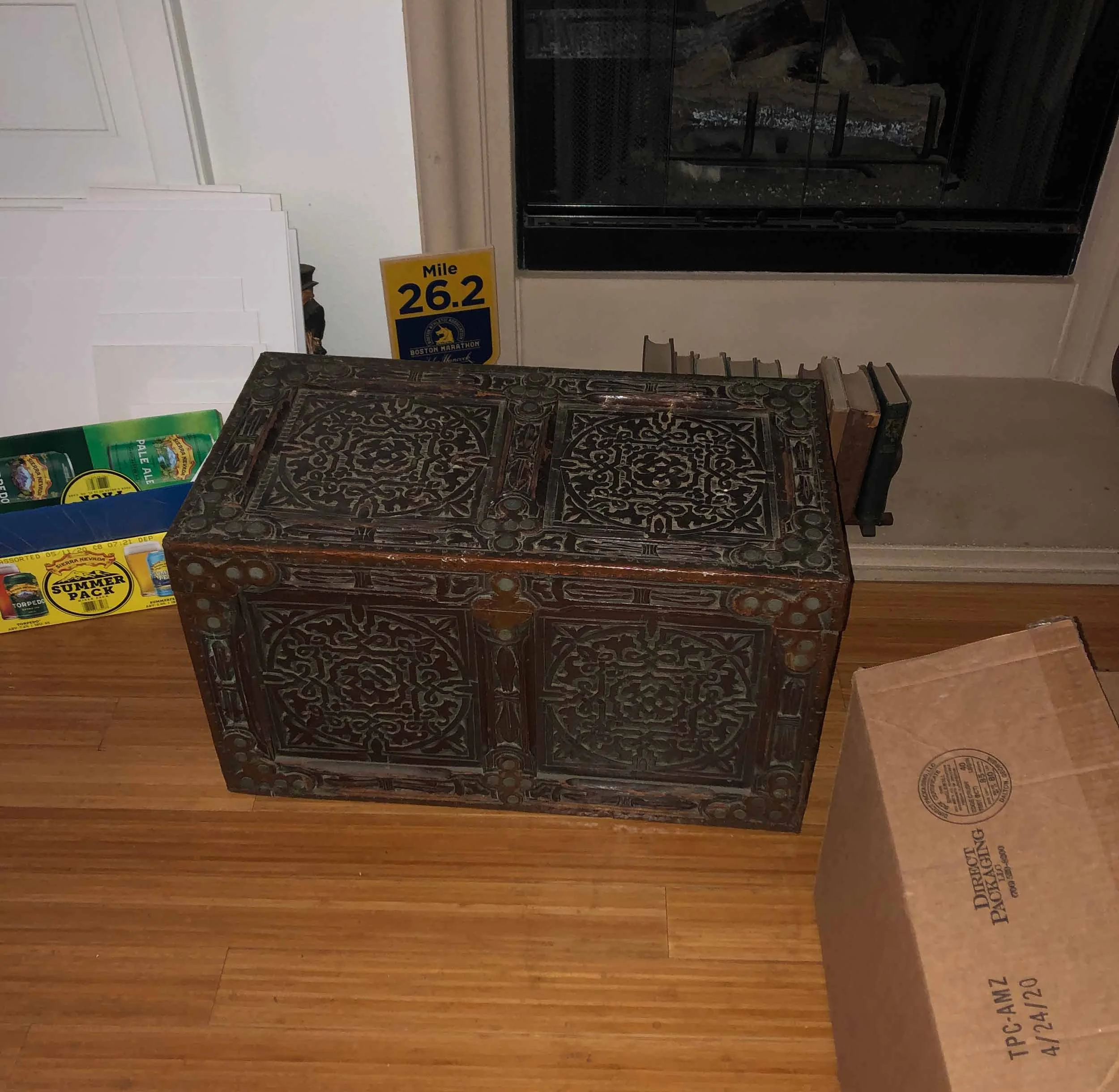
Chest carved by Edgar Payne. In Clint McCall’s personal collection.
Carl Olson: A lot of the photos used in the book Edgar Payne - The Scenic Journey came from DeRu’s Fine Art.
Clint McCall: We ended up donating those to the Laguna Art Museum. I wanted to preserve them and when when my dad passed, I wasn't really sure what I was going to do. I had no idea that I was going to continue on with the book. So all the photos have been put in storage at the Laguna Art Museum. In hindsight, I wish I had scanned all those photos so that I could share them on social media. That was a missed opportunity.
Carl Olson: Earlier we were talking about Edgar Payne's book Composition of Outdoor Painting. That book is still relevant to landscape painters, even to this day. What responsibility do you personally feel and what pride do you take in making sure that this book continues to be available to modern artists today?
Clint McCall: Well, as part of the pride I take is when I first started a social media campaign featuring the book. As the copyright holder I felt that if I didn’t keep publishing the book it would cease to be available to painters. If I don't publish this, it essentially won't be published.
I talked to many artists and I went online and read many reviews of the book and the biggest thing that I saw was that there were so many typos in the book. Edgar Payne obviously wrote in a style during influence during the depression. I don't think he had an editor who with a fine-tooth comb would look at the book. When I was in law enforcement, one of one of my duties was that I was the person people gave their reports to essentially redline them. That was because I had a knack for writing. So I read the Payne book and I fixed all the typos while remaining true to what I believe Edgar Payne would have wanted. I didn't change the spirit of what he he wrote, but there were a number of words that were misspelled. There were punctuation errors.
I did not change anything substantive, but I've made it easier for the contemporary reader to read. There were a lot of small typos that I've corrected. I felt I stayed true to his word because he was the master. Correct those things make it easier on today's reader.
Right now we are on the eighth edition of the book. It’s available on Amazon.
If a listener would like to contact me through social media, I also offer the book actually a bit cheaper than Amazon if they were to direct message me. Again, I post both Facebook and Instagram under the title of the book Composition of Outdoor Painting.
Carl Olson: Who does the printing of the book?
Clint McCall: I have a printing company out of Minnesota. They're not acknowledged in the book. They are the printing company that has done the printing for years that Payne’s daughter actually reached out to. So they understand what’s need and they have they have all the images.
And kind of going back to what we were saying earlier – after my father passed I started going through the estate and he not only had this book, but he had about fifty other titles he sold. He was publishing about fifty different titles of books. He sold through the gallery website. So he there was a separate book business from the gallery. And obviously I realized that as a one-man show I was not going to be selling forty-nine other books. I decided that what my father would really want me to do was to carry on the legacy of Payne’s book. In the current printing, there is a tribute to my father. There's a photo of him and and the Paynes daughter as well, with a little history on how my father came to be the steward of this book.
Carl Olson: It's a beautiful tribute. I appreciate you sending it to me because it's not in the older edition that I have. What a beautiful legacy you have that your father left you. I think you have a lot to be proud of too. You've accomplished quite a bit, Clint, both in your service of the community through law enforcement as well as the art community.
I think that's quite a legacy to have.
Clint McCall: Again, it was something that was just by happenstance I developed. I thought, well, you know, I have all these images, I have these stories, I want to share them with other people. So I decided I'll start this social media campaign. That’s what I do every day: I post an image and then I'll either do a quote from the book or I'll write something about Edgar Payne. If I'm out at art shows, I'll try to post what I'm doing that day at art shows. I’ll try to spotlight those contemporary artists that that I've become friends with and I admire their work. So if anybody listening was to jump on the social media they could see there's also more information about Edgar Payne and my father.
The website that I run is derusfinearts.com. And you can also order the book through a link to Amazon on on that website.
Carl Olson: Are you on are you on Facebook as well?
Clint McCall: I'm on Facebook as well, but Facebook is not business friendly and it's kind of a not well used platform as Instagram is.
Carl Olson: Yeah, I prefer Instagram. I still use Facebook, but it is frustrating.
Clint McCall: A lot of the older artists will be on Facebook. I’m not on TikTok. so I’m not that advanced.
Carl Olson: Do you ever go out and do a lecture or anything like that, talking about this legacy that you had with your father and the California impressionist and Edgar Payne and others that you've come across?
Clint McCall: I've never done that. I'm out at a lot of art events and unfortunately the contemporaries of my father I see less and less. One thing that I've noticed is the type of art that my father sold - the early nineteenth and twentieth century American art - in galleries I see less and less. And a passion for art I see less and less. And I think it's a generational thing to where before people would buy these gorgeous paintings and it would would be the centerpiece in their house. And now there's a lot of commercialized art out there. Again it's a generational thing.
I have a painting here in the house that still reminds me of my childhood. It's by an artist named Carl Moon. And it's called the Indian Dance. That takes me back to my elementary school days in our house in Bellflower because it had such a prominent space in our home. I have that displayed in my office. It beckons back to another time.
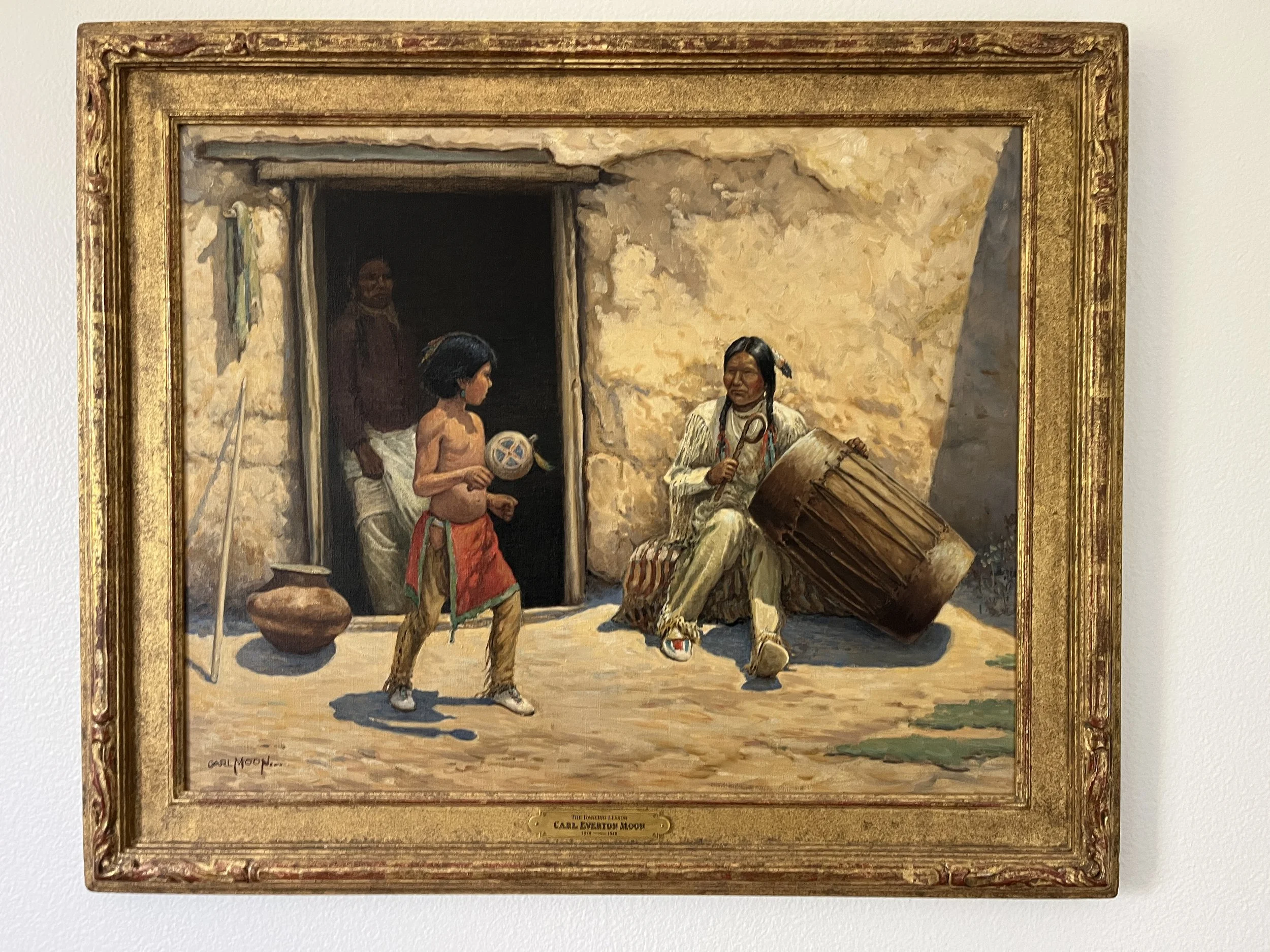
Indian Dance | Carl Moon | Collection of Clint McCall
Carl Olson: You know, visual art doesn't appeal to someone with a very short attention span. Me - I love to linger over an image. I have a small personal collection of paintings. One painting I have of is Frank Serrano which he gave me. Every morning I walk by that painting. I have other paintings, too. I have a painting by Len Chmiel that he gave me. These paintings are small but they're so full of life. And they put a pep in my step every single morning as I walk by them. Do you experience that?
Clint McCall: I do, I do. And you know, you mentioned Frank, he's a great artist. There there are a number of contemporary artists who I have collected their work. There's a young up and coming artist who has become a personal friend of mine at Laguna Beach. His name is Mason Cole Williams. He's at the Festival of the Arts this year. It’s a juried show difficult to get into. For the second year in a row he's there. I just went down to see the show a week ago today and he gave me VIP tickets to the artists’ premiere. He had posted on Instagram a painting that he had done of the San Clemente Pier. The San Clemente Pier holds a significant place for me because my long term companion, her and I, on our first date we walked along the San Clemente Pier. So as soon as I saw that that painting, I messaged him and said, “I want that painting!” He says, “Wow!, okay. I haven't even varnished it yet.” And I said, “Let me know.” And now we have that in our family room. Every time I look at it I see something different. But it brings back those memories of that first date we had together.
Carl Olson: I could not end this show on a more beautiful moment than that. That is awesome. I appreciate you sharing that. Clint, it's been an absolute real pleasure to have you on the show.
Clint McCall: Well, thank you. It's been a pleasure.
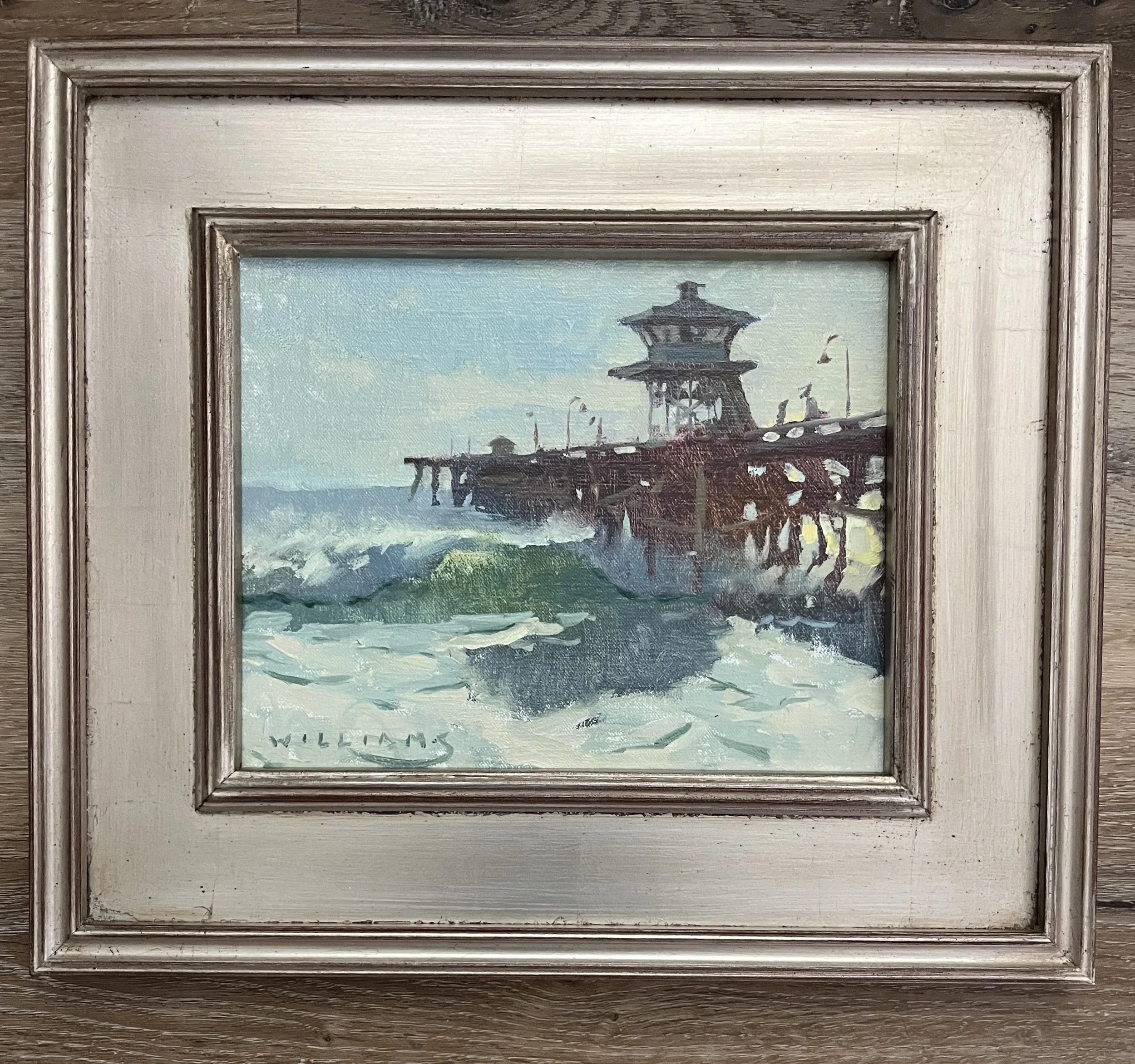
San Clemente Pier | Mason Cole Williams | Collection of Clint McCall