
LECTURE VIII.
Objects of Study.
In the few general remarks with which I prefaced the consideration of the prize-drawings at the close of last Session, I signified my intention of developing into the form of a more elaborated lecture the hints I then threw out on the objects of study in art. But a lecturer who is obliged to be frequently before an audience, whether of professed students or an interested public, labours under the disadvantages belonging to a limited theme, that his endeavours to impress on them his views on the theory and practice of art must result in a certain amount of repetition, and consequently of monotony. For the subject is of a limited nature, and it is not easy to find anything to say which is not already to a certain extent familiar to the listener, either as derived from previous study or experience, or as the result of his own unaided reflection.
In other subjects there is generally some matter sufficiently new to require explanation, discussion or refutation. The discoveries of Science are inexhaustible; there is always something fresh to tell of, or some new theory being founded on the basis of old discoveries. A scientific point moreover has the merit of being more or less demonstrable; if different opinions are held upon it, arguments of an interesting and easily appreciable nature can be brought to bear on the discussion, and until the demonstration is complete the interest is ever new. But the lecturer on art has no such means of interesting his hearers; to express myself perhaps paradoxically, a person must be interested in art to be interested in a lecture on art; — an argument, though it may be backed up by the highest authority, can never be more than the expression of a private opinion; at least, it will remain so until philosophers have developed the modern theory, that there is a discoverable and certain basis for criticism in matters of beauty and therefore of art, and that a sufficient study of the subject will make the relative values of various styles a matter of certain calculation.
The lecture I read to you at the beginning of last Session I devoted to the consideration of methods of study; and I pointed out the successive stages to be gone over in the course of a system of instruction, dwelling particularly on the necessity of a systematic and workmanlike execution, and explaining that attention to the important general truths of form, tone, and colour, must be accompanied by careful finish and study of detail, and that it is of the utmost importance that the work should be done without more than the needful amount of time being spent upon it. These are the points I more particularly insisted on, and in considering the Objects of Study I give the reasons for the recommendations I then made, and their importance will I hope become apparent. In arranging a system of Instruction, we have to bear in mind not only the best means by which that system may be impressed on the mind of the learner, but its fitness for the end in view; that is, for such a development of his natural gifts, as will give him the free and complete use of them, as well as such a habit of good work that the carrying out of His ideas shall be in no way hampered by difficulties of execution. The power of freely exercising the faculties rather than special training for a particular style, is a prominent matter for consideration in arranging such a system. The placing of good examples before students is nevertheless an important part of any plan of study; thus it is necessary constantly to urge them to the contemplation and imitation of great masters of past times, by which they may learn the possibilities of the art they are preparing for, and endeavour to emulate them in their own practice. These, therefore, are the two principal objects of study, the development of the faculties, and the cultivation of taste, and they must be considered together in treating of the subject in detail. The future career of the student being undoubtedly determined not only by the course of study pursued, but by the opinions expressed by his professors as to the form which his efforts should take in the end, it becomes a matter of necessity not only to speak of and place before him the best method of study and the highest examples for his imitation ; it is important also to direct his attention to the bad results of a bad method or incomplete course of study, and to the limits which he imposes on himself by aiming short of what his talents and capabilities will admit; and as he is incited to emulate, or at least to appreciate, the incomparable achievements of the great artists of antiquity or the Renaissance, by having pointed out to him the beauties they contain, so it would be an easy task to set before him certain works as a warning against the indifference to study and to the higher aims of art, which is too prevalent at the present time. This, however, in a public place is forbidden ground; in such circumstances we must follow an excellent rule of the Royal Academy, which forbids the lecturer to make any comments or criticisms on the productions or opinions of living artists in this country. Such remarks would doubtless give a most pointed interest to a lecture on Art, but it would be at the risk of unjustly wounding susceptibilities; it is necessary therefore to make all criticisms on the work of the present day as general as possible, and even then it is hard to veil references, if not to particular persons, at least to particular schools of art. It is nevertheless impossible for me, as perhaps I need hardly say, to sympathise with either the aims or the productions of the large majority of modern artists. I recognise a certain small number of eminent men among us who are artists in the true sense, but whom it would be invidious to name; beyond this I recognise a few younger painters whose aims are such as artists should be, with a strong feeling for the sentiment of beauty, but who are hampered in every direction by want of a proper and complete education; beyond that is a vast majority whom I can hardly consent to call artists; not, it must be clearly understood, because they do not treat the kind of subject which I personally prefer or admire, but because they fall short on their own ground in those qualities which are essential to the making of a work of art, however unimportant the subject. And this last remark will give you the key to all the opinions I hold on the objects of a system of Instruction. To train a student, whatever his ultimate career is to be, for the highest forms of art is the one end I keep in view. Thus the subjects I give out for practice in composition are always drawn from Biblical or classical sources, or are of a kind which require treatment of a classical nature — i.e., they require the introduction of nude or classically-draped figures; not because I think that no subjects of another nature should be treated; if I thought that I should be illogical in admiring much that gives me pleasure; but because I consider that practice in that form of art, demanding as it does the highest sense of beauty, and involving the greatest difficulties in drawing and design, is the best preparation for any style which the student's natural tendencies will lead him ultimately to adopt.
Again, the study of the nude figure holds a principal, indeed an almost exclusive, place in this School on the same grounds; to draw the nude figure well will enable the artist to draw anything which does not require special technical teaching. A youth desirous of becoming a landscape painter cannot do better than study the drawing, painting, and composition of figures; it will give him a power of drawing to be acquired in no other way, besides cultivating his taste, his style, and his feeling for beauty of arrangement. The mere introduction which it gives him to the works of the great figure painters will be suggestive of a higher order of landscape than that which is gained by the trivial and photographic studies of nature which pass for pictures among the younger school of landscape painters. It will suggest to his mind the perception that there is in landscape as in figure painting such a thing as abstract form. That trees and rocks have as it were bones and sinews, which underlie what is apparent to the superficial observer, and that neither the tricks of broad effect to be gained under the usual water-colour routine, nor the elaborate but trivial studies of surface or of construction which grew up in opposition, and as it were as an antidote to the clever but mannered dexterity of a corrupt school of landscape painting, will be sufficient for the production of a real work of art ; he must understand and see in nature the great leading forms and masses of tone and colour on which was formed the style of Claude, Poussin, Wilson, Turner, and others. It is the tradition of their works which is faintly reflected in the mannered and dexterous style to which I have just referred, and to their broad perceptions of nature the other or photographic style should serve but as preliminary study. A proper course of study in a school of figure painting should lead above all things to the conviction that though detail must be known, understood, and expressed, it must be kept subordinated, so as not to force itself unduly on the eye. This knowledge it is my constant endeavour to impress on my students, and it is as important for the landscape as for the figure pointer; but it must not be done by the ignoring, but by the proper expression of detail; the first is easy enough, and is but too commonly practised. I do not pretend that the great painters named above went through such a course of figure study as I should propose; but they were men of great genius, and both instinct, tradition, and cultivation led them to see nature in a grand and magnificent manner. And as an illustration of my meaning on this last point, I cannot do better than draw attention to Turner's great picture of the Garden of the Hesperides in the National Gallery Thinking this, as I do, the finest design of a landscape he ever made, I am of opinion that it is worth study as an illustration of that higher truth which is gained through the intimate knowledge of nature, a knowledge which having all by heart, pushes aside everything which is worthless and not subservient to the end in view. Moreover, it is entirely free from the manner acquired from Claude and Wilson, a manner on which, it is true, he invariably grafted something so poetical and imaginative as always to make the work his own; but I mean that their influence is to be traced only in the great breadth and massiveness of the composition, and not as having suggested the idea or arrangement. The originality in the conception of the great mass of rock pushed out into the middle of the valley, and which is the key-stone of the picture, is only equalled by the surprising truth of its drawing and the luminous sunlight in its colour. Here indeed you will see what I have called the very bones of the rock; trivialities of detail are lost in the bold treatment of its contorted mass and in the granite hardness given to its surface, but are suggested in wonderful gradations of colour; and you will further observe the simple but beautiful arrangement of the cloud, reduced to its simplest expression in form, but admirable in its gradation of light and shade and warm reflection. All combines to place this picture on the highest level as a work of poetry and of art: the mysterious gloom of the distant ravine ; the dragon, his breath mingling with the clouds, and hardly distinguishable at first from the rock on which he lies ; the opening into the valley on the right (doing more for the poetry of the picture in the glimpse it gives us of its sunlit and smiling depths than a less reticent treatment could possibly have done); the bold opposing mass of trees in the centre; the agreeable disposition of the figures in the foreground by the deep and tranquil stream, combining and contrasting harmoniously with the few valuable straight lines of the fragments of architecture; the clearness of the blue sky with the bright peaks high up cutting sharply against it; the exact balance of form and colour, and light and shade ; the qualities of painting, the certainty, richness and fullness of the brushwork — all these, I say, combine to place it in my mind as one of the great original pictures of the world. A certain blackness in the foreground alone is a remnant of his early mannerism, but this is a point which need not occupy us, as I am not criticising, but only pointing out beauties. Indeed to make a comparative criticism of Turner or any other painter or their works is not my intention at present, only to draw your attention to the capabilities of landscape when used as a field on which to exercise the imagination; such work as this is truer to nature, more really and profoundly true, than the most admirably-executed facsimiles of localities. Such art as this is dead now; studies are made from nature, not as a means for supplying the mind with material, but as an end. And as I see that the best landscape painters of to-day are to be found among the figure painters, and as I know that the drawing of the figure is the best preparation for all other drawing, for these and for the other reasons I have given, I am convinced that even a student who intends to devote himself to landscape pure and simple, can best cultivate both technical and imaginative faculties by the study of the figure. I need hardly add, though for fear of being misunderstood it may be better to do so, that I have no intention of excluding from the range of the landscape painter's education the necessary amount of careful and painstaking study of forms and colour from nature itself; obviously it is essential. I have not unfrequently been asked whether landscape painting is taught in this school, and why it might not be added as a separate course of instruction. My answer is, that there is no such thing as teaching landscape painting; I cannot consent to consider it a separate art; teach a student to draw and paint, and he will paint landscape or figures according as his inclination to one or the other dictates. My object in drawing your attention to this subject is to point out that the attainment of those qualities which I have described as being necessary to a landscape painter, that power of subordination of detail, that power of reticence arising from the knowledge of what is worthless and so to be rejected, of what is important and so to be retained as valuable, is the very foundation of all art, and is one of the most important ends to which study is to be directed. It is what gives value to such humble efforts as the study of still-life subjects, and raises them — as in the works of the French painters, Chardin especially, and of some of the Dutch painters — above the level of mere mechanical imitations, and transforms them into works capable of giving us real pleasure. I dwell, and have dwelt, always on these particular qualities, as the tendency at this time and in this country is precisely in the opposite direction, towards giving detail for the sake of detail; towards a delight in the trivialities of nature, which, charming in themselves, are only charming in a picture when kept in their proper place; and I dwell on them because no other qualities will make up for the want of them, and no work of any kind or style can be great without them ; but in considering the objects of study we have other matters hardly less important to keep in mind. In placing the study of the figure, as I do, as an essential preparation for the painter's art of whatever style, I must not lose sight of the fact that the painting of the figure, nude or draped, in all its infinite varieties of expression, either in action or in repose, is after all the highest form which that art can take. The human face and form remain the most beautiful of created things, and the most worthy of our study. What is it to us that we are told that classical subjects and nude figures have nothing to do with us at the present day? It is not Greeks or Romans we wish specially to paint, it is humanity in the form which gives us the best opportunity of displaying its beauty. One would think, if we listened to prevalent opinions on this subject, that we have no bodies, more or less beautiful, under our clothes. I would almost give as a reason for painting subjects that involve the treatment of the nude figure, the one fact which is put forward as an argument against them, that we never see the nude figure now. Be this as it may, it is not that the treatment of a modern subject is incapable of beauty or interest; what we have to consider is that subjects called classical are capable of a much higher beauty. That indefinable essence which we call the artistic gift can doubtless invest with beauty the humblest subject, and where it exists, although we may find want of ambition, we shall never find vulgarity; but when cultivated to appreciate the higher forms of beauty, it will hardly condescend to return to treat of lower matters. The outcry indeed for the modernising of art merely means that it should be brought down to the level of ignorant people, and there is no difficulty in finding a sufficient supply of what is suited to their taste. To discuss this subject would, however, be irrelevant at the present time, and lead me from my argument. Although, then, I say that the object of studying the figure is so to cultivate the natural gifts of the painter as to fit him for his future career whatever direction it may take; though I say that every artist should so study as to enable him to treat the highest class of subjects, so that when he has acquired this power he may choose those themes for treatment to which his natural tastes and instincts may guide him, I say also that there is a higher object in view, which is the cultivation of his taste for these higher forms of art. It is the absence of knowledge, and therefore of the power of choice, which limits the development of the artist's talents and leads to so much that is vulgar and commonplace in our modern schools of painting.
Doubtless the first object to which the student has to apply himself is to gain accuracy — accuracy of hand and eye. He must in fact have the power of drawing correctly what he has before him. Superficially one would say that that is all he has to learn, that if he can draw accurately he may be said to draw well, and if we take accuracy in its most extended sense, that is not far from the truth; but in its most extended sense one may say that no one ever learns to draw accurately; taken in the ordinary sense, that the drawing shall be neat, and show no faults, although an absolute necessity in drawing, it does not go very far. A drawing though accurate enough may show no feeling for the character of the figure — that is to say, the accuracy may be merely mechanical. This kind of correctness may be gained at the cost of a great and unnecessary expenditure of time; constant correction of an inaccurate beginning may get a drawing right in the end, and in order to train the eye to be accurate, these corrections doubtless have to be made. It is far from sufficient, however, that a student should be able to get his drawing right in the end; unless he acquires the habit of getting it right at once, his accuracy will be of little use to him; it is certainty and celerity that he has to aim at; he can never seize the character of his subject without this habit of certainty, however long a time he may spend over his work; and unless he combines celerity with certainty, how is he to catch the passing movement, or the passing effect? I have no intention now of going again into the question of the customary art training of students in this country; I have given my opinion on this point frequently, both here and elsewhere, and it is by this time a stale subject; it will be sufficient, if my view of the results of this training be accurate, to show how deeply it affects the art of the country. If, as I am sure is the case, the results are to make the student content to attain no more than a tolerable amount of accuracy in the long run, without his ever acquiring the habit of drawing quickly, and with certainty, the tameness of our art productions is easily accounted for. To repeat again my reasons for allowing a limited time for studies from the living model in these schools would be wearisome. I may put them concisely by saying that it is with a view to the students acquiring these two qualities of swiftness and certainty. But for this purpose I must have the co-operation of the students themselves. The student who is not possessed with the necessary enthusiasm for his work will merely make the limit of time an excuse for not finishing his study, or doing it carelessly. A master I had in Paris never allowed his pupils to rub out. I think it possible to carry this system too far; it is apt to discourage the student, and may possibly lead to the dangerous habit of leaving beginnings unfinished, but the principle is right. All work should be done with a view to its being final; the touch or the line put on should be intended to remain. This is why I view with disfavour the use of the ink-eraser in drawing; the knowledge that any mistake made can be corrected, or any amount of careless work cleaned up has a great tendency to produce not only a slovenly execution, but the want of that directness which is the essential element of a fine style in drawing (ftn. 2). Drawing, indeed, requires the constant and unwearying exercise of the mental faculties of comparison and memory. Without this it becomes a mere mechanical proceeding, and useless for any ulterior purpose. But we have another end to look to in the study of the figure, not less important to the ultimate results of a student's career, than those already mentioned; that is, the knowledge of the figure and the habit of drawing it. A knowledge of the figure, I mean, which is independent of the knowledge of the construction of the figure to be acquired through anatomical study; what we may rather call the habit of drawing the figure, which is only acquired by constant practice in drawing it. We wish the hand to fall to a certain extent mechanically, and of its own will into the representation of the human form. The importance of this habit, and the hold it acquires upon the hand and the mind is seen at once in the attempt to draw a figure in an unaccustomed position or view; it requires a fresh mental effort, and my own experience shows me that the first attempt is rarely successful. The consideration of this point indeed supplies a fresh argument in favour of constant study from the living model, as against drawing too much from the antique. The ancient statues that remain to us are so few that the student cannot acquire through the study of them that familiarity with the various positions of the figure which is essential to facility in drawing it ; for we must remember that that is the object to be kept in view — facility, through constant practice, in drawing the figure in whatever position. I do not consider that it is so much the difficulties inherent in foreshortening that make an unfamiliar position harder to draw; it is more the want of habit. One of the objects of study in the Life-school is therefore to familiarise the student with as many positions of the figure as can be given under the circumstances. In a life-school, where the model has to sit for a length of time in one position, the varieties of pose are, however, necessarily limited; but within the range of what a model can keep there is variety enough; certain fore-shortenings therefore become familiar, such as the fore-shortening of the thighs in a sitting position, and of the upper and fore-arm in various actions, also some fore-shortenings of the back and front of the torso, and the fact that a practised student generally renders these as well as the ordinary full and profile views of the body or limbs, makes me hold this opinion that it is not so much the fore-shortening that is difficult as the drawing of the body in an unaccustomed position. The habit, therefore, of drawing the figure in a great number of positions as varied as possible is one of the advantages to be gained in a lengthened course of study from the life, though a complete knowledge of the figure is only to be gained by the study of a life time.
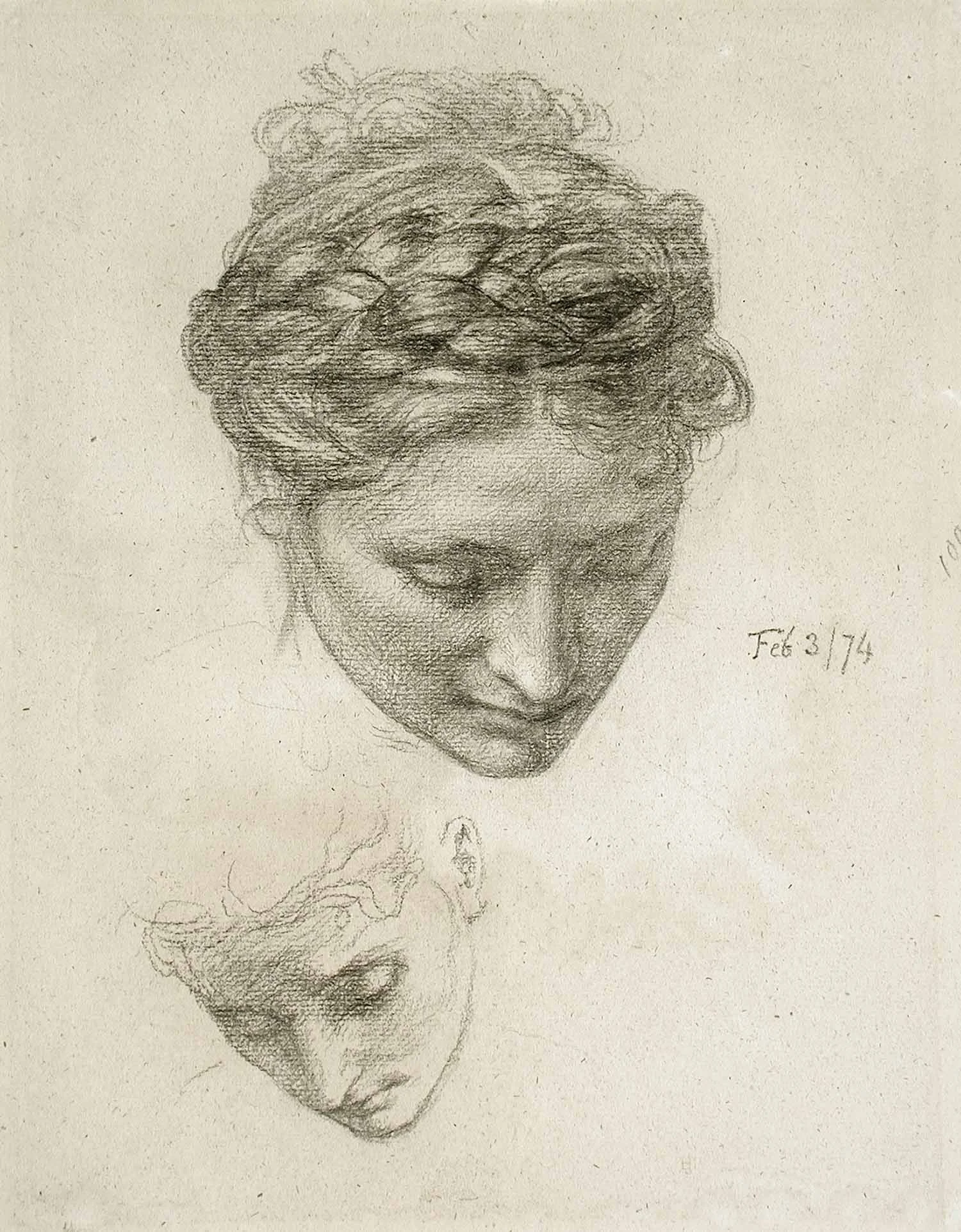
We have come then to this point, that the object of studying the figure is to be able to draw it with facility in whatever position we require for our purpose; but supposing our subject demands the figure in such a position that no model can keep it for more than a few minutes together, how can we possibly execute our intention unless we have acquired that habit of the figure which comes from knowledge of its various aspects, backed up by that certainty and swiftness in seizing with accuracy on the characteristics of the movement which I have put forward as the principal objects of the technical part of a student's education? This being established, it is not hard to understand the reason of the tame and wearisome choice of subjects which inundate our exhibition walls, or the monotonous repetition of the same ideas. If an artist has not this command of his powers in respect of drawing the figure — and I do not see how with the limited education or ambition that most students allow themselves they can be in possession of it — it is obvious that his subject must be chosen with a view to what the model or the lay-figure can give him with the least effort on his own part to represent it. I must not be understood to require that all subjects should treat of violent scenes and actions, but I do require that a figure should be made to live; it is to represent the life that is in us that should be the highest aim of the painter. In the treatment of modern or mediaeval or classic subjects this quality is alike necessary; in the slightest movement of a figure a fold of a dress changes its position; a movement through the air giving grace and undulation to its folds, which must be observed in passing, the momentary turn of a head, which cannot be retained in its freshness by a model, these are what give life to a figure, and must be arrested or they will be lost, and the picture will be dead. Look through the whole range of the works of the great masters, you will find the representation of life and movement as the one great characteristic which runs through them all; look round the walls of our exhibitions, and how many pictures will you find in which the action of the figures goes beyond that of the layfigure? A small percentage contributed by some half-dozen artists whose soul is really in their art. If you want to see this characteristic in its perfection, look at this copy of Raphael's Incendio, (ftn. 3) and see the movement and the life and the nature that runs through it. I care not for the mannerism that is complained of in the somewhat cumbrous drawing of the limbs, which became a characteristic of Raphael's later work. The grand figure of the woman with the water-pot who is stalking through the gate to assist in extinguishing the flames is so alive you may almost hear her shout, and her drapery seems absolutely moving; the half-dressed woman dragging her petticoats behind her, the children, the group of frightened women in the centre, the man dropping from the wall, the son carrying his father on his back, all are instinct with life; the intention of every movement is unmistakable at the first glance. We have no right with our puny efforts to criticise such a work; (ftn. 4) compared to our modern achievements it is the work of a giant. Nor is there any reason to suppose that its great author had more than a mortal allowance of genius; he leans on the support of a greater man than himself, and without inspiration from him he would in all probability have never acquired his highest style. His first works are comparatively feeble, far different from those of Michelangelo, the Titan who, in Fuseli's words, "as an artist had no infancy." This picture is therefore an admirable instance of what may be acquired by a continuous and determined study of the figure: something of what is here achieved is open to us all — something of it, I say, guardedly — I mean that portion of it which consists in the just representation of living action. The grace and beauty of design, and that ineffable charm of figure and face which characterise Raphael's works above those of all men, these are inherent in the genius of the artist, and unless we possess them, we may strive for them in vain. We may imitate them, but we cannot equal them; but some of what he acquired by mere force of study we also ought to be able to gain. A case in point, or special instance of the necessity for that directness of work on which I have laid the great stress in this paper, is afforded by the group I have alluded to of the son carrying away his father from the burning house, a group beautifully suggested by Virgil's account of Æneas saving his father Anchises from the flames of Troy. The study for this group remains to us, and I have acquired the photograph of it, as well as of the figure of the woman on the right, for our library. It is not to be supposed that the models which sat for this study could have held their position for long together; it is no trifling matter for one man to hold another full-grown one on his back and remain still, nor do two models sitting together ever remain long in position, or find it again when it is once lost; but you will see that, in spite of these difficulties, the directness and boldness of this drawing is only equalled by its finish and accuracy. There is no hesitation about it; no jotting down of notes at the side of variation in the position; the whole is complete — heads, hands, and feet equally studied — and everywhere the important points dwelt on. Winckehnan's remark that "Raphael's hand was prompt to execute the conceptions of his imagination," pithily expresses this faculty; nay, more, it suggests this further extension of the powers of drawing, that the hand that has gained the power of expressing swiftly and with certainty the object that is before the eye, gains also the power of expressing what exists only in the mind's eye — I mean the promptings of the invention and imagination.
I must, however, here, in as few words as possible, guard a point which arises in the discussion of this subject. There is a fear of my being misunderstood to mean, that to be able to sketch well and rapidly is the faculty whose value I wish to impress on you. Facility of sketching, as it is generally understood, is far from expressing the power of drawing I mean. Many people have it by nature. What I wish to point out in such drawings as the one I have referred you to is the amazing accuracy and finish of the work; they have evidently been used as studies to paint from without the necessity for any further studies of detail. I have not had the opportunity of comparing the drawing I have spoken of above with the group in the picture, as I have only within the last few days seen it and obtained it for the Library, but I have no doubt it will be found to correspond closely to the picture, and to have had no further alteration made in it than the addition of a certain fulness and roundness in the limbs; that subordination of detail being also kept in mind which I impressed on you as the characteristic of all great works, and which is here necessary to elevate the group from a study of individual peculiarities to its place as a type required by the elevated nature of the subject. For in criticising a work of this kind, or all monumental work, it must be remembered that we are looking not at a mere accidental representation of a fact, but at a typical representation. The figures and incidents are each of a representative kind, and are as far as possible selected so as to produce the utmost amount of effect. The individual peculiarities of the model, therefore, would be of no value, and would distract from the attention to be devoted to the monumental nature of the work. But the expression of the incident must be caught from nature, and it is this that requires the power of seizing the characteristic points. There is a drawing, however, not of Raphael's, but of Michelangelo's, which I have been able to compare with the original. I know nothing more remarkable than the exactness with which the study for the drapery of the Libyan Sibyl is reproduced in the fresco on the ceiling. At first sight it may not appear remarkable that Michelangelo should have been able to copy exactly a study of drapery of his own doing. But we must look at the matter in another way. It is not the copying of the study which is difficult, it is making the study for such an action so perfectly and absolutely true and correct that it requires no alteration. I have compared studies of draperies by Raphael with the pictures, and have always found that some alteration has been made, either towards conventionalising the forms, or to make them suit more accurately to the movement of the figure. The fact is, that to make a study of drapery involves a double difficulty ; it must be correct in itself, and the form beneath must be expressed correctly. When a figure is represented in an attitude of repose this is a comparatively simple matter, but the moment that action is introduced the difficulty becomes very great. The mere facility of sketching which comes by nature will obviously be of no use to the artist here. Nothing will help him but the certainty of eye and knowledge of form, which comes through practice.
If, then, I have explained myself clearly, my meaning will by this time be understood when I say that the object of the study of the figure is, by acquiring the habit of drawing accurately, swiftly, and with certainty its various aspects and characteristics, to give the widest possible scope to the artist's powers; and that without this habit, although a natural taste may enable him to give charm and grace to his subjects, his efforts cannot but be limited to a lower order of art, and a monotonous repetition of ideas. These habits will give the wings to the artist's imagination, without which there is no sustained flight. Unless, however, the genius of the artist be such that he can, like Michelangelo, dispense with the accessories to his pictures, and make the interest depend on the figures alone, there are other objects of study which have to be taken into consideration. His pictures will be empty of interest, not by choice, but from want of range in his ideas. The modern popular conception of an artist indeed, seems not to require much more than that he should be able to ring the changes on some one limited theme. Thus we have some artists who devote their lives to birds' nests, others take a fancy to rustic subjects, another is celebrated for his moonlight scenes, others make a fortune out of sunsets, and so on; and that, not because a special genius impels them in those directions, but because they consent to the opinion of the public, that it is sufficient to have a trick of doing one thing passably well. It is worth while to compare these aspirations with the idea of an artist of the Middle Ages and Renaissance in Italy, when he was frequently not only painter, but sculptor and architect, and not seldom more besides. We need not do more than refer to the great names of Lionardo, Raphael, and Michelangelo; with Lionardo, the most universal genius the world ever saw, painting, which he brought to an inconceivable perfection, was only one of many pursuits; indeed, he may be said to have been rather an engineer who painted, than a painter by profession, to say nothing of the other arts he practised. Raphael, who was a painter, was architect of St. Peter's for many years after the death of Bramante, and to a limited extent he practised sculpture; Michelangelo is well known in his fourfold character of painter, sculptor, architect, and poet. But we find also that Giotto, who revived the art of painting, was equally great as an architect; the Campanile he built for the Cathedral of Florence is one of the most beautiful buildings in the world, and Vasari tells us of other works executed by him. Orgagna, whose frescoes in the Campo Santo at Pisa and in other places place him on the highest level as a painter, both as architect and sculptor has left two of the most beautiful works in Florence, the Loggia de' Lanzi, and the Tabernacle in the church of Orsammichele. Andrea Verocchio, the master of Lionardo da Vinci, is announced by Vasari as goldsmith, master in perspective, sculptor, carver in wood, painter, and musician; he ceased, however, to paint on recognising the extraordinary powers of his pupil, and though Vasari says that he had a somewhat hard and crude manner in sculpture, the famous statue of Bartolommeo Colleoni at Venice, would seem to give the lie to this opinion, for in life and energy, as well as in workmanship, it may be said to be unsurpassed.
The list of those artists who combined two or three arts might be greatly extended, but a brief notice of one of the great men of that period, whose powers appear to me particularly enviable, will give a better notion of the nature of an Italian artist of the Renaissance than any list of names. Baldassare Peruzzi, appears to have been exceptionally gifted among even the artists of those times; a contemporary of Raphael, born two years earlier, and outliving him by sixteen years, he never rose to so high a position; it is his life even more than the greatness or variety of his gifts which one is inclined to envy. Brought up at his own wish as a painter at Siena, he soon gave evidence of such talent that he was entrusted with important commissions at Rome, making acquaintance by this means with one of the great Roman patrons of art, Agostino Chigi, the same for whom Raphael painted a chapel in Santa Maria del Popolo. Baldassare found leisure to devote himself to the study of architecture; from this time he seems to have had almost the happiest lot that one can imagine falling to an artist, that of building palaces and decorating them with his own hand. He began with the celebrated Farnesina Palace for Agostino Chigi, one of the most justly celebrated in Rome for its beauty. Vasari says, "This should be rather described as a thing bom, than as one merely built." This he decorated with figure-pictures, the stories of Medusa, and covered with decorations in imitation relief so admirably executed, that the great Titian himself was deceived by them, and remained in astonishment when he was persuaded that they were not real. He then executed many more paintings enumerated by Vasari, and some temporary decorations, including scenes for a theatre, which seem to have been quite wonderful as illusion and for fertility of invention. He then executes the portico of a house, and does various other paintings, decorative and pictorial. He next makes the design for the organ in a church at Siena. Being called to Bologna, he makes designs in two different styles, Italian and Gothic, for the facade of San Petronio, builds certain houses there, paints a great chiaroscuro picture of the Adoration of the Magi, and designs the portal of San Michele in Bosco, which may be seen there to the present day; he also began another church, but was recalled to Siena to design the fortifications of that city, which having done, he returned once more to Rome, where he builds various houses, and, on the death of Raphael, is appointed architect to St. Peter's, his designs for which were so much admired that succeeding architects availed themselves of parts of them, including, I presume, as it is Vasari who says this, the great Michelangelo himself.
After executing in Rome numerous other works, including another scene for a theatre which excited much admiration, he is taken prisioner at the Sack of Rome by the Spaniards, but escapes after having painted the portrait of Constable de Bourbon after death. The last work, and not the least beautiful or important, that he executed before his death was the celebrated Palazzo Massimi, which, like the Farnese, he entirely decorated with paintings. This palace is justly considered one of the most beautiful and ingeniously constructed in Rome (ftn. 5). I put the life of this artist briefly before you to show you the enormous gap that exists between such a man and our modern idea of an artist; I do not refer to individuals, for among the few men I have mentioned as being the only glory of our English school, we may find one at least who in the variety of his talents, and the perfection to which he brings them, may be said to emulate the painters of the great Italian period.
At the present day there is doubtless not so much need for an artist being able to practise two or more arts, the various professions being more separated; many painters in Italy moreover, probably the majority, did nothing but paint. But you will not find any of whatever school that did not understand the artistic side of architecture, even if they did not practise it as a science. All their pictures give evidence of this fact, from the time of Giotto to the decadence of the art; look through every school from the Florentine to the Venetian, and you will not find one who cannot place his figures in architectural surroundings, not only correctly drawn, but entirely designed and invented by themselves with all their beautiful and appropriate decorations, full some-times of the most ingenious inventions and original imagination. From the elegant Gothic Baldacchinos in which the early Florentines enshrined their Madonnas, to the gorgeous colonnades with which Paul Veronese enriched not always appropriately his antique and biblical subjects, all show evidence of a complete and thorough understanding of the art of architecture. And wten we think of what infinite value architecture is in the composition of figures, it seems a shame that all painters should not possess a sufficient knowledge of it to draw it at least correctly, even if they do not aspire to designing it for themselves; as it is, I doubt if there be half-a-dozen figure-painters in England at the present time who could introduce correctly a background of Classic or Gothic architecture into their pictures, much less design one. Therefore, I intend to make this an important object of study in this school, and the subjects I give for composition will be generally designed with a view to practice in this art. I cannot indeed imagine a better preparation for a student of painting than that he should have been in an architect's office. Turner was apprenticed to an architect to begin with, and it is easy to see what the world would have lost, had not his profound knowledge of architecture helped him to build up those magnificent compositions which he calls Carthage and Rome, which, whatever their faults in painting and colour, are unequalled for the effect they have on the imagination. The lectures of the architectural professor are available for all the students, and they cannot do better than attend them. I myself shall also, as far as I am able, give assistance to the students in the simpler and more leading rules of classic architecture in my Friday lectures. Akin to this study, and a necessary addition to it, is the study of Perspective. A course of lectures on this subject will therefore be open free to all students who attend the general course for the while session. It will proceed regularly from the elements of geometrical drawing, that is, the proper use of the rule and compass and square in drawing geometrical figures, through the simpler to the higher forms of Perspective.
It is impossible that any course of instruction can make artists of those who are deficient in talent or industry, but my whole endeavour is devoted to miking that course the best I am capable of devising, anc if I afford the opportunities to even a few of my students to make the best of their talents, or if in the course of placing before them the objects of study to-day I have stirred their ambition, I shall have done much towards achieving my intentions in the conduct of this school, and in writing this paper.
Footnotes:
1. Given at the opening of the fourth Session of the Slade School.
2. The modern tendency towards loading water-colour drawings with white in order to conceal or correct bad work has precisely the same effect. Compare, for instance, the disagreeable quality in the undoubtedly clever work of the late Mr. Pinwell and his followers, with the beautifully luminous and simple effect produced by the direct work of our best early water-colour artists.
3. A full-sized copy of the Incendio del Borgo, which hangs in the Life-School at University College.
4. With regard to the front of the house being open, or rather removed, as in a scene on the stage, which superficial observers always seize hold of as a fault, it is obvious enough that Raphael might have closed it if he pleased, and that he did not so treat it without consideration. The wall over which the man is climbing must be considered as the symbol of the wall of a house, a perfectly legitimate artifice in a work, meant, as I have explained, to be typical and decorative. The intention, clearly, is to introduce an additional element of interest by showing the interior of the house in flames, from which the man is escaping.
5. See Suys and Haudebourt's work on the Falazzo Massimi, published in Paris, 1818. Lomazzo says that the sight of this palace gave him as much pleasure as that of a picture by Raphael.